




What Is a Power Bank and How Does It Work?
This power bank guide explains how portable chargers work, how to choose the right battery capacity, and what to consider when comparing charging speeds, USB-C technology, safety standards, and airline travel regulations. Whether you’re buying a power bank for everyday use or sourcing portable chargers for your business, this guide covers the essential information you need.
A power bank is a rechargeable battery in a case with the electronics needed to transfer energy to a phone, tablet, or other device through a cable or wireless charging pad. Also known as a portable charger or portable battery pack, it helps keep your devices running when no wall outlet is available.
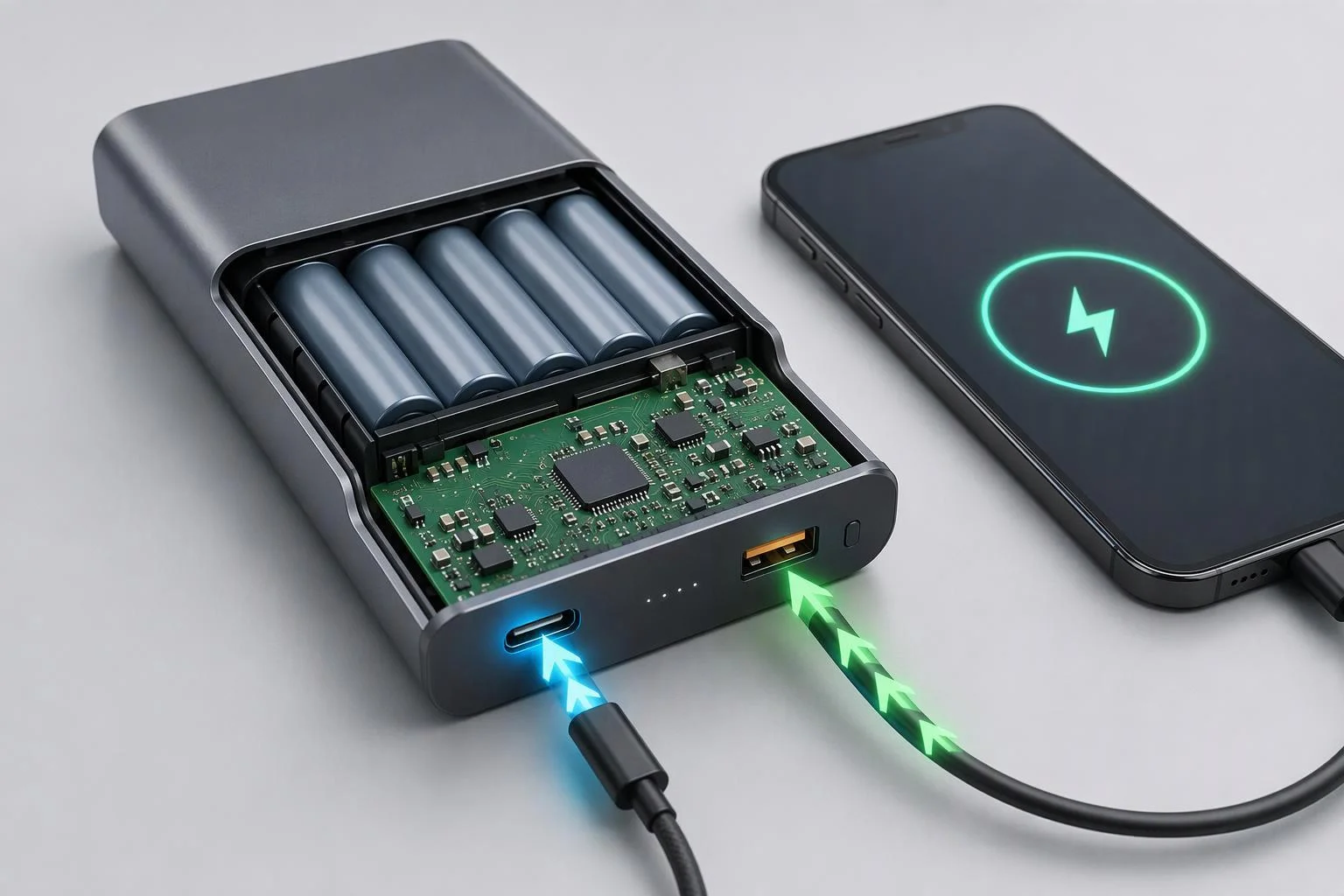
Inside, lithium-ion or lithium-polymer cells store the energy. Lithium-polymer cells can be shaped more freely, which is one reason very slim power banks are possible; both chemistries rely on the same basic principle of moving lithium ions between electrodes during charge and discharge. A protection circuit board watches for overcharge, overcurrent, overvoltage, short circuits, and excess temperature. A charging controller manages how much power flows in and out, and the input and output interfaces — usually USB-C, USB-A, or a built-in cable — connect the pack to a charger or a device.
Recharging works in reverse: you plug the power bank into a wall charger or a computer port, and the controller regulates the incoming power until the cells are full. To charge a phone, you connect the device and the pack negotiates a voltage and current both sides can accept.
The terms overlap but are not identical. A portable charger or portable battery pack is the general idea of carrying your own power. A power bank is the specific product that stores that power in a battery. A wall charger converts mains electricity but stores nothing, so it is useless once you leave the outlet. Many travelers carry both: a wall charger for the hotel room and a power bank for the hours in between.
Understanding Power Bank Capacity: 5000mAh, 10000mAh, 20000mAh, and Beyond
Capacity is the first number shoppers look at, and the one most often misunderstood. Milliamp-hours (mAh) express charge: how much current a cell can deliver over time. Watt-hours (Wh) express energy, which is charge multiplied by the voltage the cell actually operates at. You convert between them with Wh = (mAh × nominal voltage) ÷ 1,000. A 10,000mAh pack at 3.85V works out to roughly 38.5Wh; the same 10,000mAh rating at 3.7V gives about 37Wh. That is why two packs can carry identical mAh figures and different amounts of energy.
Voltage is the piece most people skip. The cells inside a power bank sit at about 3.6–3.85V, while a USB output delivers 5V or more. The pack has to step the voltage up, and that step, along with heat, cable resistance, and the phone’s own charging circuitry, uses some of the energy on the way. This is the difference between rated capacity — what the cells hold, printed on the label — and usable output capacity, which is what actually reaches a device. Some manufacturers state both, for example “10,000mAh rated at 3.7V, 6,000mAh usable at 5V.” Where only one figure appears, assume it’s the cell rating and expect less at the port.
Because loss varies with conversion design, output voltage and load, no fixed percentage applies across products. Published tests of specific models, or a sample you measure yourself, tell you more than a generic efficiency rule. Be cautious with packs that claim near-total transfer.
Charging counts follow the same logic: divide the usable energy at the output by what your phone’s battery holds, then allow for losses inside the phone. A 10,000mAh pack often gives a modern phone roughly one to two partial or full top-ups, but screen-on use, temperature, charging speed and battery age all move that figure. Treat any single number as an estimate.
Delivered energy per cell is only one variable; form factor is the other. The table below groups the common capacity tiers by what they suit rather than by exact weight, since two 10,000mAh models can differ noticeably in grams depending on housing, port count and whether a wireless coil is fitted.
Rated capacity | Typical use case | Portability | Suitable user type |
|---|---|---|---|
5,000mAh | Top-ups on a night out or a commute | Pocket-sized, usually the lightest tier | Minimalists who want an emergency reserve |
10,000mAh | A day or two of everyday phone charging | Fits a jacket pocket or small bag | Most smartphone users; daily commuters |
20,000mAh | Weekends away, tablet charging, multi-device days | Bag-friendly but noticeably heavier | Travelers, photographers, remote workers |
30,000mAh and above | Festivals, camping, laptop top-ups | Bulky; needs a bag with room to spare | Outdoor users and heavy multi-device users |
Choose capacity by the gap you need to close, not by the biggest number on the shelf. A 5,000mAh pack that lives in your pocket gets used; a 30,000mAh brick left at home does not.
10000mAh Power Bank: The Ideal Capacity for Portable Charging
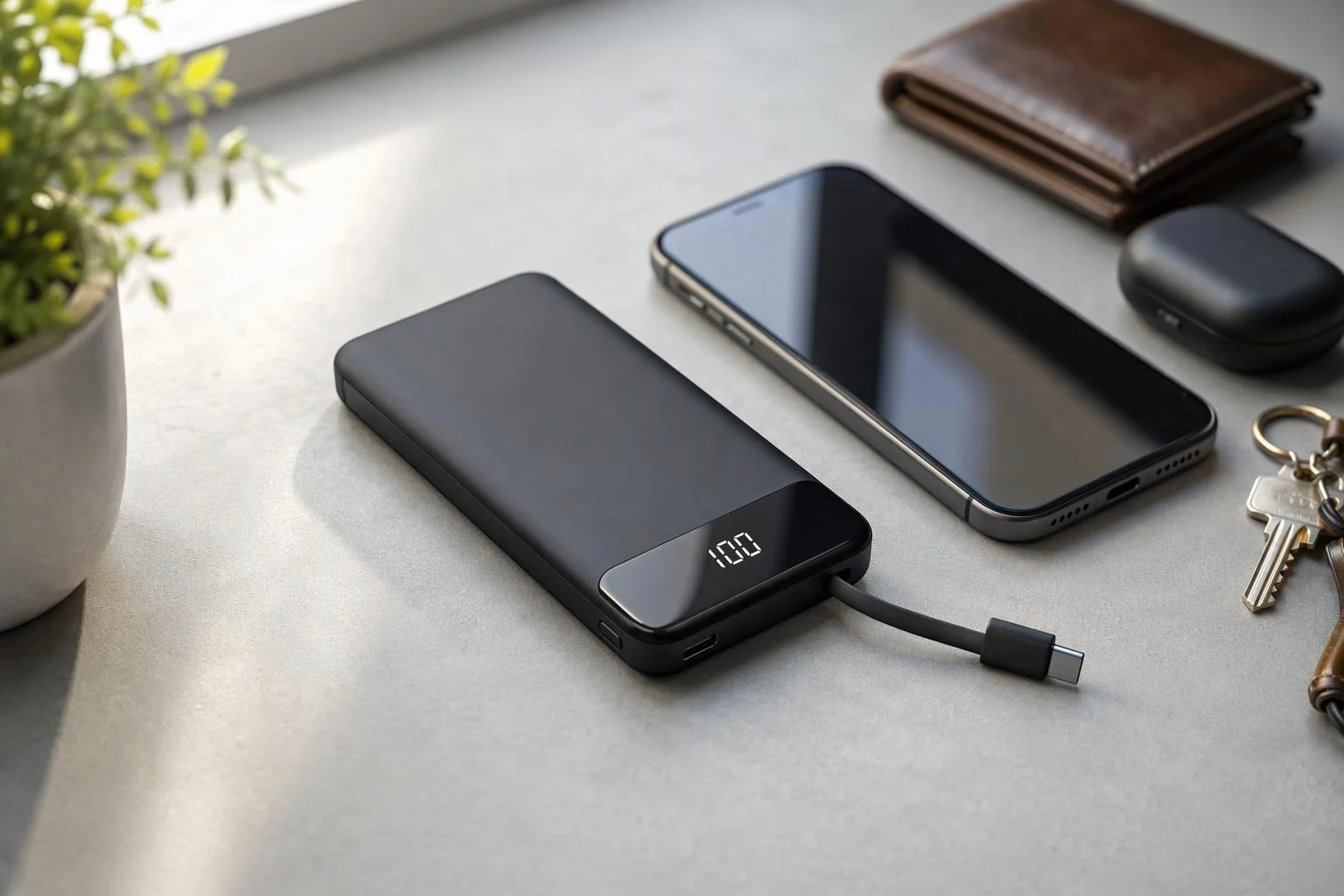
The 10,000mAh power bank sits at the practical center of the market for a simple reason: it is the largest capacity most people can carry without noticing it. Most units in this class slip into a jacket pocket or a small crossbody bag, and they carry enough cells for a day of travel, a conference, or a hike without hunting for an outlet. Weight varies by design — housings, port count, wireless coils and built-in cables all add grams — so compare the spec sheet rather than assuming one figure.
That balance is why 10,000mAh is the default recommendation for everyday portable charging. It usually costs less than the 20,000mAh tier while staying light enough to actually leave the house with. Many models now pair the capacity with USB-C PD output in the 20W–30W range, which is enough to fast-charge current phones that support PD, and some add a built-in cable or a wireless pad to cut down on what you need to pack.
When comparing 10,000mAh options, check four things: the Wh rating on the label, the maximum output wattage per port, whether USB-C supports both input and output, and the number of devices it can charge at once. Two 10,000mAh packs can differ by around 1.5Wh depending on whether the cells are rated at 3.7V or 3.85V, and a pack that caps output at 10W will charge a modern phone slowly no matter how much energy it holds.
For a deeper comparison of models, specifications and what to verify before ordering in bulk, see our dedicated 10000mAh power bank buying guide for wholesale buyers.
Charging Speed, Output Power, and USB-C Technology
Capacity tells you how much energy a power bank holds; wattage tells you how fast it can move that energy. A 20,000mAh pack limited to 10W output will charge a phone more slowly than a 10,000mAh pack with 30W output. Both numbers matter, and they answer different questions.
Output power in watts is the product of voltage and current the pack can supply on a given port. The tiers below describe what a port can support, not what every phone will draw: 20W is a typical fast-charge level for many current iPhones and mid-range Android phones, 30W suits larger phones and small tablets, 45W to 65W reaches into tablet and thin-laptop territory, and 100W or more covers many notebooks that accept USB-C charging. These are ceilings. The actual rate depends on what the connected device requests, and it drops when several devices share the pack.
That negotiation is where USB Power Delivery (PD) comes in — and it’s worth separating two things people often merge. USB-C is a physical connector with a defined pin layout. USB Power Delivery is a protocol that runs over USB-C and lets a device and a charger agree on voltage and current; the USB-IF specification has been extended up to 240W for supporting cables, chargers and devices. A USB-C port is not automatically a PD port, and a PD port only delivers its highest rate with a cable and device that also support it. Older USB-A ports rely on fixed-voltage schemes or proprietary fast-charge protocols, which is why a USB-A output on a power bank often tops out lower than its USB-C sibling.
Compatibility is a chain. The power bank, the cable, and the device must all support the same protocol and sufficient wattage. A 100W-capable power bank paired with a charge-only cable and a phone that caps at 20W will deliver 20W. When you plug in several devices, the pack splits its total output, so each port may drop below its solo maximum. Check the multi-port rating if simultaneous charging matters to you.
Key Features to Look for in a Portable Charger
Specifications on a box describe potential; features determine what the product is like to live with. The ten below are the ones that most often separate a power bank you keep using from one that ends up in a drawer.
Battery capacity and usable energy. Look at both mAh and Wh, and at any separately stated output capacity. Wh is comparable across packs and is the figure airlines use. Delivered energy is always lower than the cell rating.
Charging speed and protocols. Match the maximum output to your devices. A 20W PD pack suits a phone; a laptop needs 45W or more, and PD support is essential.
USB-C input and output. A USB-C port that handles both directions means one cable can recharge the pack and charge your devices. Packs with only micro-USB input feel dated.
Number and types of ports. Two or three outputs let you charge a phone and earbuds together. Check the combined output when all ports are in use.
Built-in charging cables. A power bank with a built-in cable removes the risk of forgetting one, though built-in cables add bulk and cannot be replaced if damaged.
Size, weight, and portability. A pack you carry is worth more than a bigger one you leave behind. Check the gram figure, not just the dimensions.
Digital battery indicators. Four small LEDs are adequate; a percentage display removes guesswork, especially on longer trips.
Wireless charging. Convenient for compatible phones and earbuds, but wireless transfer is less efficient than a cable and generates more heat.
Built-in protection. Overcharge, overcurrent, overvoltage, short-circuit, and temperature protection are baseline expectations, not premium extras.
Housing materials and durability. Flame-retardant polycarbonate or aluminum housings resist drops and heat better than thin plastics. Ports and buttons are the parts that fail first, so build quality around them matters.
How to Choose the Right Power Bank for Different Needs
There is no single best power bank, only the right one for a given device and routine. The decision usually comes down to four variables: what you need to charge, how fast it must charge, how much weight you will tolerate, and how long you will be away from an outlet.
Everyday smartphone charging. A 10,000mAh pack with 20W USB-C PD covers most people. It handles a full day out and fits in a pocket.
iPhone and Android users. Both benefit from PD, and most current phones fast-charge over USB-C. iPhone users should confirm the pack supports PD and use a USB-C to Lightning or USB-C to USB-C cable as appropriate; Android users should check for the fast-charge protocol their phone uses, since some brands rely on proprietary standards alongside PD.
Tablets and iPads. Tablets carry larger batteries and often draw more power. A 20,000mAh pack with 30W or higher output is a more realistic companion than a pocket-sized unit.
Laptops and notebooks. Laptop charging needs 45W–100W and a PD-capable USB-C port. A 20,000mAh pack at 65W can add meaningful runtime to a thin-and-light laptop; gaming laptops generally exceed what a portable pack can usefully supply.
Business trips and international travel. Prioritize a pack under 100Wh, an accurate Wh label, and a compact form that fits a carry-on. You can carry at most two power banks on international flights under the current ICAO rules, so pick them deliberately.
Camping, hiking, and outdoor activities. Capacity and durability outweigh slimness. A 20,000mAh or 30,000mAh pack with a rugged housing and a built-in light earns its weight.
Multiple devices at once. Check the combined output rating. A pack that promises 65W total may split that across three ports, leaving each device on a slow charge.
Power Bank Safety, Battery Quality, and Certifications
A power bank concentrates a lot of energy in a small space, and lithium cells can fail if they are abused, poorly made, or damaged. Safety is therefore a design and manufacturing question, not a marketing claim.
Lithium-ion and lithium-polymer cells are both used in power banks, and both rely on the same basic movement of lithium ions during charge and discharge. Polymer construction allows thinner shapes; cylindrical cells are common in higher-capacity packs. Chemistry is not a safety ranking — design, cell quality and consistency matter far more. When cells in a pack differ in age or condition, they can charge unevenly and develop localized heat. Reputable manufacturers source cells with documented test data and match them during assembly, which is why cell records are a more useful question to ask than the chemistry name on the box.
Protection circuitry is the second layer. Overcharge protection stops the pack from accepting more energy than the cells can safely hold. Overcurrent and overvoltage protection guard against excessive current or voltage from a faulty charger or cable. Short-circuit protection responds to accidental contact or a damaged cable, and temperature protection cuts or reduces output when the pack runs hot. These functions are usually handled by a protection IC and a battery management system, but their effectiveness depends on the quality of the components and the design.
Testing and quality control are the third layer. Charge and discharge cycling, temperature-rise tests, port insertion and removal, drop tests and assembly inspections all help catch defects before a product ships. A sample that passes these checks says more about a production batch than a datasheet does.
Beyond internal testing, three different types of paperwork get mixed together in power bank marketing. They answer different questions and are not interchangeable.
Product safety certification covers whether a specific design meets a published safety standard, tested by a recognized laboratory. In the battery space this includes standards such as IEC 62133-2 for portable lithium cells, UL 2056 for power banks in North America, or the equivalent national schemes elsewhere. A certificate of this kind applies to the exact model and construction that was tested; change the cells, circuitry or housing and the basis for the certificate changes.
Market-specific regulatory compliance covers the permissions required to sell in a given country. The EU applies CE marking for applicable directives and regulations, along with RoHS and REACH restrictions on substances; the US relies on FCC equipment authorization for radio-frequency emitting devices plus any relevant state or federal rules; other markets have their own regimes. The EU Batteries Regulation adds category-specific requirements for portable batteries placed on the EU market. What you need depends entirely on where you plan to sell.
UN 38.3 transport testing answers a different question again: whether a lithium cell or battery design can be shipped safely. It is a test summary required for transport documents and for carriers accepting the shipment. A pack can carry a clean UN 38.3 summary and still be missing the safety certification or the market approval your destination requires.
No single document proves a product is safe. A test report confirms that defined tests were passed under defined conditions, on a defined sample. Buyers should verify that each document matches the actual model and configuration they are buying, that it names the right standards for their market, and that the issuing body is legitimate — then treat the paperwork as one input alongside samples, batch records and returns data.
Can You Bring a Portable Charger on a Plane? Aviation Rules, Capacity Limits, and Sourcing Guide for Global Buyers
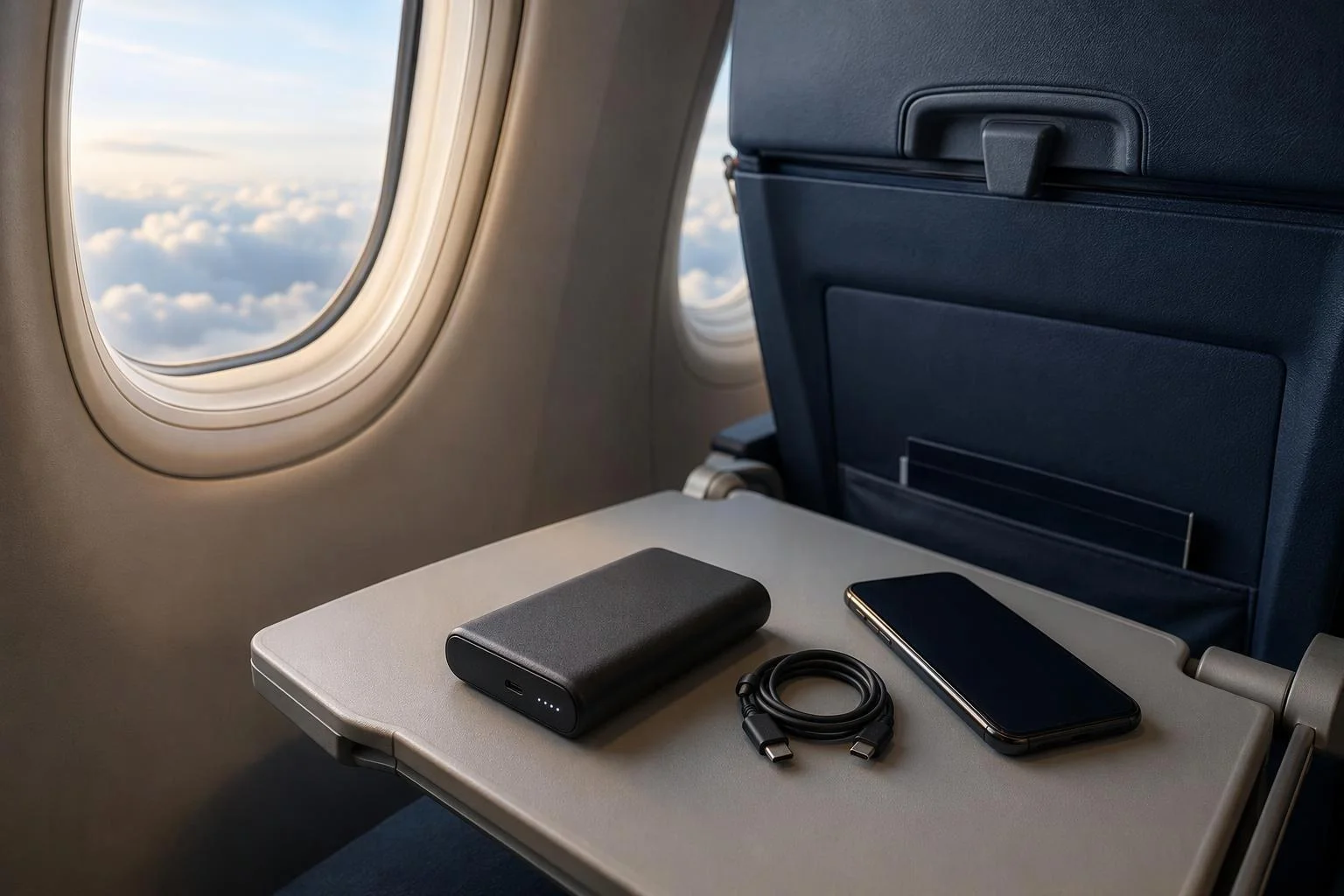
Portable chargers are allowed in the cabin, but not in checked baggage. The reason is fire risk: a lithium battery that short-circuits or overheats in the cargo hold is far harder to reach and manage than one in the cabin. Under ICAO’s updated Technical Instructions, which took effect on 27 March 2026 and apply across member states, the baseline international rules are now:
Two power banks per passenger. Power banks are counted separately from other spare lithium batteries, and the personal allowance is capped at two.
Cabin baggage only. Power banks must travel in the cabin, never in checked or hold baggage. That applies even if your cabin bag gets gate-checked — remove the power bank and keep it with you.
No recharging in flight. Passengers may not recharge a power bank during the flight, whether from a seat outlet or a USB port. That prohibition sits in the ICAO baseline itself, so it applies wherever the updated Technical Instructions are adopted.
Using a power bank to charge a phone or other device during the flight is a separate question, and it’s where policies diverge. ICAO and IATA guidance discourages the practice, and several carriers ban it outright, while others simply ask passengers to keep the pack within reach and visible. Some national authorities have gone further than the international baseline, and a few require additional marking on the unit itself. Assume nothing from a policy you read about a different airline: check your carrier’s own passenger rules before you fly, since the crew’s instructions on board are the final word.
Capacity is expressed in watt-hours. The ICAO and IATA framework treats power banks rated at 100Wh or less as allowed in the cabin without operator approval. Units rated above 100Wh and up to 160Wh may be accepted with the airline’s approval, and units above 160Wh are not permitted in passenger baggage at all. ICAO and IATA guidance treats the 100–160Wh allowance as transitional; it is scheduled to be withdrawn when the next edition of IATA’s Dangerous Goods Regulations takes effect on 1 January 2027. Check before you fly if you carry a pack in that band.
Convert before you pack. Divide mAh by 1,000 and multiply by the nominal voltage on the label: a 20,000mAh pack at 3.85V is about 77Wh, comfortably inside the no-approval band; a 30,000mAh pack at 3.7V is about 111Wh and needs approval. Because nominal voltage differs between models, two packs with the same mAh figure can sit on different sides of a threshold.
The ICAO baseline is not the whole picture. National regulators set their own rules: the FAA, for instance, permits lithium-ion batteries of 100Wh or less in carry-on for personal use, allows 101–160Wh spare batteries only with airline approval and limits those to two, and bars anything above 160Wh — a structure that broadly mirrors the ICAO tiers but reflects US rules, not a worldwide standard. EASA and other authorities have their own frameworks, and many airlines apply stricter quantity, capacity, storage or in-flight-use limits on top. Where an airline’s policy is tighter than the baseline, the airline’s policy governs your flight. The IATA guidance on power banks is the most practical reference for how operators are applying the changes.
Storage and handling matter as much as the numbers. Protect each power bank’s terminals with the original packaging, a pouch or non-conductive tape so loose keys or coins can’t bridge the contacts. Keep the unit somewhere reachable rather than buried in an overhead bin if the airline requires it accessible, and never travel with a damaged, swollen or recalled pack. Packaging that states capacity and watt-hours accurately is part of the product, not just marketing — a mislabeled pack can be refused at the gate or held by customs.
For a detailed breakdown of airline policies and regional rules, see our guide to portable charger airline rules and travel restrictions.
What Should Global Buyers Look for When Sourcing Power Banks?
Sourcing power banks is not a single purchase decision; it is a commitment to a category where an unverified capacity label, a substituted cell or a missing transport document can turn into customs delays, returns and reputation damage months after the container ships. The checklist is broadly the same for everyone, but the emphasis shifts with who you are.
Wholesalers and distributors are buying a repeatable unit, so consistency between the sample and the production batch carries the most weight. Ask how cells are matched, what changes between runs, and which panel and housing suppliers are locked in. A pack that tests well once and drifts on the third order costs more in replacements and account management than a slightly higher unit price.
Importers and regional agents carry the compliance burden in the destination market. Documentation that matches the exact model and configuration is the priority: safety test reports, market approvals for the country of sale, UN 38.3 transport summaries and correct labeling. Confirm who holds the technical file, what happens if the destination rules change mid-season, and how the supplier handles customs questions after the shipment has left.
Retail purchasing managers are answering to a shelf and a category plan. Sell-through and returns rate matter more than the spec sheet headline, so ask for defect and return data by model where it exists, and check that packaging, accessories and warranty terms match what shoppers in your channel expect.
OEM/ODM buyers need all of the above plus clarity on customization ownership: which elements can change — logo, color, housing, capacity and port configuration, packaging, firmware behavior — and who controls tooling, artwork and approvals. Customized units should still pass the same quality and compliance checks as catalog models, not a lighter version of them.
Across all four, six areas separate a supplier you reorder from one you replace within a season:
Battery cell quality and capacity consistency. Request cell specifications, matching records and test data showing what reaches the output at 5V. Compare that with the label.
Charging performance. Check input and output wattage per port, supported fast-charge protocols, and the combined rating when several devices are connected.
Compliance documentation. Confirm that safety certification, market approvals and transport test summaries each match the model being purchased, and that they’re valid for your market.
Quality control. Ask for charge and discharge, temperature-rise, port cycle, drop and durability records, plus appearance, assembly, label and packaging checks.
Customization and IP. Agree in writing on tooling ownership, artwork approval and who is responsible for the label wording that regulators read.
Long-term reliability and after-sales. Assess capacity planning, sample turnaround, production scheduling, communication during peak season, and a defined defect and replacement process.
JOYROOM is a 3C accessories brand that designs and supplies charging, audio and protection products for consumers and trade partners alike. If you’re shortlisting suppliers, the practical next step is a comparison on evidence rather than price alone: share the capacity tier, port configuration and destination market you have in mind, and JOYROOM’s team can respond with the matching specifications, samples for testing, and the documentation relevant to that market. For wholesalers, distributors and importers building a repeatable range, or OEM/ODM buyers planning a private-label program, that conversation is a low-cost way to test whether a supplier’s answers hold up.
Ask for evidence rather than assurances. A specification sheet describes intent; a test report, a batch record or a sample you measured yourself describes what will actually arrive. Where a supplier can’t provide a document, treat that gap as an open question to resolve before placing volume rather than an automatic rejection — but do resolve it.
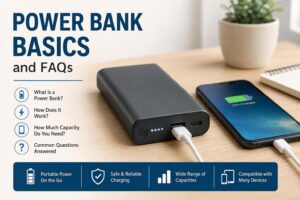
Power Bank Basics and FAQs
These are common questions about power banks, answered briefly. For a fuller explanation of the fundamentals, see our guide to power bank basics and how they work.
What is a power bank? A rechargeable battery pack with charging circuitry and ports that lets you charge a phone, tablet, or other device away from a wall outlet.
How does a power bank work? It stores energy in lithium cells, converts that energy to a suitable output voltage, and uses a controller and protection circuit to manage charging and guard against overcharge, overcurrent, short circuits, and excess heat.
What size power bank do I need? It depends on your devices and how long you’ll be away from an outlet. A 10,000mAh pack suits most daily phone use; 20,000mAh is better for weekends, tablets, or multiple devices; laptop charging generally needs 45W or more of output.
Is 10000mAh enough for daily use? For most phone users, yes. Heavy users or people charging several devices may want more capacity.
How many times can a power bank charge a phone? Divide its output capacity in Wh by your phone’s battery capacity in Wh, then allow for losses inside the phone. Published figures count cell capacity, not delivered energy, so expect fewer full charges than the label implies.
How long does it take to charge a power bank? It depends on capacity and input wattage. A higher-wattage USB-C input shortens charging time, and a 20,000mAh pack generally takes longer than a 10,000mAh pack at the same input.
Are power banks safe? Well-designed models with protection circuitry and appropriate certification are made for everyday use. Avoid damaged, swollen, recalled, or uncertified packs, and keep them away from excessive heat.
Can you bring a power bank on a plane? Yes, in cabin baggage only. Under ICAO rules in force since 27 March 2026, passengers may carry up to two power banks and may not recharge them in flight; packs rated 100Wh or less need no airline approval, 100–160Wh units may be accepted with approval, and anything above 160Wh is barred from passenger baggage. Whether you can use a power bank to charge a device on board depends on the country and the airline, and national regulators and individual carriers can be stricter overall, so check your carrier’s policy.
What should you look for when buying a power bank? Check capacity in both mAh and Wh, output wattage and protocol support, USB-C input and output, the number of ports, size and weight, protection features, build quality, and the certifications and documents required in your market.
Conclusion: Choosing the Right Power Bank for Your Needs
Capacity is the number printed largest on the box, but it is the least reliable single indicator of whether a power bank will serve its owner well. A well-made 10,000mAh unit with honest labels, matched cells and a compatible fast-charging protocol will usually beat a poorly built 20,000mAh unit in daily use, and it’ll do so while weighing less and lasting longer. Charging performance, device compatibility, portability and safety together decide whether the product earns a place in a bag or a drawer.
For consumers, the practical route is to start from the device: what it accepts, how much charge a day away from an outlet requires, and how much weight you’re willing to carry. Then check that the power bank’s output, ports and protocols match. For buyers, the same logic applies at portfolio level, with compliance, consistency and supply reliability added on top. A product that clears customs, matches its sample and arrives on schedule protects margin in a way that a lower unit price rarely does.
JOYROOM designs and supplies charging and mobile accessories for consumers and trade partners, and works with wholesalers, distributors, importers and OEM/ODM buyers on product selection, customization and private-label programs. If you’re reviewing your power bank range, the business development team can talk through specifications, samples and partnership terms for your market — and it’s worth bringing your own test criteria to that conversation.