




Almost every traveler who has packed a power bank has asked the same question at a check-in counter: is this allowed? The answer changed in 2026, and the change was not a small one. Aviation authorities reclassified power banks as a category of their own, separate from spare batteries, and airlines began applying tighter limits at very different speeds.
Understanding portable charger on a plane regulations is essential before traveling. Airlines and aviation authorities have specific rules covering battery capacity, carry-on baggage, onboard usage, and short-circuit protection.
This guide follows the rules in the order you actually meet them. First whether a charger may fly with you, then how much energy it may carry, then how carry permission differs from permission to use it. The international, national and airline layers come next, and for distributors and importers the last two sections look at the design, testing and documentation that decide whether a product clears a border — not just a security checkpoint.
Can You Bring a Portable Charger on a Plane?
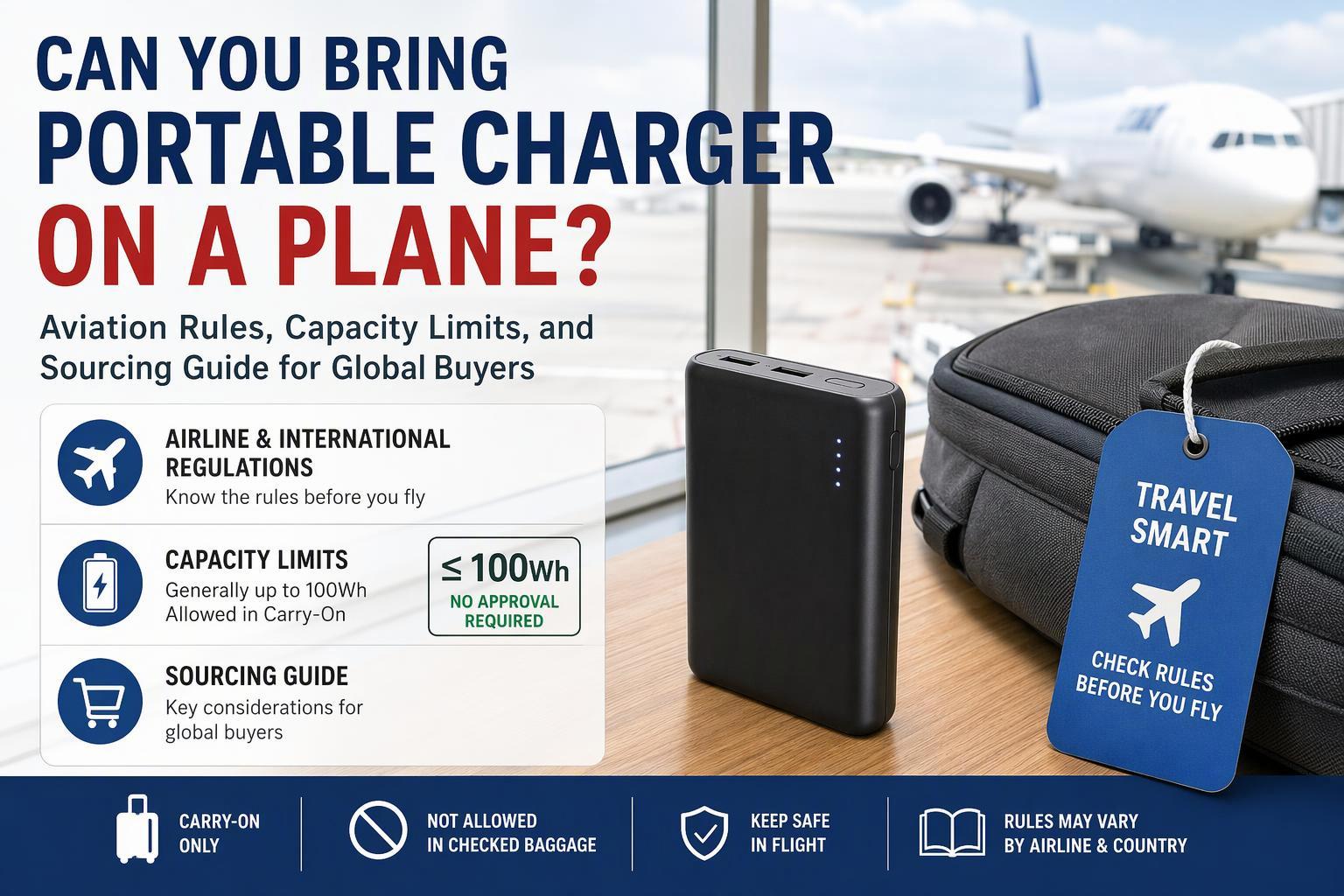
Yes, generally — but only in the cabin, only within a capacity limit, and only if it travels protected. The current baseline comes from an ICAO addendum to the Technical Instructions for the Safe Transport of Dangerous Goods by Air, reflected in IATA’s operator guidance. That package of changes separates power banks from spare batteries as a distinct category, limits passengers and crew to two power banks for personal use, and prohibits recharging a power bank in flight (IATA guidance to operators).
The same document lists the conditions in full. Power banks must be carried as carry-on baggage, must not be recharged on board, and each unit must be individually protected against short circuits when not in use. The addendum also allows an operator to impose stricter conditions, such as extra separation between units or a low state of charge — under 25% when installed in a device.
The quantity figure is a risk-management number. IATA’s operator guidance frames the hazard directly: power banks present “an increasing concern with the threat of thermal runaway and fire risk in aircraft,” with low barriers to manufacturing and limited confidence in regulatory oversight of non-conforming manufacturers. Wireless power banks are flagged as an emerging concern. A carrier that has handled incidents therefore has reason to go below two, and Southwest and Emirates now allow one.
Spare batteries draw on a separate allowance: IATA’s table permits up to 20 spare batteries of any type per person, with operator approval available for more, while power banks are capped at two. That distinction matters at the checkpoint, because a 20,000mAh camera battery and a 20,000mAh power bank are counted differently.
How to Pack Multiple Power Banks Safely
Individual protection applies to each unit separately rather than to the group. IATA’s passenger guidance specifies protection through the original retail packaging or by otherwise insulating the terminals; the FAA is more concrete, advising that terminals be taped or boxed and the items placed in separate bags, and kept accessible in the cabin (FAA). That last point extends to gate-checking — if cabin baggage is checked at the gate or planeside, spare lithium batteries and power banks must be removed and kept with the passenger.
In practice, two packing patterns cover most itineraries. A single phone charger — one 10,000mAh unit — sits well inside both the count and the capacity ceiling; keep it in the personal item, terminals protected, and read the carrier’s onboard rule before plugging anything in. Two power banks is the working maximum under the international baseline, so pack each in its own pouch or retail box, keep both within reach, and expect to declare them at check-in. Photographers can add camera spares on the separate battery allowance, subject to the per-unit ceiling and the carrier’s own quantity limits.
For buyers moving samples or stock, none of these patterns apply. Batteries carried for sale or distribution fall outside the passenger allowances entirely and must move as cargo under the applicable dangerous goods requirements.
What Is the Maximum Power Bank Capacity Allowed on a Plane?
Capacity is the number that decides most borderline cases, and it is also the number travelers most often guess wrong. The ceiling is 100Wh per unit for carriage without approval. Between 101Wh and 160Wh, a limited allowance applies with airline approval, and above 160Wh passenger carriage is not permitted at all.
The trap is that shops sell capacity in mAh, while regulators read Wh. Convert with volts multiplied by amp-hours. For a 20,000mAh pack at 3.7V nominal, that is 20Ah × 3.7V = 74Wh. Raise the cell voltage to 3.85V and the same pack becomes 77Wh — still legal, but sixteen percent closer to the line. Neither figure is unusual; both are common on retail shelves.
Pack label | Nominal voltage | Rated energy | Status on a passenger flight |
|---|---|---|---|
5,000mAh | 3.7V | 18.5Wh | Carry-on, no approval |
10,000mAh | 3.85V | 38.5Wh | Carry-on, no approval |
20,000mAh | 3.7V | 74Wh | Carry-on, no approval |
30,000mAh | 3.7V | 111Wh | Approval band; many carriers refuse |
40,000mAh | 3.85V | 154Wh | Approval band, tightly restricted |
Read the printed Wh before you read anything else. FAA guidance states that a lithium-ion battery’s watt-hour rating should be marked on the unit and, where it is not, must be calculated from volts and amp hours (FAA PackSafe resources). A unit whose label has worn away is a screening problem before it is ever a flying problem.
Why the 100Wh Line Exists
The threshold is not arbitrary. Energy density determines how much heat a failing cell can release in a confined space, and 100Wh is the point at which regulators decided a single unit needs a human decision rather than a blanket allowance. Above it, three things change at once: approval becomes discretionary, quantity shrinks toward a single unit, and carrier policy rather than the international baseline decides the outcome. A 140Wh pack that boards one airline can be refused by another on the same route.
For a buyer, the arithmetic is also a listing decision. A 30,000mAh unit sits at roughly 111Wh at 3.7V and already needs approval on most carriers, so products positioned just under 100Wh have a longer commercial shelf life than products that depend on a discretionary allowance.
Can You Use a Portable Charger on a Plane During the Flight?
Permission to carry a power bank is not permission to use it. The international rules now being adopted let passengers bring power banks into the cabin while prohibiting the recharging of the unit itself from an aircraft power supply, and recommending against using it to charge another device onboard. Airlines are applying that distinction at very different speeds.
Can You Use a Portable Charger to Charge Your Phone on a Plane?
Under the ICAO addendum reflected in IATA’s 2026 guidance, using a power bank to recharge a portable electronic device onboard is a recommendation against, not an outright prohibition: power banks “should not be used to recharge a portable electronic device while onboard the aircraft.” Recharging the power bank itself is stated as a requirement — it “must not be recharged while onboard the aircraft.”
That difference in verb strength is where airline policy takes over. Several major carriers now prohibit onboard use altogether: Singapore Airlines, Cathay Pacific, Qantas, and several European and Asia-Pacific operators including the Lufthansa Group, KLM, Emirates and Japan Airlines ban charging a device from a power bank in flight, and most of them also ban recharging the bank from seat power or USB. EASA’s passenger advice goes further than the carriage rules, telling travelers not to charge devices using anything other than the aircraft power supply at their seat. The practical reading: assume the power bank is cargo in the cabin until the operating carrier’s own page says otherwise.
Why Recharging a Power Bank in Flight Is Restricted
The restriction targets a specific failure mode. A power bank being charged is a battery under active load and heat generation, in a sealed cabin, with limited ability to remove it from service if a cell begins to fail. The FAA describes the hazard from the passenger side: thermal runaway can occur without warning if a battery is damaged, overheated, exposed to water, overcharged or improperly protected, and it can also occur on its own due to manufacturing defects.
This is also why the rules separate power banks from spare batteries. A spare battery is inert until installed; a power bank is a complete charging circuit that a passenger can activate. Charging one in flight adds an overcharge and heat pathway that neither the passenger can monitor nor the crew can easily isolate — which is why the ICAO addendum drew the category line where it did.
Takeoff, Landing, and Where the Power Bank Should Sit
Most airlines that permit any onboard use draw a hard line at the runway. IATA’s passenger guidance states that power banks should not supply power to other devices during taxi, take-off or landing, and Delta’s published rule matches it. The reason is procedural rather than electrical: those are the phases with the highest crew workload and the narrowest window for intervention, and a power bank in active use is a device in use, cabled to another device. Carriage is unaffected — the unit stays with you, it simply shouldn’t be powering anything.
Storage follows the same logic. IATA’s passenger guidance states that power banks should not be stored in overhead lockers, and Delta directs passengers to keep them somewhere easily accessible, such as under the seat in front or in the seatback pocket. The reasoning is response time: if a unit begins to vent, crew need to reach and isolate it, and a locker several rows away removes that option. In practice the power bank travels at your feet — and if you’re asked to gate-check the roll-aboard, it comes out first.
What Should You Do If Your Power Bank Overheats?
Tell the crew immediately, and don’t handle it yourself. The FAA’s instruction is explicit: notify the flight crew if a lithium-ion battery or portable electronic device is overheating, expanding, smoking or burning. EASA adds a detail that’s easy to overlook — if you lose a device or battery during the flight, call a cabin crew member and don’t operate your seat, since moving the seat can crush the battery and start a fire.
Three habits reduce the chance of reaching that point. Keep the unit out of direct sunlight and away from heat sources for the duration of the flight. Don’t use a power bank that is swollen, dented, wet or showing a damaged port, and don’t charge it in the cabin to “test” whether it still works. Finally, treat a missing or unreadable capacity label as a screening problem, because a unit that can’t be identified by its Wh rating may be refused at the checkpoint before onboard use ever comes up.
What Are the Rules for International Flights?
A power bank under 100Wh can generally fly with you in the cabin on an international itinerary, but three separate layers govern the trip: the international dangerous-goods provisions that set the baseline, the national regulators in the departure and destination countries, and the policy of each airline operating a segment. A charger that clears one layer can fail the next.
Layer One: The International Baseline
The baseline comes from the ICAO Technical Instructions (Doc 9284), whose addendum took effect on 27 March 2026, and from the IATA Dangerous Goods Regulations that airlines implement in practice. Under it, power banks travel as carry-on baggage only, must be individually protected against short circuits, are capped at two units per passenger for personal use, and must not be recharged from an in-aircraft power supply. Using one to charge another device is a recommendation against at the international level, not a prohibition.
The 101–160Wh approval band is the part with a shelf life. IATA has stated that the provision will not be carried into the 68th edition of the DGR, effective 1 January 2027, so a unit purchased on the strength of a discretionary allowance is buying time, not durability. Check the operating carrier’s policy before travel rather than the addendum’s text.
Layer Two: National Regulators
National authorities enforce the baseline and may set stricter conditions, so the departure and destination markets both matter.
United States. The FAA’s passenger guidance permits lithium-ion batteries up to 100Wh per battery for personal use with no federal quantity limit, and up to two spare batteries of 101–160Wh with airline approval. Spare batteries and power banks are carry-on only and must be protected from damage and short circuit. Batteries carried for sale or distribution — vendor samples, for example — are prohibited. The FAA also states plainly that airlines may apply stricter quantity and Wh limits regardless of capacity, which is the sentence that explains most of the variation travelers encounter.
Europe. EASA guidance follows the same thresholds: 100Wh without approval, 100–160Wh with operator approval, above 160Wh not permitted. Its passenger advice goes beyond carriage and discourages charging devices from a power bank in flight, which several European carriers have turned into a rule.
Asia-Pacific. This is where national rules diverge most. Singapore’s CAAS adopted the ICAO addendum’s two-power-bank limit and onboard charging restrictions for flights departing Singapore. Other regulators have moved at different speeds and with different emphases — some on quantity, some on usage, some on stowage — so the operating carrier’s published policy remains the operative document.
Layer Three: Airline Policy
Airline policy is where the variation actually bites, because operators may go below the international baseline on any of four dimensions: the Wh ceiling, the quantity cap, whether onboard use is permitted, and where the device must be stowed. Delta, for example, allows up to two power banks each up to 100Wh without approval, permits 101–160Wh units only with its approval, prohibits anything above 160Wh, and bars storage in an overhead bin (Delta). Southwest and Emirates cap power banks at one. Singapore Airlines, Cathay Pacific and Qantas allow two but prohibit onboard use.
What Should You Check Before Packing?
Four things, in this order: the Wh rating printed on your power bank, every operating carrier’s dangerous-goods page for quantity, usage and stowage rules, the departure and destination regulators’ passenger guidance, and destination customs rules for lithium batteries and personal electronics.
Check each airline on the itinerary, not just the one that issued the ticket. Conditions attach to the carrier operating the segment, so a connection that is compliant on the first leg can breach the second carrier’s stricter cap — and codeshare arrangements make this easy to miss, because the marketing carrier’s name on your booking may not be the operator of the aircraft you board. Look for four statements on the carrier’s own restricted-items page: the Wh limit, the quantity limit, whether onboard use is allowed, and where the unit must be stowed. Screenshot the page before you travel; policies have been changing through 2026, and a dated reference is useful at the gate. Where a page is silent, the international baseline applies — but silence isn’t permission to assume the looser reading.
How Do Manufacturers Test and Certify Travel-Ready Power Banks?
Aviation rules decide whether a power bank may board. Engineering decides whether it should. For buyers, the useful question is not “does this model pass the 100Wh line?” but “does the design hold that margin across batches, and can the supplier prove it?” This is also where most travel articles stop short. They explain what a passenger may carry and never explain how a manufacturer verifies the label, runs the thermal and mechanical tests, keeps UN 38.3 documentation current, and prepares OEM packaging for international distribution.
A travel-friendly power bank needs more than a compliant Wh rating. Importers should expect a document set that covers transport testing, battery safety, and market access — and each document answers a different question.
Document or Standard | Procurement Relevance |
|---|---|
UN 38.3 | Lithium battery transport testing |
MSDS / SDS | Material and safety information |
IEC 62133-2 | Portable sealed secondary lithium cell and battery safety |
CE | Applicable EU product conformity requirements |
FCC | Relevant US electromagnetic compatibility requirements |
Cell Quality and Why It Decides Everything Downstream
IATA’s operator guidance notes that non-conformance with UN 38.3 testing is left to the new owner — wholesaler, retailer or consumer — to consider (IATA). That sets the buyer’s default posture: verify rather than assume.
Cell verification at goods-in should cover four things. The cell specification — chemistry, nominal voltage, rated capacity and continuous discharge rating — matched against the approved sample. Batch consistency, since a cell substitution changes capacity, temperature behavior and the Wh figure printed on the housing. Internal resistance, which drifts with cell quality and age and shows up later as heat and voltage sag. And supplier documentation tying the delivered cells to the tested configuration.
That last point carries real weight, because UN 38.3 is a type test, not a per-unit inspection. The UN Manual of Tests and Criteria requires retesting after defined changes, including a change in the number of component cells, a change in their connecting mode, and a change of safety design such as a venting valve. A cell swap or a reworked pack layout can move a product outside its test basis, so ask the supplier to confirm in writing that the shipped configuration matches the tested one.
Label Accuracy: mAh, Voltage, and Wh Must Agree
The label is where engineering meets the checkpoint. Three values must agree with the approved battery specification: printed mAh, nominal voltage and Wh. A common error is mixing a cell-level figure with a pack-level figure, or printing a marketing capacity that reflects usable output rather than rated cell energy. Either creates a mismatch between what the label claims and what the test report supports — the kind of inconsistency that stalls a customs query or a retailer’s compliance review.
Label verification belongs in the inspection plan, not only in the artwork approval. Check the printed values against the approved specification on production units, and confirm the marking survives normal handling. A Wh figure that rubs off in a seatback pocket is not a marking.
Protection Circuitry, Temperature Monitoring, and Thermal Margin
Protection circuitry is the layer between a cell fault and a cabin event. FAA describes thermal runaway as possible “without warning as a result of various factors, including if the battery is damaged, overheated, exposed to water, overcharged, or improperly protected,” and adds that it can also occur on its own due to manufacturing defects. Each trigger maps to a protection function that can be tested: overcharge, over-discharge, overcurrent, short circuit and abnormal temperature.
Record the trip threshold and the recovery behavior rather than marking the result “pass,” and test at the extremes of the input range the product claims to accept. Confirm the protection responds before cell temperature reaches the limit the design assumes, and state the sample size and acceptance criteria — a single unit that trips correctly is an observation, not a validation.
Temperature monitoring is a separate design decision about where the sensor sits. A thermistor placed away from the cells reports the board’s temperature, not the battery’s. Ask where it is mounted, what temperature triggers derating versus shutdown, and whether the response is tested at the highest ambient temperature the product is rated for. Because thermal behavior depends on load and protocol, a temperature-rise record should define ambient temperature, charge and discharge current, and duration, then plot cell surface temperature over time. That curve — not a single number — tells a buyer whether a fast-charging claim and a thermal margin can coexist in the same housing.
Mechanical Durability and Multi-Port Fast Charging
Travel imposes loads that bench testing does not: compression in a packed bag, drops onto terminal floors, repeated connector cycles. Mechanical qualification should include drop testing with inspection for enclosure cracks, internal component movement and cell deformation, followed by a post-impact electrical check. That last step is the one buyers most often forget to request, yet a unit that looks intact but has a shifted cell or a stressed solder joint is the one that fails in a customer’s bag months later. Connector testing records insertion and removal cycles, then inspects retention force, receptacle wear and charging stability at the end of the run.
Housing design also feeds back into the aviation rules. Because spare batteries must be individually protected against short circuits, a recessed or capped terminal, or packaging that doubles as an insulator, supports that requirement at product level rather than leaving it entirely to the passenger.
When several ports share a cell pack, total output is limited by the pack’s continuous discharge capability and the converter’s thermal headroom — not by the sum of the port ratings. A design advertising high wattage per port should document the combined-output profile and the derating logic that protects the cells when ports are used together. Fast charging adds protocol negotiation to the equation: higher input power shortens charge time and raises cell temperature, so the charge profile should be validated at the maximum input the product accepts, across the protocols it claims to support. Ask for the combined-output specification, the thermal test conditions behind the fast-charge claim, and confirmation that protection thresholds stay active at maximum load. For travel-oriented programs, the practical sequence is cell and protection architecture first, then port configuration, then the label. Reversing that order produces products whose marketing outruns their documentation.
How Do You Verify Test Reports and Supplier Documentation?
Check four things before accepting a document package. The model number on the report must match the SKU you are ordering, not a sibling product or a predecessor. The cell manufacturer and model named in the report should match the cells in the delivered units. The report date and issuing laboratory should be current for the design as shipped, since UN 38.3 requires retesting after the specified changes. And the approved sample should be compared against production units — housing, cell, protection board and label — so the paperwork describes the product rather than a prototype.
The content of each document differs. UN 38.3 is the test section in the UN Manual of Tests and Criteria that classifies lithium cells and batteries for transport: a transport classification requirement, not a consumer product safety standard, a distinction IATA makes explicitly in its 2026 operator guidance on power banks. The test summary carries the manufacturer, the laboratory, a unique report number and date, the cell or battery description with mass and Wh rating, model numbers and pass/fail results — the practical basis for matching a report to a SKU. IATA assigns power banks to UN 3480 (lithium-ion) or UN 3090 (lithium metal) for shipping purposes.
The Safety Data Sheet supplies material and hazard information, and its Section 14 carries transportation information — the FAA notes this section indicates whether a product is a regulated dangerous good. The battery specification sheet is separate and should state cell model, chemistry, nominal voltage, rated capacity, Wh rating and charge/discharge limits. Neither demonstrates that the product passed safety testing. IEC 62133-2:2017 does: it specifies requirements and tests for the safe operation of portable sealed secondary lithium cells and batteries under intended use and reasonably foreseeable misuse, which is the product-safety layer UN 38.3 does not provide.
CE covers applicable EU product conformity requirements and FCC covers relevant US electromagnetic compatibility requirements. For unintentional radiators — digital circuitry — the FCC route is the Supplier’s Declaration of Conformity, per the FCC equipment authorization procedures; power banks with wireless charging or Bluetooth add intentional-radiator functions, which follow the certification route. Neither mark substitutes for battery safety or transport testing, and each market may impose additional labeling and language requirements.
Why Certification and Traceability Matter for Importers
IATA’s guidance links non-conforming manufacturing to thermal runaway and fire risk in aircraft. Distributors face three exposures: a carrier refusing or offloading a shipment, customs or market-surveillance action against a product whose file doesn’t match the SKU, and liability after a field incident that can’t be traced to a production batch. A document set that matches the delivered product is the only version of compliance that protects the buyer.
What Should Wholesale Buyers Consider When Sourcing Power Banks?
A power bank can look excellent on a spec sheet and still fail the buyer’s real test: moving through customs, clearing a retailer’s compliance review, and reaching the shelf without relabeling or rework. Sourcing travel-friendly power banks means treating documentation, cell quality, labeling and packaging as part of the product, not as paperwork that follows it.
Choosing Between 10000mAh, 20000mAh, and Higher-Capacity Power Banks
The capacity decision is a market segmentation decision as much as a technical one. At 3.7V nominal, a 10,000mAh pack carries roughly 37Wh and a 20,000mAh pack roughly 74Wh — both comfortably under the 100Wh threshold. A 30,000mAh pack lands near 111Wh, in the band where airline approval and stricter operator limits apply. Many products use 3.85V cells instead: JOYROOM’s 10,000mAh JR-PBM08, for example, is rated 3.85V (38.5Wh), which is why the printed Wh figure, not a generic conversion, should anchor the listing.
For retail, 10,000mAh suits commuters and light travellers, 20,000mAh suits multi-device travellers and long-haul flyers, and sub-100Wh high-capacity designs serve buyers who want maximum energy without pushing customers into approval territory. Higher-capacity units can still be sold, but they narrow the addressable use case and shift responsibility onto the retailer to explain the rules.
OEM, ODM, and Packaging for Travel-Oriented Products
Customization usually covers capacity, port configuration, housing, branding and packaging. A travel-oriented brief adds constraints: the printed Wh rating must match the approved cell configuration, the housing must survive transit, and any wireless charging function needs the same documentation scrutiny as a wired model. IATA flags wireless power banks as an emerging counterfeiting and testing concern, so a custom wireless design deserves extra verification of its UN 38.3 evidence.
Labeling is where market differences become concrete. The capacity marking, voltage and Wh figure must agree with the tested configuration; manuals must match the languages the destination market requires; and packaging must carry the barcodes and regulatory marks the retailer’s compliance team will check. Because these requirements vary by market, a single packaging design is rarely enough for a multi-country program. Build the label and manual variants into the quotation stage rather than discovering them at the port.
For private-label orders, packaging inspection covers logo color against the approved Pantone reference, print alignment, barcode scannability, and the accuracy of regulatory and capacity markings. A misprinted Wh figure or a missing warning line isn’t cosmetic: it can trigger relabeling, retailer rejection, or a customs question at the destination. Sea freight exposes cartons to humidity swings and condensation, so controls typically include carton strength verification, moisture barriers, desiccant placement sized to the pack volume and route, and inspection of units after storage.
MOQ, Sample Approval, and Batch Traceability
Approved samples are the reference point for every later dispute. Before confirming a bulk order, lock the sample, record its measured capacity and labeling, and agree on the inspection criteria that will be applied to production. Quote lead time with packaging and documentation steps included, since relabeling or manual revisions can add weeks. Quality records — inspection reports, traceability, corrective-action documentation — should be retrievable per batch, not reconstructed on request.
Unit price is the least reliable comparison point in this category, because a lower quote often excludes the testing, documentation or packaging work the buyer will pay for later through delays and rejected shipments. Compare suppliers on four fronts instead: whether transportation documentation matches the exact model, whether test reports are current and traceable to the delivered configuration, whether the factory holds labeling and packaging tolerances across repeat orders, and whether it answers a question about a failure mode with specifics.
Why JOYROOM Is Worth Evaluating as a Sourcing Partner
For a distributor, the real question is narrower than brand preference: does one supplier’s range let you serve several travel-driven buyer segments without assembling a portfolio from many sources, and does the paperwork behind each SKU hold up at the border?
Capacity tiers map onto distinct retail conversations. A 10,000mAh unit is the impulse and gift purchase — light, low landed cost, easy to merchandise beside phone cases. A 20,000mAh unit serves the traveller who wants two or three phone charges without thinking about it, and it stays inside the 100Wh ceiling at typical cell voltages. Higher-capacity models attract buyers who understand watt-hours, and they carry the approval questions covered earlier in this guide.
JOYROOM states that it was among the first companies to receive CCC certification for power banks, in 2024. That is a Chinese market certification and doesn’t substitute for UN 38.3 transport testing, IEC 62133-2 safety evaluation or destination-market conformity — treat it as one data point in a document set. Its published figures (operations since 2009, products sold in more than 130 countries and regions, over 300 utility and design patents) describe scale and longevity, not certification of any individual model.
Before committing to volume, assemble a document pack per SKU using the checklist above: specification sheet with rated Wh and cell details, UN 38.3 test summary, safety test reports, applicable conformity documentation, approved sample and packaging artwork sign-off. Then ask two operational questions — how batch traceability works, and what corrective-action records look like when an inspection fails. A supplier that expects those questions is easier to work with than one that treats them as an obstacle.
Frequently Asked Questions About Taking Portable Chargers on Planes
Can You Bring a Portable Charger on a Plane in Your Carry-On Bag?
Yes. Spare lithium-ion power banks are permitted in carry-on baggage, and the FAA’s PackSafe chart lists them as carry-on only. They must be protected from damage and short circuit, and many airlines now require them to stay within reach rather than in the overhead bin.
Can I Take a Portable Charger on an Airplane in Checked Luggage?
No. Spare batteries and power banks aren’t allowed in checked baggage under US DOT rules (49 CFR 175.10), and the same carry-on-only rule applies under ICAO and IATA provisions. If your cabin bag is gate-checked, remove the power bank and keep it with you in the cabin.
Is a 20,000mAh or 30,000mAh Power Bank Allowed on a Plane?
A 20,000mAh pack generally is: at 3.7V that’s about 74Wh, and at 3.85V — as on JOYROOM’s JR-QP192 Mini — it’s rated 77Wh, still below the ceiling. A 30,000mAh pack at 3.7V is about 111Wh, which puts it in the approval band where many carriers refuse; JOYROOM’s JR-QP193 is labelled 30,000mAh 3.7V (111Wh) for exactly that reason. Read the printed label, not the mAh figure.
How Many Power Banks Can You Take on a Plane?
Under the ICAO addendum reflected in IATA’s 2026 guidance, no more than two power banks per person. The FAA sets no federal quantity limit for batteries under 100Wh carried for personal use, but notes that airlines may be stricter — Southwest and Emirates allow one.
What Happens If Your Portable Charger Does Not Display Its Wh Rating?
The FAA advises calculating it: divide mAh by 1,000 and multiply by the voltage. A unit with no legible rating and no calculable figure invites scrutiny at the checkpoint, and security officers have discretion. For buyers, an unmarked unit is a specification defect, not a traveler’s problem to solve at the airport.
Conclusion
The compliance picture for portable chargers now has four moving parts: carry-on-only carriage with terminals protected, a 100Wh ceiling per unit with limited approval up to 160Wh, a two-unit passenger limit under the 2026 ICAO addendum, and onboard use that is restricted or prohibited depending on the airline. No single capacity figure satisfies all four.
For buyers, the consequence is that a power bank’s airworthiness is decided at the label and in the file cabinet. A legible rating in mAh, nominal voltage and Wh lets a passenger and a checkpoint officer reach the same conclusion. Protection circuitry and cell quality determine whether the unit behaves predictably under the thermal stress of a long flight. UN 38.3 documentation and market-specific conformity evidence determine whether the carton clears customs at all. A product that fails any of these costs more than the margin it appeared to protect.
JOYROOM manufactures power banks across the 10,000mAh, 20,000mAh and 30,000mAh tiers with printed Wh ratings, and its public site describes B2B wholesale pricing and partnership applications. Buyers should confirm OEM/ODM scope, product specifications and documentation availability directly with the supplier before committing to volume. Capacity and fast charging sell the first order; compliance and consistency sell the next ten.