




What Makes a Fast Charge Power Bank Different?
Fast charging power banks are designed to deliver higher charging speeds through advanced power delivery protocols, optimized voltage and current output, and efficient battery management systems. However, choosing the right model involves more than comparing headline wattage. Understanding charging protocols, output capabilities, battery capacity, and device compatibility is essential for buyers, wholesalers, and distributors evaluating high-wattage portable chargers.
This guide explains how fast charging power banks work, compares different wattage levels from 22.5W to 240W, and explores the engineering, testing, and wholesale considerations behind reliable high-performance products.
USB Power Delivery (PD) is the negotiation layer that makes those combinations possible. The charger advertises its available voltage and current steps, and the device accepts a level within them; the USB-IF specification originally capped PD at 100W over 20V/5A USB-C cables before Revision 3.1 extended the ceiling to 240W through new 28V, 36V and 48V fixed voltages. PPS, an optional extension of PD 3.0, goes further by letting a phone request voltage in fine increments rather than jumping between fixed steps, which trims conversion losses and heat. Qualcomm’s Quick Charge follows a parallel path: Quick Charge 5 scales above 100W, supports input voltages from 3.3V to 20V, and is cross-compatible with USB PD, including the PPS variant, according to Android Authority’s launch coverage.
Device behaviour differs in ways buyers feel as returns. Samsung’s own documentation is explicit that Super Fast Charging requires USB PD with PPS, and that a charger with a high maximum output may still fail to trigger it if PPS is absent; the same page notes that cable requirements vary with the charger’s maximum output and that under-spec third-party cables can raise resistance and cause charging to stop intermittently (Samsung support). Apple’s guidance points the other way: faster wired charging on iPhone 15 and later needs a USB-C Power Delivery charger and USB-C cable, and a wired charger providing 7.5W or less will charge noticeably slower (Apple support). Many Android handsets from other brands rely on proprietary schemes layered over or alongside PD.
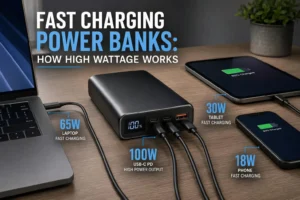
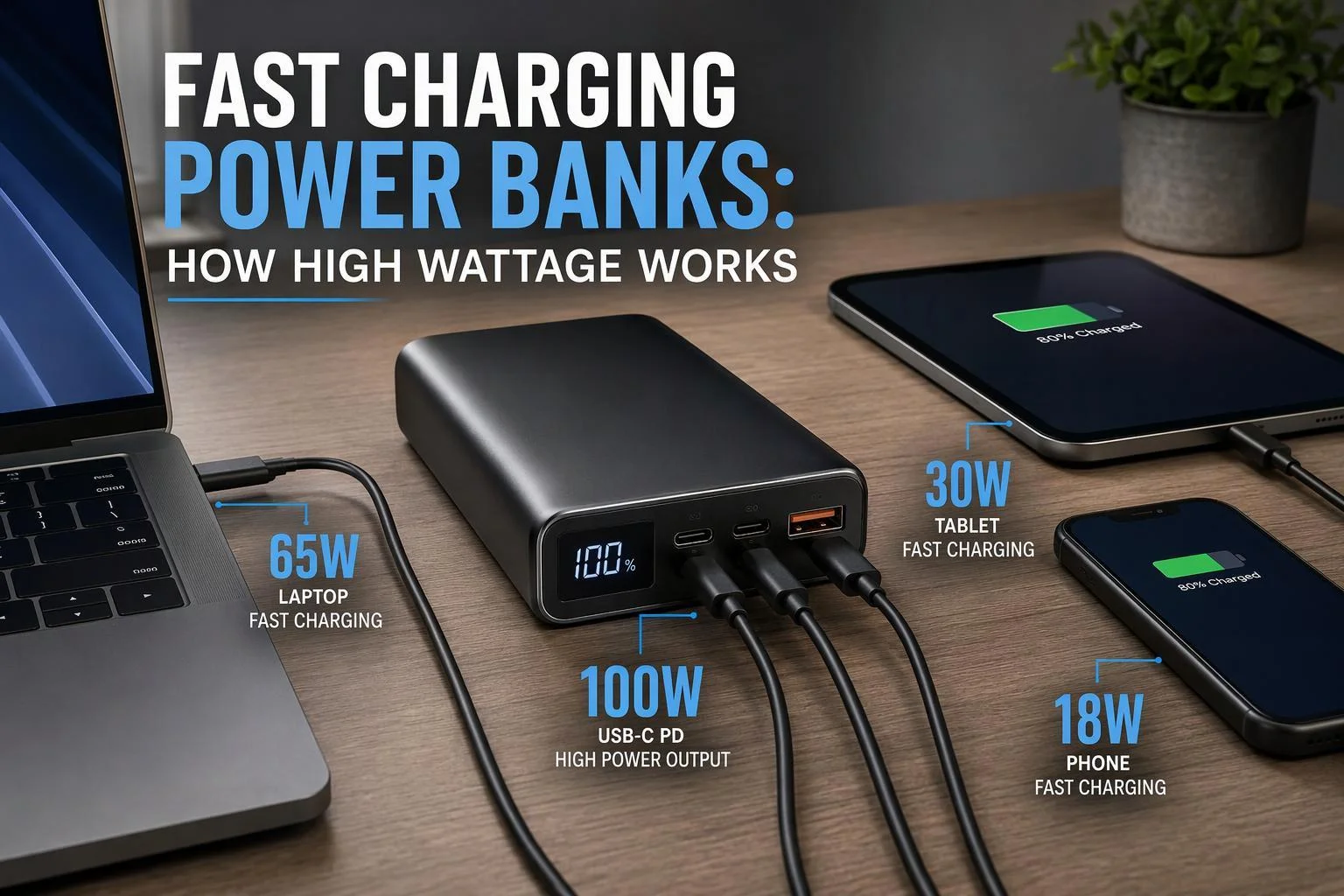
The practical consequence is that higher advertised wattage does not automatically mean faster charging. A 100W port feeding a phone that accepts 25W will run at the phone’s ceiling, not the port’s. A PD-only charger paired with a PPS-dependent Galaxy will fast-charge, but not at the phone’s peak PPS rate.
This is where most buying decisions go wrong. A channel that stocks the best fast charging power bank for its own market is usually not the one with the biggest number printed on the box; it is the one whose protocol list matches the phones its customers actually carry. When you compare SKUs, read the protocol list and the per-port voltage and current table first, and treat the headline wattage as a summary rather than a promise.
How High-Wattage Power Banks Deliver Faster Charging
Getting 100W or more out of a pocket-sized pack is a chain of conversions, and every link costs energy. The sections below follow that chain from cell to connector, then look at what each output tier is actually for.
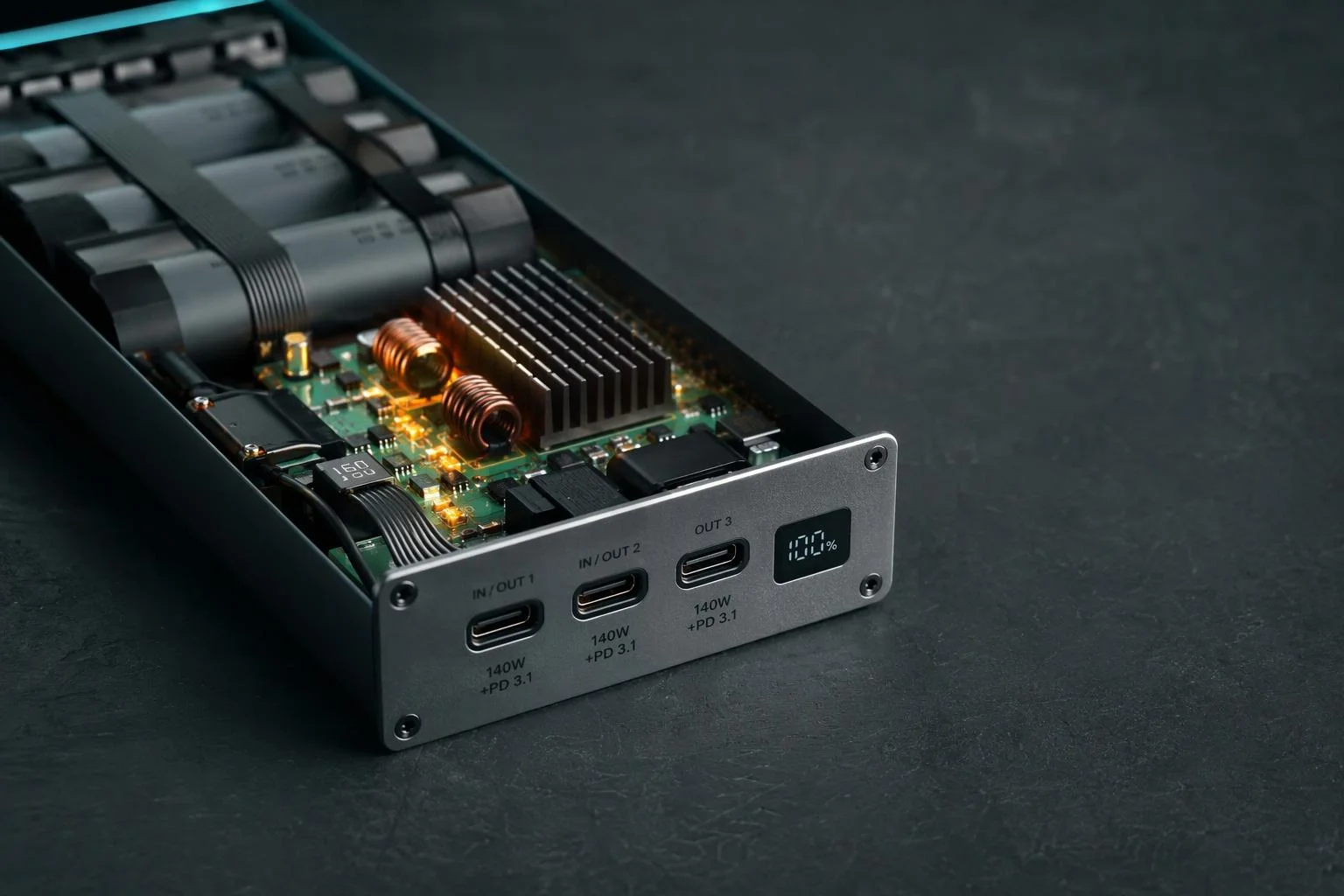
From Battery Cells to USB-C Output
Lithium cells store energy at their own nominal voltage, typically around 3.7V to 3.85V per cell, while USB-C PD may ask for 5V, 9V, 15V or 20V. A DC-DC conversion stage steps the cell voltage up or down to whatever the negotiation settles on, and the battery management system (BMS) supervises cell voltage, current and temperature throughout. Conversion is never free: some energy leaves as heat, which is why conversion efficiency and thermal design are inseparable. A pack that converts efficiently runs cooler and delivers more of its rated capacity to the device.
Understanding 22.5W, 65W, 100W, and 165W Power Banks
Taken at face value, each tier maps to a buyer segment. A 22.5W fast charging power bank covers phones and small accessories; 65W handles most thin-and-light laptops and tablets; 100W takes on larger laptops and quick self-recharge; 165W and above is a multi-device ceiling rather than a single-port figure.
That last point deserves more attention than it usually gets. Take the Anker 25,000mAh model: total output is 165W, yet each USB-C port and the built-in cable stop at 100W, and the 165W figure only applies when two USB-C ports share the load, falling to 130W with three or four devices connected (Anker product page).
The label on a 22.5W SKU carries the same ambiguity in reverse. Most 22.5W models run a 9V/2.25A or 10V/2.25A step over USB PD, and a Galaxy phone that accepts a 9V PD input will charge at that level. What it won’t do is display Samsung’s “Super fast charging” status, because that 25W tier runs over PD with PPS at a finer voltage granularity than a fixed 9V step provides. So the phone charges faster than a 5V/2A brick would, just not at the PPS ceiling. That distinction decides whether a unit is positioned as a compatible phone charger or a Samsung portable charger fast charge claim your retail partners can honestly repeat.
Why Actual Charging Speed Can Be Lower Than Advertised Wattage
Five factors routinely pull real charging below the label. The device caps its own intake, often well under the port’s maximum. The cable may not be rated for the current the port wants to push. The protocol handshake may settle on a lower tier than either side could theoretically reach. Temperature derates the system, and Samsung notes that charging speed may be reduced when the charger or device heats up (Samsung support).
The fifth is the one distributors most often miss: multi-port allocation. A pack rated at 100W total across three ports may give any single port 100W only when nothing else is plugged in. Once a second device connects, the controller re-splits the budget, and the laptop in the room can drop from 100W to 45W or lower without any warning on the screen. Ask for the allocation table, not just the total.
High Capacity Charger vs. High-Wattage Power Bank: What Is the Difference?
The two terms get used interchangeably in trade listings, but they describe different axes of performance. A high capacity charger is judged by how much energy it stores; a high-wattage power bank is judged by how quickly it can move that energy out. A product can be strong on one and ordinary on the other, and buyers who conflate them end up with SKUs that disappoint either on runtime or on charge speed.
One label line does most of the work here. Watt-hours are computed from cell capacity and nominal cell voltage (Wh = mAh ÷ 1,000 × V), and that figure, not the mAh number, drives air freight and carry-on rules.
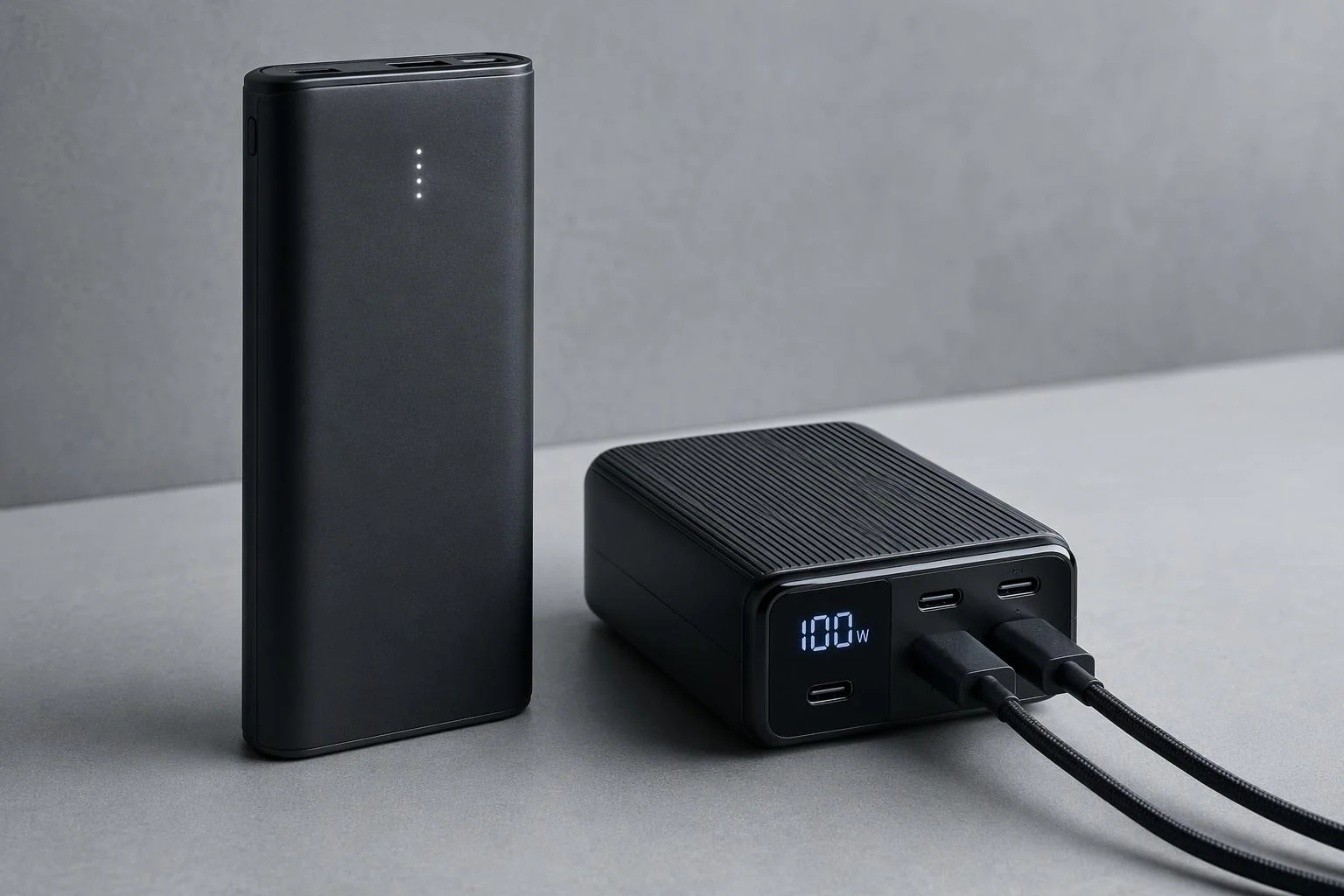
Battery Capacity (mAh) vs. Charging Output (W)
Milliamp-hours describe charge stored at the cell’s nominal voltage; watts describe how fast it moves out. A 10,000mAh pack at 3.85V rates at 38.5Wh, which is why two 20,000mAh SKUs from different factories can land in different watt-hour bands. Advertised capacity is also cell capacity, not deliverable energy at USB voltage — conversion losses mean usable output is lower.
Wh is what aviation rules read. IATA guidance allows packs up to 100Wh in carry-on baggage generally, with 100–160Wh subject to airline approval (IATA). Verify the label value for each SKU rather than assuming it from mAh. Capacity and speed remain independent specs: a large pack with a modest output runs long and charges slowly, which is a perfectly good product for the right shelf.
How Capacity and Wattage Affect Product Applications
10,000mAh packs stay pocketable and suit phone-first retail; 20,000mAh adds tablet and laptop headroom at roughly double the weight; 25,000mAh approaches the 100Wh line and targets laptop-adjacent channels. Pair each with the right output tier: a 10,000mAh unit at 22.5W is a phone accessory, while a 25,000mAh unit at 100W+ is a workstation backup.
For a high capacity charger listing, the pairing matters more than either number alone. A 20,000mAh pack with a single 18W port sells on runtime but disappoints anyone who expects a fast charge power bank to top up a phone during a commute. A 10,000mAh pack with 65W output is the reverse trade — fast, but only one full phone cycle in reserve.
Engineering Challenges Behind High-Wattage Fast Charging Power Banks
Pushing 100W through a hand-held enclosure concentrates three problems: heat, electrical safety and mechanical wear. Each is a design discipline in its own right, and each shows up in the test data a supplier should be able to produce.
Thermal Management and Temperature Control
Heat comes from two places: the cells themselves under high discharge current, and the DC-DC conversion circuits. Designers respond with thermal sensors placed near both, BMS-driven power regulation that steps output down before limits are breached, and layout choices that spread heat away from the user’s hand. Continuous high-load temperature-rise testing is the check that matters: run the pack at its rated output into a load for an extended period and log where temperatures settle, rather than measuring a brief peak.
Battery Protection and Electrical Safety
A working BMS covers overvoltage, overcurrent, overtemperature, short-circuit and overcharge protection, cutting output or input when any threshold is crossed. Protection is only as reliable as the cells it monitors: mixed cell batches with inconsistent internal resistance can cause one cell to work harder and heat faster than its neighbours. Buyers should ask how incoming cells are graded and matched, and whether BMS validation is documented per model rather than per factory.
USB-C Port and Cable Durability
At 5A, contact resistance in the connector and cable becomes a real heat source, which is why cable current ratings must match the port’s maximum. Insertion and removal cycle testing simulates years of daily plugging and checks that contact resistance stays within limits rather than degrading silently. Built-in and retractable cables add a second wear path: the retraction mechanism and strain relief at the cable exit need their own mechanical cycling, since a failed internal cable takes the whole pack out of service.
How Manufacturers Test Fast Charging Power Banks Before Mass Production
Testing is where a specification sheet becomes a shippable product, and it’s where a purchase order either holds or quietly drifts. The checks below are the ones that separate a consistent batch from a lucky sample.
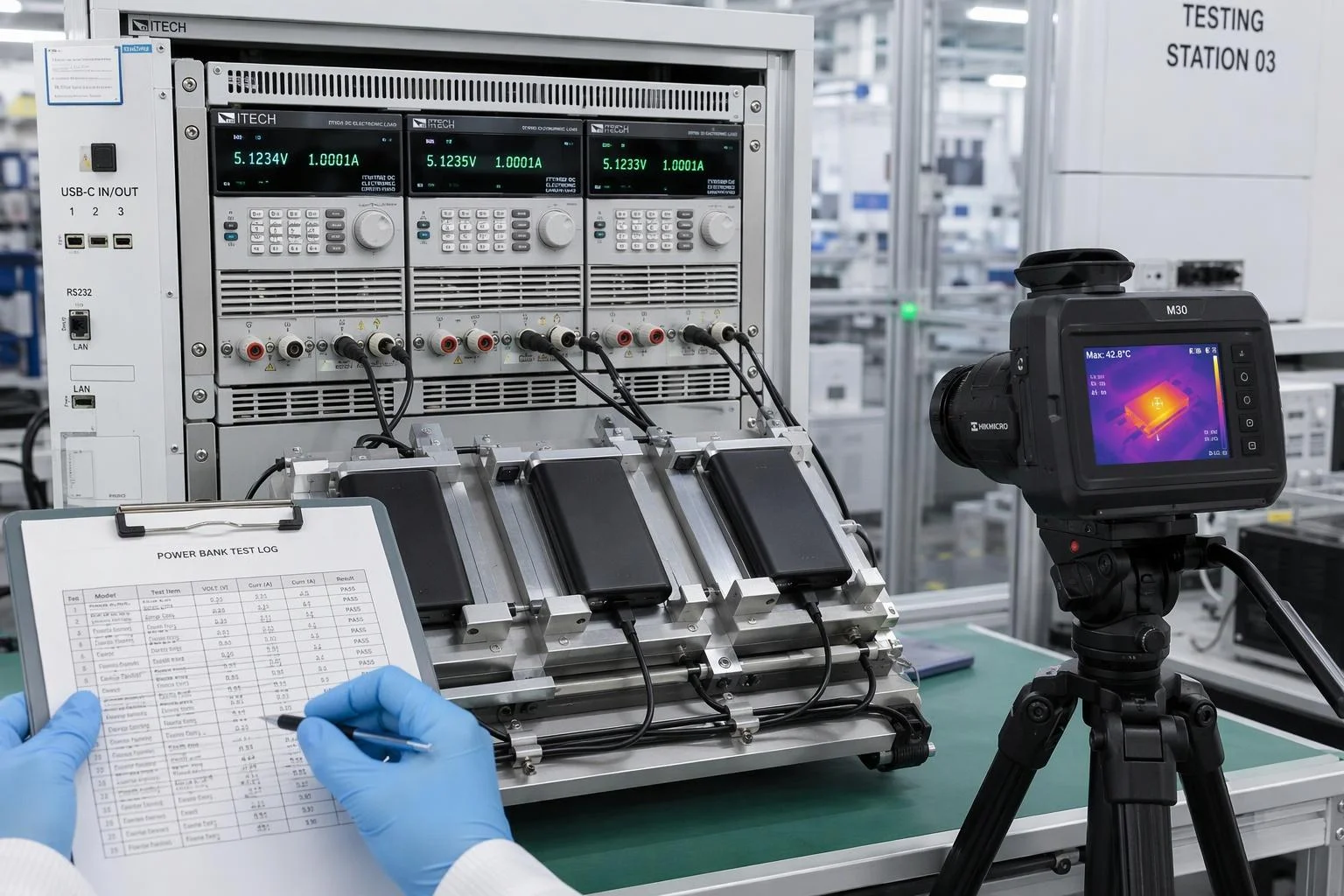
Output Power and Charging Efficiency Tests
Electronic load testing draws controlled current at each advertised voltage step and records actual output against the rating. Voltage and current verification confirms the port holds its negotiated level under load rather than sagging, and output stability checks for ripple and drift over time. Protocol testing repeats the handshake across PD, PPS and QC to confirm each mode triggers, and multi-port load conditions verify that allocation behaves as documented when several devices draw at once.
Thermal, Drop, and Reliability Testing
Temperature-rise tests under sustained load, product drop tests from defined heights onto defined surfaces, repeated charge/discharge cycles and connector durability runs together build a reliability picture. The value to a buyer is in the records: per-batch test logs let you compare one shipment against the next and spot drift before it becomes a field failure. Ask for the raw data, not just a pass certificate.
OEM Quality Control and Packaging Inspection
Incoming cell inspection grades capacity, internal resistance and appearance before cells enter the line, and in-process checks catch assembly faults early. For private-label orders, logo placement, packaging colour consistency and printing colour difference are inspected against the approved sample, since a shade shift on a retail box is a visible quality signal. Packaging drop tests and moisture-resistant packaging protect goods through international freight, and batch inspection with a pre-shipment quality report gives the buyer a documented release point before the container ships.
How to Choose the Best Fast Charging Power Bank for Wholesale and Distribution
Selection comes down to three decisions: which wattage tier fits your market, whether the compliance file matches the SKU, and whether the supplier can hold quality across repeat orders.
Match Wattage to Your Target Market
22.5W and 30W models suit phone-led channels at a low landed cost, and most carry a PD 9V step that works with iPhone fast charging and standard Galaxy PD charging. Be careful with retail copy here: a 22.5W unit is not a Samsung 25W Super Fast Charging match, so position it as fast charging for iPhone and Android, not as a 25W SFC equivalent. If your shelf needs the SFC claim, specify a PPS-capable SKU at 25W or above.
65W and 100W units belong in laptop-adjacent retail, where buyers pay for a port that can genuinely top up a MacBook Air or a USB-C notebook while a phone shares the load.
Evaluate Certifications and Product Compliance
UN38.3 covers transport, and IEC 62133-2 sets safety requirements for portable lithium cells and batteries under intended use and reasonably foreseeable misuse (IEC 62133-2). Destination requirements vary, so match each certificate to the exact SKU and model number on the invoice rather than to the product family name. A certificate naming a sister model is not a compliance file for the unit in your container.
Compare OEM and ODM Manufacturing Capabilities
Compare suppliers on cell grade, port layout, cable design, logo printing and packaging customization, then confirm sample approval, mass-production consistency, lead time and after-sales terms in writing.
A short practical checklist keeps these requests comparable across vendors:
Per-port output table — what each port delivers alone and with one, two or four devices connected
Protocol list per model — PD, PPS, QC and anything proprietary, tied to the model number
Sample evaluation on your own devices — test with the phones and laptops your market actually carries, not with a demo unit
Batch consistency records — capacity and internal resistance from incoming cell inspection across consecutive lots
Packaging proof — retail box artwork, colour consistency against the approved sample, drop test results
MOQ and lead time — quoted per configuration, with tooling and artwork approval time separated from production time
JOYROOM’s power bank line-up covers the tiers above, from 22.5W pocket models to the 240W PODIX PR70, and OEM/ODM configurations, MOQ and lead time are quoted per project, so it’s worth sending your target spec before requesting samples.
Frequently Asked Questions About Fast Charging Power Banks
Short answers to the specification questions buyers and retail staff ask most often.
What Is the Fastest Wattage for a Portable Power Bank?
There’s no single ceiling. USB PD 3.1 defines delivery up to 240W over USB-C, and JOYROOM’s PODIX PR70 is rated at 240W total output with a 25,000mAh capacity. That 240W is the pack’s aggregate figure across its ports, not a per-port rating: the Type-C2 cable outputs up to 140W and Type-C1 and Type-C3 up to 100W each. In practice, the device’s accepted input sets the real rate. A phone requesting 25W will draw 25W from a 240W bank.
Is a 22.5W Fast Charging Power Bank Good Enough for Smartphones?
For iPhone, generally yes. A 22.5W unit with USB PD delivers 9V/2.22A or 10V/2.25A steps that sit above Apple’s fast-charging threshold, so a fast charging power bank for iPhone buyers is a good fit at this tier. Android is more nuanced: a 22.5W pack will charge a Galaxy phone at its PD rate, but Samsung’s 25W Super Fast Charging only appears when the charger supports PD with PPS and the cable is rated for the current. Without PPS, expect solid PD charging, not the SFC badge.
Do Samsung Phones Need a Special Charger for Super Fast Charging?
Yes — for the full rate, they do. Samsung’s own guidance ties Super Fast Charging to USB PD with PPS, and notes that a charger with a high maximum output can still fail to trigger it if PPS is missing. For 25W, a 3A USB-C cable is the baseline; the 45W Super Fast Charging 2.0 tier calls for a 5A E-marked cable. That’s the detail to check when you list a Samsung portable charger fast charge claim: protocol, cable rating and phone model, in that order.
Does a 165W Power Bank Charge Phones Faster Than a 65W Model?
Usually not. A phone negotiates only what it can accept, often 25–45W, so both units top it up at the same rate. The extra headroom earns its place when a laptop and a phone share the pack, or when you need fast self-recharge between shifts.
What Should You Look For in a Fast Charging Power Bank for iPhone?
USB PD support and at least 20W available on the port you’ll use. Apple’s fast-charging guidance for USB-C iPhone models centres on a USB-C PD charger and cable, and a wired charger giving 7.5W or less charges noticeably slower. PPS is not an Apple requirement, so paying extra for PPS on an iPhone-only channel adds no benefit. Port count and capacity should follow how customers use the device — phone-only buyers rarely need 25,000mAh.
Which Power Bank Configuration Suits Android Users?
Most Android brands layer proprietary fast-charge schemes over or alongside PD, so a PD + PPS + Quick Charge combination covers the widest field.
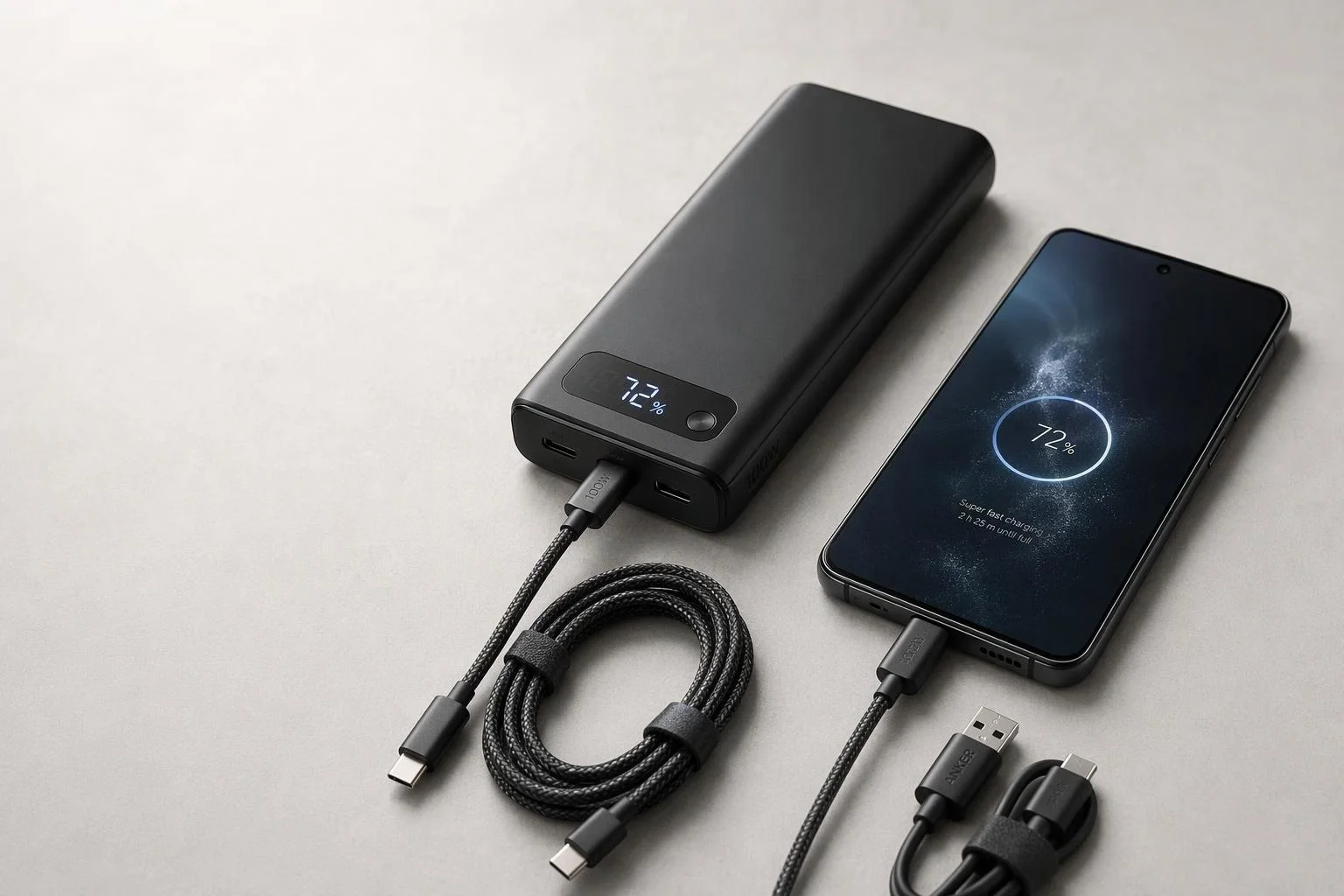
Check the proprietary protocols that matter in your region against the protocol list on the SKU, and confirm the per-port table holds those rates when two devices are attached.
Can a High-Wattage Power Bank Charge Laptops?
Yes, provided the individual USB-C port sustains the laptop’s required wattage. A 65W or 100W port covers most ultrabooks and thin-and-light notebooks; a 140W port on a model like the PR70 handles high-draw laptops. A higher total rating doesn’t help if the laptop’s port is allocated only 45W once a phone is plugged in.
Does Higher Wattage Reduce Power Bank Battery Life?
Higher current raises cell heat, and sustained heat accelerates aging. A well-designed bank manages this through thermal sensing and BMS-driven power regulation, so wattage alone doesn’t determine longevity — cell grade, heat spread and how often the pack runs at maximum output matter more.
Conclusion
Wattage is the headline number, but it is not a performance verdict. A fast charge power bank delivers real speed only when its protocols match the device, its output stays stable under load, its thermal design holds temperature in check, and its protection circuits and cell consistency survive volume production. Two units printed with the same 65W can behave very differently on a customer’s desk, and that difference shows up later as returns, chargebacks and lost shelf space.
That is why the specification sheet is only the start of a sourcing decision. Ask for the protocol list, the per-port allocation logic, the temperature-rise and insertion-cycle records, and certificates that name the exact model. A high capacity charger paired with a weak BMS is a liability; a modest 22.5W unit built to consistent standards is an asset that keeps a channel quiet.
JOYROOM’s power bank line-up runs from 22.5W pocket models to the 240W PODIX PR70, with several configurations aimed at different channels. The PR70 pairs 240W total output and 25,000mAh with dual TFT displays, built-in dual cables and support for up to four devices at once. The PC50 steps up to 100W over USB-C with PPS support. For phone-led retail there are 22.5W units such as the JR-PC1 and JR-PC2, retractable-cable designs like the JR-PR1, and dual-built-in-cable models including the JR-PBF27 series.
For distributors and importers, the practical next step is to shortlist two or three configurations against your target market, request samples plus the matching test reports and certificates for those exact model numbers, then test each unit on the phones and laptops your customers actually carry. From there, our team can discuss OEM/ODM customization, packaging, MOQ and lead time for your region.