

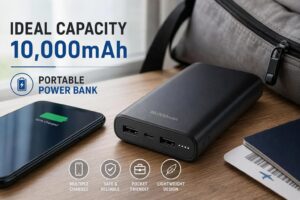

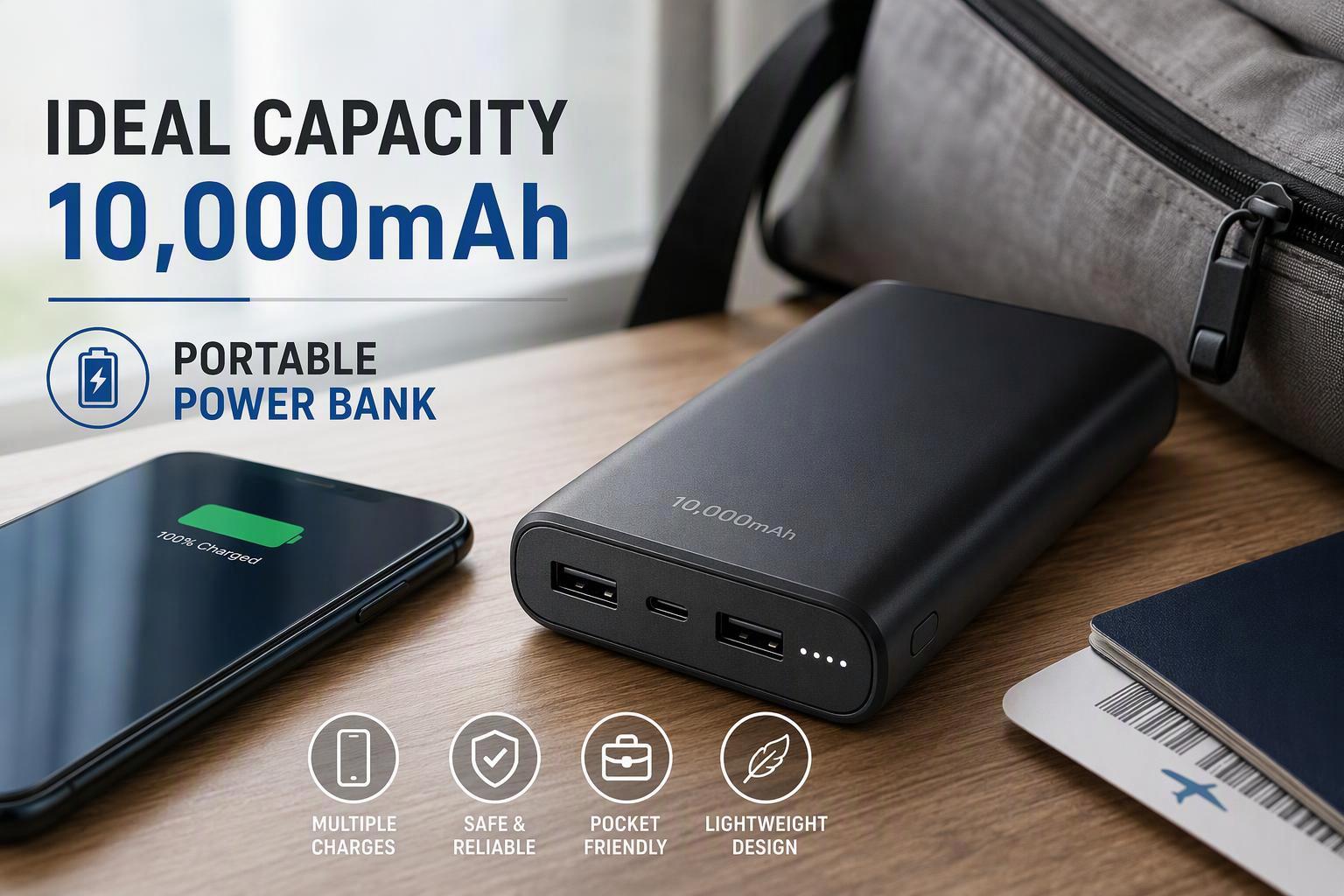
A buyer comparing quotes for a 10000mAh power bank usually runs into the same gap: the spec sheet says 10,000mAh, the sample tests lower, and the retail price sits in a band where a 500mAh shortfall is enough to trigger returns. This guide works through what that capacity actually delivers, how it compares with 5,000mAh and 20,000mAh options, and what to check before committing to a bulk order.
It is written for importers, distributors and private-label owners who need to qualify a SKU once and defend it across several channels.
Specifications below come from published product data and manufacturer documentation; where a figure depends on the model, the condition is stated.
Why Is a 10,000mAh Portable Power Bank the Ideal Balance of Capacity and Portability?
Is a 10000mAh Power Bank Good for Everyday Charging?
For most smartphone users, yes. A 10000mAh power bank carries roughly 37Wh of stored energy at a nominal 3.7V cell voltage, which translates into one to two full phone charges after conversion losses. That covers a commute, a long workday away from a desk, or an evening out without a wall socket.
The capacity also sits comfortably under the 100Wh threshold that governs air travel, so a passenger can carry it in the cabin without operator approval. For a retailer, that combination of adequate daily power and unrestricted portability is what keeps the SKU moving.
Small Power Bank vs. High-Capacity Battery Pack: Balancing Size, Weight, and Power
Weight is where the trade-off becomes visible on a shelf. Many 10000mAh portable chargers land between 190g and 250g, light enough for a jacket pocket and small enough to disappear in a bag. A 20,000mAh unit typically doubles that weight and adds noticeable thickness.
The higher-capacity pack wins on total energy, but it loses on the decision most consumers actually make in store: whether the device is worth carrying every day. A small power bank that travels unnoticed gets used more often, and repeat use is what builds category loyalty.
Why 10K Power Banks Appeal to Consumers, Retailers, and Distributors
Consumers pick the 10k power bank because it solves a daily problem without demanding a lifestyle change. Retailers like it because it occupies a mid-price slot that converts across income levels and needs little explanation at the counter.
Distributors have a different reason: a single capacity tier simplifies inventory. One power bank 10000mah platform can be dressed into several SKUs through color, cable configuration and packaging, which reduces the number of distinct battery platforms a warehouse has to hold.
What Makes a Portable 10000mAh Power Bank a Practical Choice for Modern Mobile Users?
Modern phones carry larger batteries than they did five years ago, but screen time and 5G radios have grown faster. A portable 10000mah power bank bridges that gap without the bulk of a travel battery.
It also fits the accessory pattern most users already follow: one cable, one pocket, one device. Products that add a built-in cable or a magnetic mount remove a step from that routine, and removing steps is what separates a repeat purchase from a one-off.
How Many Times Can a 10000mAh Power Bank Charge a Smartphone?
Understanding Rated Capacity vs. Actual Usable Output Capacity
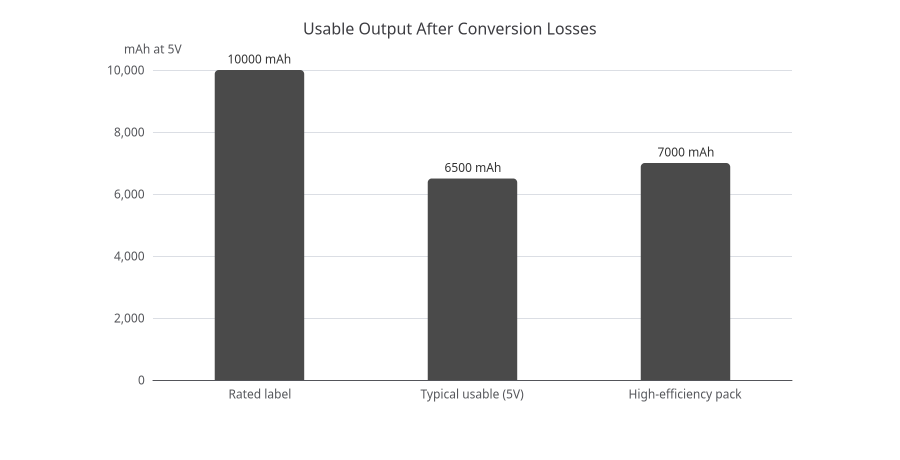
The printed 10,000mAh is cell capacity, measured at the internal 3.7V. USB output runs at 5V, and the boost conversion consumes energy, so usable output is always lower than the label.
Manufacturer guidance commonly puts typical usable output at roughly 60% to 70% of rated capacity after voltage conversion and efficiency losses. On a 10,000mAh pack that works out to about 6,000mAh to 7,000mAh delivered at 5V. JOYROOM’s own JR-QP191 listing follows the same logic, stating a 10,000mAh 3.7V cell (37Wh) alongside a rated capacity of 6,000mAh at 5V/3A and an energy conversion rate of at least 80%.
That second number, not the first, is what determines how many charges a customer actually gets. Ask for it in writing.
How Many Times Can a 10000mAh Power Bank Charge an iPhone or Android Phone?
With 6,000mAh to 7,000mAh of usable output, the arithmetic depends on the phone. A device with a 3,500mAh to 4,000mAh battery lands at roughly 1.5 to 2 charges; a 5,000mAh phone lands closer to one full charge plus a partial top-up.
That matches the one-to-two-charge range most brands quote for this capacity class. JOYROOM lists the JR-QP191 at up to two full charges for an iPhone 16. Both figures assume a healthy cable and a phone that is not running heavy load during the charge.
10000mAh Power Bank for iPhone: What Buyers Should Know About Charging Efficiency
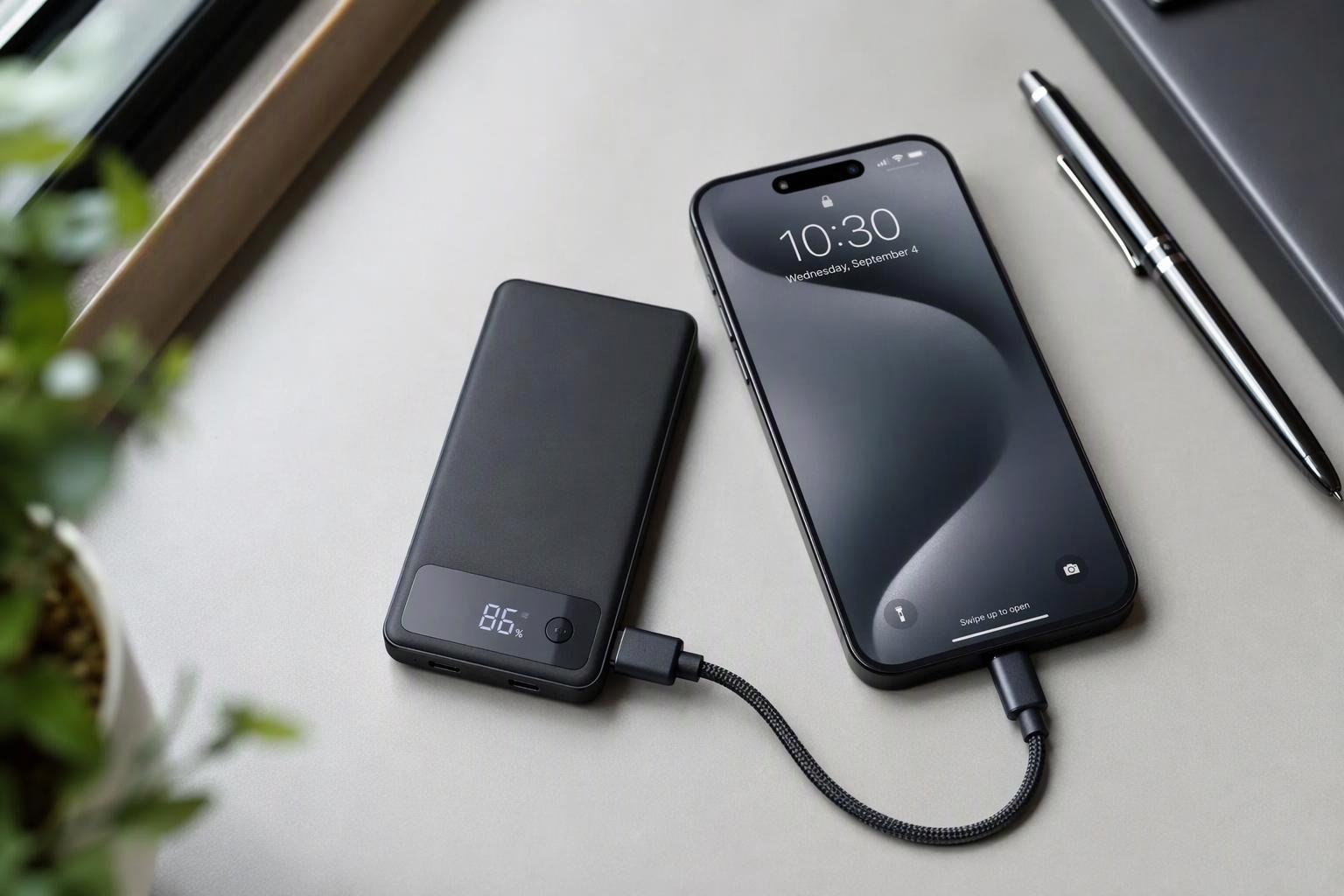
Apple devices negotiate power over USB Power Delivery, so the pack’s PD implementation matters as much as its capacity. A pack that advertises 20W PD will charge a recent iPhone at a useful rate; one limited to 5V/2.4A will not.
There is also a physical constraint. Wireless charging adds a second conversion step, and every step costs energy. A magnetic 10,000mAh pack that delivers 15W wirelessly will return fewer net charges than the same cells wired through USB-C.
Why Conversion Losses, Cable Quality, and Charging Protocols Affect Real-World Performance
Cable resistance is the quiet culprit in most field complaints. A thin, long or worn cable drops voltage, the phone draws less current, and the customer concludes the pack is weak. Cable gauge and connector plating belong in your incoming inspection, not just the pack itself.
Protocol mismatch is the second cause. A phone that supports PPS or a vendor fast-charge standard will fall back to slower 5V charging if the pack does not implement it. Test the actual phone models sold in your market, not a generic load bank — and if a quote claims PD, check which revision it actually implements against the USB-IF Power Delivery specification.
What Makes a Good 10000mAh Portable Charger?
Lightweight Power Bank 10000mAh: Balancing Portability and Battery Performance
A lightweight power bank 10000mah is a design outcome, not a component choice. Cell chemistry, cell format and housing thickness all move the final number, and shaving grams usually means choosing a slimmer pouch cell over a cylindrical one.
That trade-off has a limit. Below roughly 190g, housings tend to lose wall thickness and drop protection. Set a weight floor in your spec and hold the factory to it across production lots.
Mini Power Bank vs. Standard 10000mAh Battery Pack: Which Design Sells Better?
A mini power bank wins on impulse and gift channels, where size is the first thing a shopper notices. A standard 10000mah battery pack wins on specification-led channels, where the buyer compares port counts and wattage.
Neither is universally better. The practical answer is to carry both if your channel mix spans counter retail and e-commerce, and to keep the internal battery platform shared so the supply chain stays simple.
USB-C Fast Charging, 22.5W Output, and Multi-Device Compatibility
22.5W output has become the volume tier for this capacity class. It covers 20W PD for iPhone, 22.5W for Huawei SCP and similar Android fast-charge schemes, and standard 5V charging for accessories.
Protocol coverage is the specification to verify. A pack listing PD3.0, QC3.0, Samsung AFC and Huawei SCP/FCP covers most of the installed base in Southeast Asia, the Middle East and Latin America. Ask for a compatibility matrix against the top twenty phone models in your market.
Built-In Cables, Multiple Ports, and Wireless Charging Options
Built-in cables reduce accessory friction and, from a returns standpoint, remove the most common point of failure. Models with a lanyard-style Type-C cable also eliminate the “forgot the cable” complaint entirely.
Wireless charging adds a premium tier. The Qi2 standard announced by the Wireless Power Consortium in 2023 added a magnetic power profile that aligns the phone and coil for better efficiency and removes port wear, originally at up to 15W. Confirm Qi certification rather than assuming compatibility.
Battery Protection, Temperature Control, and Product Safety
A power bank is a thermal product before it is an electrical one. Over-temperature, over-current, over-voltage, short-circuit and over-charge protection should all be present, and the housing should use flame-retardant PC+ABS rated to UL94-V0.
Ask for the protection IC part numbers and the temperature cutoff thresholds. A factory that cannot name them is assembling, not engineering.
Digital Displays, Remaining Battery Indicators, and Other User-Focused Features
A four-LED indicator is the minimum; a digital percentage display is now the differentiator at mid-tier. The display also reduces warranty claims, because customers stop guessing whether the pack is charged.
Low-current mode matters more than most buyers expect. It lets the pack charge earbuds and smartwatches without the auto-shutoff that small loads trigger on older designs.
Mini Power Bank vs. Small Portable Charger: How Compact Can a 10000mAh Power Bank Be?
What Defines the Smallest 10000mAh Power Bank in Today’s Market?
The smallest 10000 mah power bank on the market today sits near 17mm thick and around 190g to 200g, with a footprint close to a credit card plus a few millimeters. JOYROOM’s JR-QP191 measures 116 × 70 × 17mm at 194g, which is a useful benchmark for the class.
Anything materially smaller usually means a lower true capacity or a thinner housing. Treat extraordinary size claims as a prompt to request a teardown photo and a capacity test report.
Mini Portable Charger vs. Small Power Bank: Size, Weight, and Usability Trade-Offs
A mini portable charger optimizes for pocket carry; a small power bank optimizes for ports and output. The mini design often drops to a single output and a smaller display to hit its dimensions.
For a distributor, the question is which compromise your customer notices. Commuters notice weight; multi-device households notice port count. Stock accordingly rather than trying to satisfy both with one SKU.
Why Battery Dimensions, Internal Layout, and Housing Materials Matter
Pouch cells can be shaped to fill a housing efficiently, which is how slim packs reach 10,000mAh without bulk. Cylindrical 18650 cells are cheaper per watt-hour but constrain the form factor.
The housing material then decides durability. PC+ABS with flame retardancy adds cost over plain ABS, but it is the difference between passing a drop test and shipping a cracked unit back.
How to Evaluate the Lightest 10000mAh Power Bank Without Sacrificing Performance
Weigh the sample, then run a discharge test at a fixed load and compare delivered watt-hours against the claim. A lightest 10000mah power bank that delivers 60% or more of its rated capacity is performing within the normal band.
Then check the mechanical side: connector insertion cycles, drop height, and housing flex. Weight reduction that comes from thinner walls shows up here first.
Is a Small 10000mAh Power Bank More Practical Than a Mini 5000mAh Portable Charger?
A 5000mah mini portable charger power bank for phone is lighter still, often under 130g, but it typically delivers less than one full charge to a modern phone. That is enough for an evening, not for a full day out.
The 10,000mAh tier costs more and weighs more, yet it removes the anxiety of a second charge. For most markets, the 10,000mAh version is the volume seller and the 5,000mAh is the add-on.
5000mAh vs. 10000mAh vs. 20000mAh Power Bank: Which Capacity Is Best?
5000 vs. 10000mAh Power Bank: Comparing Portability and Daily Charging Needs
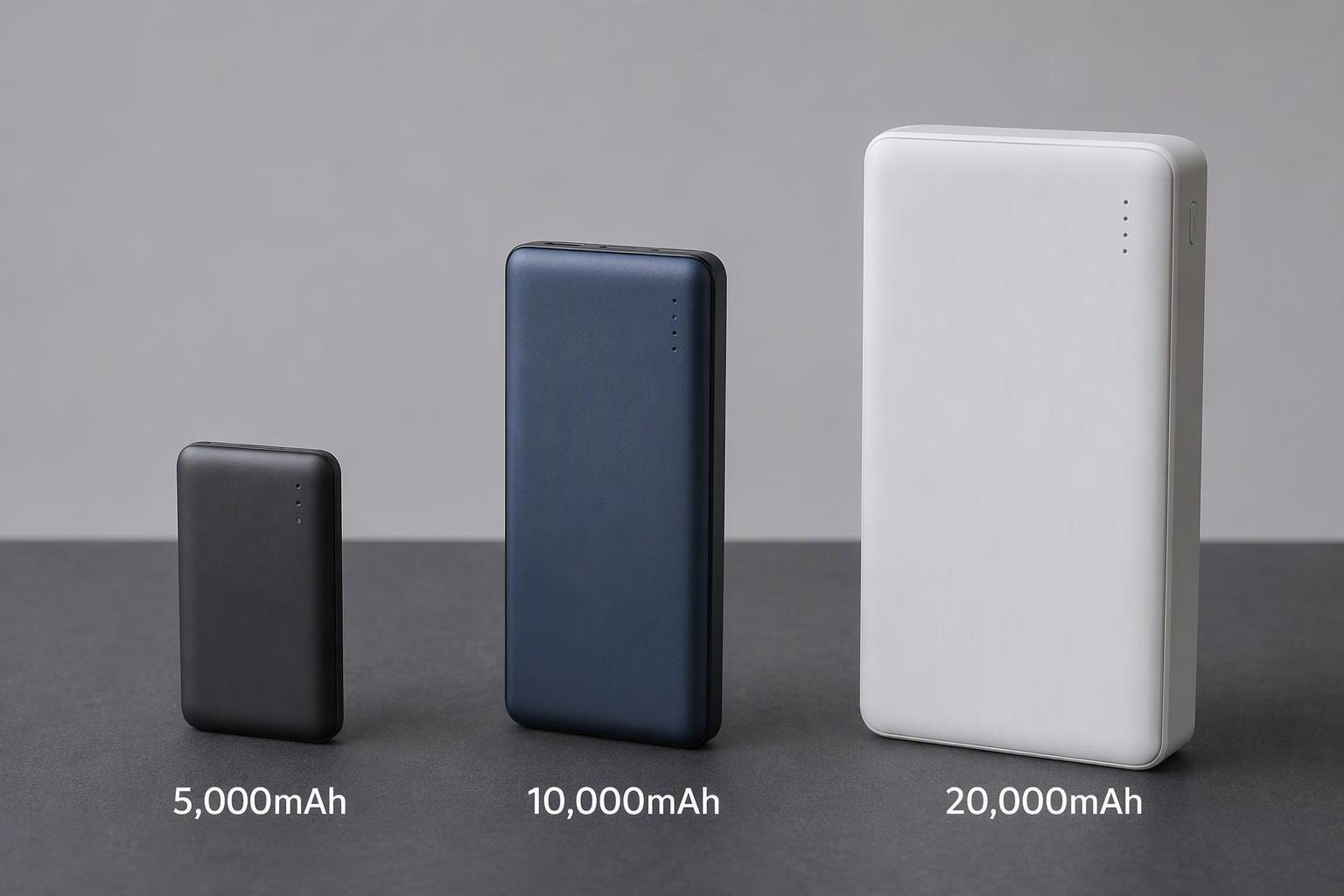
The 5000 vs 10000 mah power bank comparison comes down to one question: does the user need more than one charge per outing? At 5,000mAh, usable output lands near 3,000mAh to 3,500mAh, which is a partial refill for most phones.
At 10,000mAh, the same user gets a full charge plus a second partial one. The weight penalty is roughly 70g to 100g, which most buyers accept once they understand the difference.
10000 vs 20000mAh Power Bank: Capacity, Weight, and Travel Convenience
A 10000 vs 20000 mah power bank decision usually tracks trip length. The 20,000mAh tier delivers three to four phone charges and can top up a tablet, but it weighs 330g to 450g and takes noticeably longer to recharge.
Both remain under the 100Wh cabin limit, so air travel does not force the choice. Portability and recharge time do.
When Should Buyers Choose a 10000mAh Portable Battery Charger Instead of a Higher-Capacity Model?
Choose the 10000mah portable battery charger when the end user carries the pack daily rather than occasionally. Daily carry rewards low weight and fast recharge; occasional use rewards raw capacity.
A second trigger is channel fit. Where shelf space is tight and price sensitivity is high, the 10,000mAh tier sits in the sweet spot between margin and volume.
Comparing Charging Cycles, Recharge Time, and Retail Price Positioning
Recharge time scales with capacity. A 10,000mAh pack at 18W input refills in roughly two to three hours; a 20,000mAh unit at the same input takes twice as long, and that difference shows up in reviews more often than capacity complaints do.
So don’t brief buyers on milliampere-hours alone. Give them delivered capacity, recharge time, weight and landed cost side by side, then map each tier to a segment: 5,000mAh for gift and promo programs where unit cost dominates, 10,000mAh for commuters, students and business travelers, 20,000mAh and up for outdoor users and tablet owners.
That mapping keeps the range from cannibalizing itself and hands sales staff a script for the counter.
Which Features Make a 10000mAh Power Bank Competitive in the Market?
USB-C Power Delivery and Fast-Charging Performance
USB PD is the baseline for cross-device compatibility. The specification now spans up to 240W over USB-C, though a 10,000mAh pack realistically operates in the 18W to 30W range.
What matters for procurement is bidirectional support. Dual Type-C ports that accept input and output let the pack recharge and discharge through the same connector, which simplifies the accessory bundle.
Mini Portable Power Bank Designs With Built-In Cables
A mini portable power bank with an integrated cable removes the most common failure point in the customer’s daily routine. Lanyard-style Type-C cables that double as a carry strap are a practical variant for travel retail.
Check the cable’s bend life and connector retention in the sample report. Built-in cables that fail turn a convenience feature into a warranty liability.
Wireless Charging and Magnetic Attachment Options
Magnetic attachment has moved from premium novelty to expected feature on iPhone-oriented SKUs. The Qi2 standard specifies 15W magnetic charging with alignment that improves efficiency and reduces heat.
For Android-heavy markets, the value proposition is weaker. Match the wireless feature to the phone mix in your region rather than adding it across the whole line.
Small Portable Battery Charger Designs for iPhone and Android Devices
A small portable battery charger built for iPhone usually leads with Lightning or USB-C PD and a magnetic ring. Android-focused designs lean on 22.5W SCP or PPS support instead.
Where a market is mixed, a dual-protocol pack covers both. The cost difference is small; the assortment simplification is not.
How to Compare Specifications, Certifications, and Warranty Terms
Compare delivered capacity, not label capacity, then line up warranty terms in the same table. A one-year warranty with buyer-paid return freight costs differently than a two-year warranty with DOA replacement, and that gap belongs in your landed-cost model rather than in a footnote.
Certification scope gets its own check in the wholesale section below, because a certificate that names the wrong model fails inspection no matter how good the pack performs.
Which Applications Are Best Suited to a 10000mAh Portable Power Bank?
Small Portable Charger for iPhone and Everyday Smartphone Users
A small portable charger for iphone sells on convenience: it fits a pocket, charges over USB-C PD, and needs no cable if it has a built-in connector. That combination is what drives repeat purchase in the accessory aisle.
Position it as a daily-carry item rather than an emergency device. The framing changes how much the customer is willing to pay.
Mini Portable Battery Charger for Commuting, Office Use, and Short Trips
A mini portable battery charger earns its place in a bag during a commute or a meeting-heavy day. The use case is a top-up between outlets, not a full off-grid weekend.
Office and campus channels respond well to slim designs with a digital display, because the pack lives on a desk and appearance matters.
Portable 10000mAh Power Bank for Tablets, Wireless Earbuds, and Other USB Devices
A portable 10000mah power bank can top up a tablet, though not fully recharge a large one. Low-current mode is the feature that makes it useful for earbuds and smartwatches, which otherwise trigger auto-shutoff.
Multi-port output lets one pack serve a phone and a pair of earbuds at once. That is a meaningful selling point for families and shared-device households.
Travel-Friendly Battery Packs for Business Trips and Outdoor Activities
For air travel, the rules are specific. IATA’s passenger guidance on lithium batteries limits passengers to two power banks not exceeding 100Wh each, carried in the cabin and never in checked baggage, and the FAA PackSafe rules for spare lithium batteries require power banks to travel as carry-on only, with airline approval needed above 100Wh.
A 10,000mAh pack at roughly 37Wh to 38.5Wh sits well inside those limits. Print the Wh rating on the housing; inspectors look for it.
Corporate Gifts, Promotional Products, and Branded Power Bank Programs
A 10000mah power bank is a workable corporate gift because it is used, not stored. Logo printing on the housing and a branded gift box turn it into a marketing item with a long exposure window.
Keep the customization simple for gifting programs: one or two housing colors, a single print location, and standard packaging. Complex customization raises MOQ and lead time in ways that rarely pay back on a gift order.
What Should Wholesale Buyers Look for in a 10000mAh Power Bank Manufacturer?
Battery Cell Quality, Capacity Consistency, and Production Reliability
Cell quality determines everything downstream. Ask which cell supplier the factory uses, whether cells are graded A, and what the incoming inspection rejects. Capacity spread across a production lot should sit within a narrow band, typically a few percent.
Consistency matters more than peak performance. A pack that delivers 6,300mAh every time is easier to support than one that swings between 5,800mAh and 6,900mAh.
OEM and ODM Customization: Logo Printing, Housing Design, and Packaging
OEM and ODM work splits into tiers: stock unit with logo, stock unit with custom packaging, modified housing, and new tooling. Each tier carries its own MOQ and lead time, and the jump between them is steep.
Ask for the MOQ at each tier before designing the program. The answer usually reshapes the plan.
USB-C PD, Fast-Charging Protocols, and Device Compatibility Testing
Compatibility testing should cover the phone models actually sold in your market, not a generic reference list. Request the test log with model names and measured wattage.
Protocol support is where cheap units cut corners. A pack that claims PD but delivers only 5V under negotiation will generate returns that cost more than the savings.
Safety Certifications, Compliance Documentation, and Quality Control Procedures
Certification scope is the detail buyers miss. UL 2056 addresses the finished power bank as a product category, IEC 62133-2 covers the lithium cells and battery pack, and UN 38.3 governs transport by air and sea — three different documents that answer three different questions.
Match every certificate to the exact model on the invoice. A factory-level or sibling-model certificate does not satisfy an importer’s duty of care, and customs officers check the model number.
MOQ, Sample Approval, Lead Times, and Bulk Order Management
Sample approval is the control point most buyers underuse. Approve the sample against a written specification sheet, then require the production lot to match it, including cell supplier and protection IC.
Lead times should be quoted at the same customization tier as the MOQ. A 15-day lead time for stock units does not apply to a custom-housing order.
How to Evaluate Supplier Pricing Beyond the Unit Cost
Unit price is only one line of landed cost. Freight, duties, certification fees, packaging, and DOA return handling all sit on top, and Incoterms decide who pays which.
Build the landed-cost model before comparing quotes. Two suppliers with a 40-cent gap can reverse positions once freight and warranty exposure are included.
Why After-Sales Support and Warranty Policies Matter for Distributors
Warranty terms define who absorbs the failure. Clarify DOA thresholds, who pays return freight, and how replacements are shipped before the first order, not after the first claim.
A supplier with a clear RMA process and a stated warranty period is easier to defend to your own customers than one that negotiates each claim separately.
How Can Retailers Choose the Best 10000mAh Power Bank for Their Target Market?
Best 10000mAh Power Bank Features for Budget, Mid-Range, and Premium Segments
The budget tier needs reliable 5V/2.4A output, a four-LED indicator and a one-year warranty. The mid-tier adds 20W PD, a digital display and a second port.
The premium tier adds wireless charging, a magnetic ring, a metal or soft-touch finish and a two-year warranty. Each step should be visible on the shelf, or the price gap will not hold.
Choosing Between Mini Power Banks, Built-In Cable Models, and Fast-Charging Designs
Mini designs suit impulse and gift channels. Built-in cable models suit travel retail and commuter-focused stores. Fast-charging designs suit specification-led e-commerce listings.
Carrying all three is viable if they share a battery platform. Carrying three unrelated platforms multiplies your certification and spare-parts burden.
How Packaging, Product Appearance, and Branding Influence Shelf Appeal
Packaging carries the specification story. A front panel that states delivered capacity, wattage and included cable answers the questions a shopper would otherwise ask staff.
Print color consistency is a real procurement issue on branded programs. Request a proof and a production sample before the full run, and specify the color reference in the purchase order.
Matching Product Specifications to Regional Consumer Preferences
Phone mix drives protocol priority. Markets dominated by Huawei and Samsung benefit from SCP and AFC support; iPhone-heavy markets benefit from PD and magnetic charging.
Climate matters too. High-ambient-temperature markets should be specified with a lower thermal cutoff margin, and humid shipping lanes need moisture protection in the export carton.
Building a Profitable Portable Charger 10000mAh Product Portfolio
A workable portfolio is three SKUs: an entry portable charger 10000mah, a mid-tier fast-charging model, and a premium wireless or built-in-cable design. That covers the price ladder without overextending inventory.
Review the portfolio against sell-through each quarter. A SKU that sits below a threshold for two consecutive quarters is capital tied up in a shrinking price band.
Why Choose JOYROOM for 10000mAh Portable Power Banks?
Exploring JOYROOM Portable Power Bank Designs and Product Features
JOYROOM has manufactured mobile accessories since 2009 and sells across more than 130 countries. Its 10,000mAh range covers several design directions rather than a single model.
The JR-QP191 pairs a 10,000mAh cell with 22.5W output, multiple ports and a digital display at 194g. The JR-PBM02 and JR-PBM08 Pro add magnetic wireless charging with a ring grip and stand, and both are listed as flight approved.
Evaluating JOYROOM OEM and ODM Customization Options
Customization runs from logo printing and retail packaging to housing changes and new tooling, with MOQ and lead time scaling at each level. JOYROOM’s OEM/ODM customization services are structured around that tiering rather than a single published minimum.
For buyers who need regional marks, the company supports testing assistance for certifications such as PSE, KC, BIS or UKCA under the client’s brand or importer name.
How JOYROOM Supports Bulk Orders, Quality Control, and Product Development
Production runs across three manufacturing facilities with ISO 9001-certified lines, and products carry a one- to two-year warranty depending on model. JOYROOM was among the first companies to receive CCC certification for power banks in 2024.
Documentation is handled per order. CE, RoHS, FCC, UN38.3 and MSDS files are available for contracted SKUs through the product compliance and certification process, which matters when a customs broker asks for the model-specific report.
Selecting JOYROOM Power Banks for Different Retail and Distribution Channels
The catalog splits by channel need: single-port entry SKUs for price-led shelves, multi-port and built-in-cable models for travel retail, and magnetic wireless designs for iPhone-heavy assortments. The full range sits in the JOYROOM power bank collection, and our bulk import guide for JOYROOM power banks covers the B2B ordering path.
Start with a sample order across two or three tiers, test them against your market’s phone mix, then scale the SKUs that clear your return-rate threshold.
Frequently Asked Questions About 10000mAh Portable Power Banks
Is a 10000mAh Power Bank Good for Everyday Use?
Yes, for most smartphone users: one to two charges, roughly 200g to 250g, and it clears the 100Wh cabin limit.
How Many Times Can a 10000mAh Power Bank Charge a Phone?
Roughly 1.5 to 2 times on a 3,500mAh to 4,000mAh battery, since usable output lands at 6,000mAh to 7,000mAh. Bigger phone batteries pull that number down.
How Much Does a 10000mAh Power Bank Cost?
It varies by market and feature tier, so wholesale pricing only means something when quoted against a written specification and an order volume.
Is a 10000mAh Power Bank Enough for an iPhone?
Yes. Most iPhones get a full refill plus a partial one; PD support decides how quickly.
Can a 10000mAh Power Bank Charge an iPad Mini?
It will top up an iPad mini, not refill a large tablet from empty. Check low-current mode and output wattage.
How Long Does It Take to Recharge a 10000mAh Power Bank?
About two to three hours at 18W input, roughly five hours at 5V/2A.
Is a 10000mAh Power Bank Allowed on Airplanes?
Generally yes, carry-on only. IATA guidance limits passengers to two lithium-ion power banks not exceeding 100Wh, and the FAA applies a 100Wh per battery limit. Some airlines are stricter, so confirm before travel.
What Is the Difference Between a Mini Power Bank and a Standard Portable Charger?
A mini prioritizes pocket size and usually fewer ports; a standard unit prioritizes output and multi-device charging. Both can hold 10,000mAh.
How Long Can a 10000mAh Battery Pack Maintain Its Performance?
Standard cells typically hold about 80% capacity for 300 to 500 cycles; higher-grade cells are rated past 1,000. Storage temperature and depth of discharge shift the outcome.
What Should Buyers Check Before Placing a Bulk Order for 10000mAh Power Banks?
Verify delivered capacity on a sample, match certificates to the exact model, confirm protocol support against your market’s phones, and agree on MOQ, lead time, Incoterms and DOA handling in writing.
Is a 10000mAh Portable Power Bank the Right Choice for Your Market?
Most sourcing decisions on this capacity class fail for predictable reasons, and none of them is really about milliampere-hours. What breaks a SKU is a mismatch between the label and what the customer measures at home, or a protocol list that looks complete on paper and falls short on the phones sitting in your market.
The 10,000mAh tier earns its place because it solves that tension better than either neighbor. It carries enough stored energy for a full charge plus a top-up, still fits a jacket pocket at roughly 190g to 250g, refills in two to three hours over USB-C, and clears the 100Wh cabin limit with room to spare. Nothing about it is extreme, and that is exactly why it outsells extremes.
What to Verify Before You Commit to a Container
Three numbers decide whether the pack holds up in the field, and only one of them is printed on the box. Delivered capacity at 5V tells you how many charges a buyer actually gets. Negotiated wattage against your top-selling phones tells you whether fast charging is real or claimed. Cycle life tells you what the second-year complaint rate will look like.
Fast-charging compatibility deserves its own test file. PD, QC, AFC and SCP support varies more between factories than between price tiers, so request a log with model names beside measured wattage — and re-test whenever the factory switches its protection IC or cable supplier.
Safety documentation is the third gate. Thermal protection thresholds, flame-retardant housing rating, and certificates that name the exact invoiced model are what a customs broker and a claims handler will ask for. A supplier that treats these as paperwork rather than engineering will cost you more on the second order than it saved on the first.
How Distributors and Brand Owners Should Shortlist Suppliers
Work outward from your own market rather than inward from a price list. Start with the phone mix, since it dictates protocol priority and whether magnetic wireless belongs in the assortment at all. Then set the customization tier you need — logo only, retail packaging, modified housing, or new tooling — because MOQ and lead time move sharply between those steps.
Quality assurance should be verifiable, not asserted. ISO 9001-certified lines, a stated capacity tolerance across production lots, and an RMA process with named responsibilities are the three things worth asking for in writing before a sample order ships.
Why JOYROOM Fits That Brief
JOYROOM has built mobile accessories since 2009 and supplies buyers in more than 130 countries, so the 10,000mAh range is designed around export channels rather than a single home market. The JR-QP191 covers the volume tier at 22.5W with three ports at 194g, while the JR-PBM02 and JR-PBM08 add 15W magnetic wireless charging for iPhone-heavy assortments.
Customization follows the tiering described above, from logo printing and packaging to housing changes and new tooling, with testing support for regional marks such as PSE, KC, BIS and UKCA under your brand or importer name. Production runs on ISO 9001-certified lines across three facilities, and model-specific CE, RoHS, FCC, UN38.3 and MSDS files are issued per contract — the version a customs broker will accept.
If you’re weighing whether this capacity tier belongs in your range, start with samples across two or three design directions, test them against the phones your customers actually carry, and scale the models that clear your return-rate threshold. The right 10,000mAh power bank isn’t the lightest or the cheapest one on the quote sheet; it’s the one whose measured output matches its label every time.