


A certificate that names the factory but not the model on the invoice is the most common reason a power bank shipment stalls at customs or fails a retailer’s intake audit. In the United States, the importer is the finished-product certifier for goods made abroad, and the certificate has to identify the product by a unique identifier such as a model number or SKU (16 CFR Part 1110). A supplier pack that lists a certificate for the factory, or for a sibling model, does not close that gap.
That mismatch sits on top of a category that is growing but not exploding. Two research houses measure the 2025 global power bank market differently: Grand View Research puts it at USD 20.9 billion, while Global Market Insights puts the same year at USD 18.6 billion. Treat the size as a range, not a number to quote in a board deck.
For a distributor choosing a bulk power bank supplier, the practical question is narrower than market size: which SKUs can you qualify once, stock across several channels, and defend if a buyer asks for the paperwork. This guide walks through the JOYROOM Power Bank range on that basis, with the specifications, certification requests and landed-cost lines you need before you place a first order.
Why JOYROOM Power Banks Are a Must-Have in Your B2B Portfolio
The reason to carry a branded power bank line is not the brand name. It is that a documented, certified range shortens the qualification work you repeat for every new SKU and every new retail account.
Charging compatibility is where most returns start, and it is a specification problem, not a quality problem. Power Delivery is a negotiated contract: the charger advertises its voltage and current capabilities and the device accepts a power level within them. PPS, an optional extension of PD 3.0, lets a phone request voltage in 20 mV steps and current in 50 mA steps, which cuts conversion losses and heat. A charger that supports PD but not PPS will still fast-charge, just not at the phone’s peak PPS-dependent rate. That gap is what a customer experiences as “slow charging” and returns.
The wattage ceiling has moved, which changes what a premium SKU can claim. USB PD Revision 3.1 raised the ceiling from 100 W to 240 W, using new 28 V, 36 V and 48 V fixed voltages to reach 140 W, 180 W and 240 W respectively (USB Implementers Forum). A 240 W output is a laptop-class claim; a 20 W unit is a phone accessory. Stating the protocol and wattage exactly as the catalog does keeps you out of the returns queue.
On the European side, RoHS sits inside the CE-marking obligation rather than standing alone as a voluntary mark, and the EU Batteries Regulation has applied its battery-specific CE conformity duties since 18 August 2024 (Intertek). In the US, unintentional radiators need Part 15 Subpart B authorization before marketing, by SDoC or certification (47 CFR Part 15). Neither framework names power banks specifically, so the certificate you request should state the model and the rule it is issued under.
Key Takeaway: Match every certificate to the exact SKU on the invoice. A factory-level or sibling-model certificate does not satisfy an importer’s certification duty.
On margin, the duty line is small but real. Lithium-ion batteries under HTS 8507.60.00 carry a 3.4% Column 1 General rate, with duty-free treatment for a long list of FTA partners (U.S. International Trade Commission). Confirm the subheading with your customs broker before you build a JOYROOM power bank wholesale price sheet, because the classification drives the number.
The supplier facts that matter for a portfolio decision: JOYROOM runs three manufacturing facilities with production lines certified to ISO 9001, holds 300+ utility and design patents, sells in more than 130 countries and regions, and backs products with a 1–2 year warranty depending on model. The company was among the first to receive CCC certification for power banks in 2024.
Top-Selling JOYROOM Power Bank Categories for Bulk Orders
The right category depends on the channel, not on capacity alone. A bulk power bank supplier relationship works when the range maps cleanly onto where you sell: impulse counter, marketplace listing, or carrier bundle.
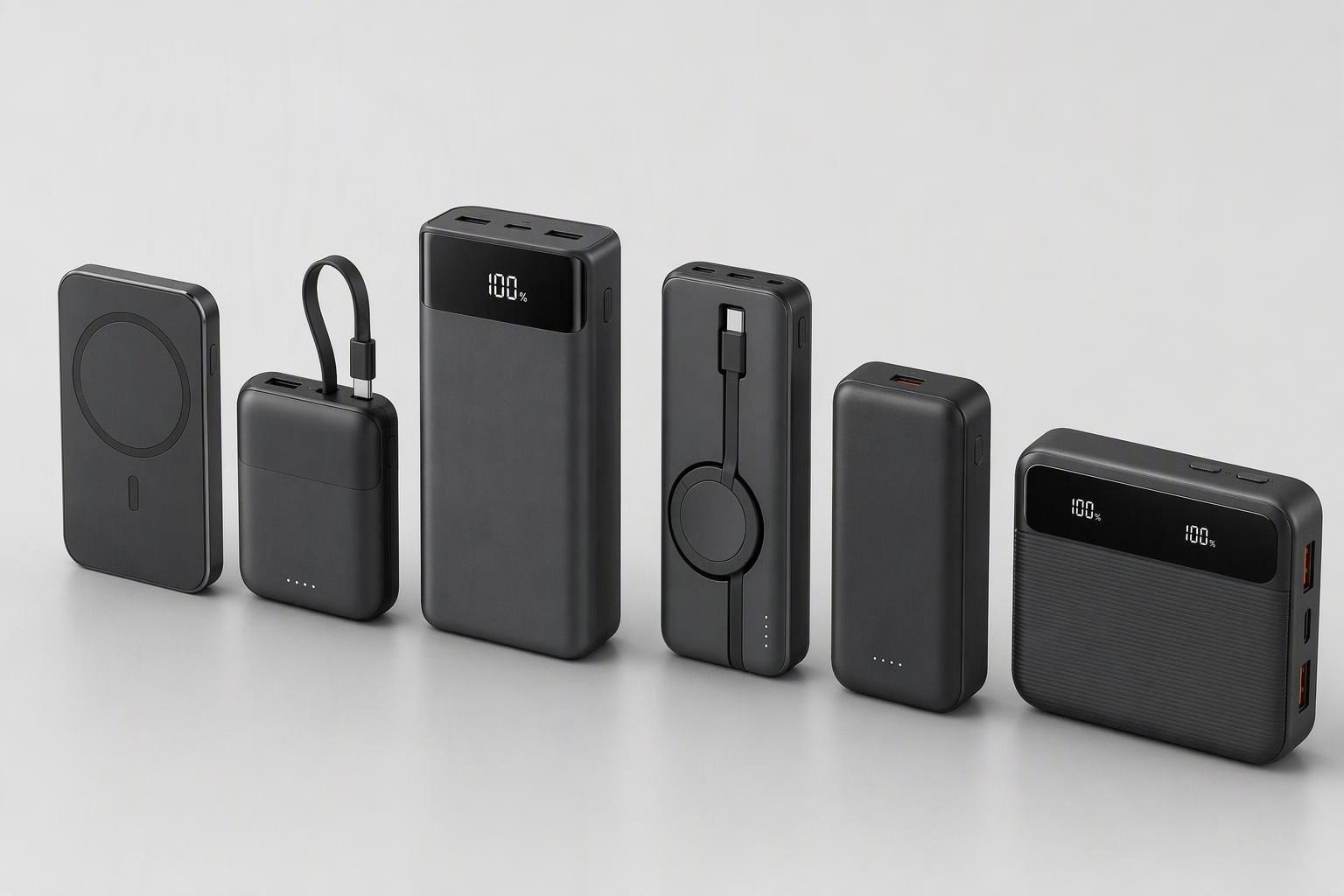
The JOYROOM Product Catalog (2026 Q3) organizes the range into seven charge series plus a flagship display model. The catalog figures are the ones to carry into your line sheet, not the broader category bands:
Catalog series (2026 Q3) | Output | Catalog positioning |
|---|---|---|
PODIX Series | 240 W | Flagship TFT dual-screen model |
With Built-in Cable Series | 67 W | Cable-free convenience for travel and EDC |
Multi-Port Series | 30 W / 45 W | Shared charging across mixed device sets |
Single-Port Series | 20 W / 30 W / 65 W | Entry to mid-tier, price-ladder SKUs |
Magnetic Wireless Charging Series | 20 W to 45 W | Snap-on iPhone and Qi2 buyers |
Standard Fast Charging Series | 20 W to 45 W | Marketplace volume and promotions |
Mini Dual-Cable Series | 20 W to 45 W | Impulse counter and carrier bundles |
Retractable Cable Series | 22.5 W to 45 W | Travel retail and tidy-cable displays |
Two catalog entries are worth flagging for a bulk order. The Single-Port Series spans 20 W to 65 W inside one series name, so ask for the per-SKU wattage before you price a shelf: a 20 W SKU and a 65 W SKU do not belong on the same price tag. The With Built-in Cable Series tops out at 67 W, which is a laptop-capable tier rather than a phone top-up, and it is the cleanest answer to the cable-loss complaint.
Magnetic Wireless Charging Series (5,000–20,000 mAh, 20 W to 45 W). Best for phone shops and carrier stores selling to iPhone owners who want a snap-on unit. A magnetic wireless power bank sells on convenience, and the standard now supports the claim: Qi2 brought 15 W charging, and the April 2025 Qi 2.2 specification, branded Qi2 25W, raised it to 25 W, nearly 70% more charging power (Wireless Power Consortium). Only Qi Certified products may display the Qi or Qi2 logo, so a listing that claims Qi2 without certification is a takedown risk.
Standard Fast Charging and Mini Dual-Cable Series (5,000–20,000 mAh, 20 W to 45 W). Best for marketplace listings and price-led promotions. The built-in cable removes the “where is my cable” complaint that drives one-star reviews, and the 10,000 mAh band is the volume mover.
High-Power Display Series (20,000–25,000 mAh, 65 W to 240 W). Best for laptop-adjacent retail and business buyers. These are the SKUs that justify a premium shelf price, and they are also the ones where a 5,000 mAh slim unit would be the wrong recommendation: a slim pocket unit is a phone top-up, not a laptop charger.
Flagship SKU in the 2026 Q3 Catalog: PODIX PR70
The PODIX PR70 is the catalog flagship and the SKU that carries the 240 W ceiling into a shelf conversation. It is positioned as the world’s first 240 W TFT dual-screen power bank, with four claims you can verify on a sample: a TFT color display, a dual-screen layout, dual-path charging, and first-ever horizontal use.
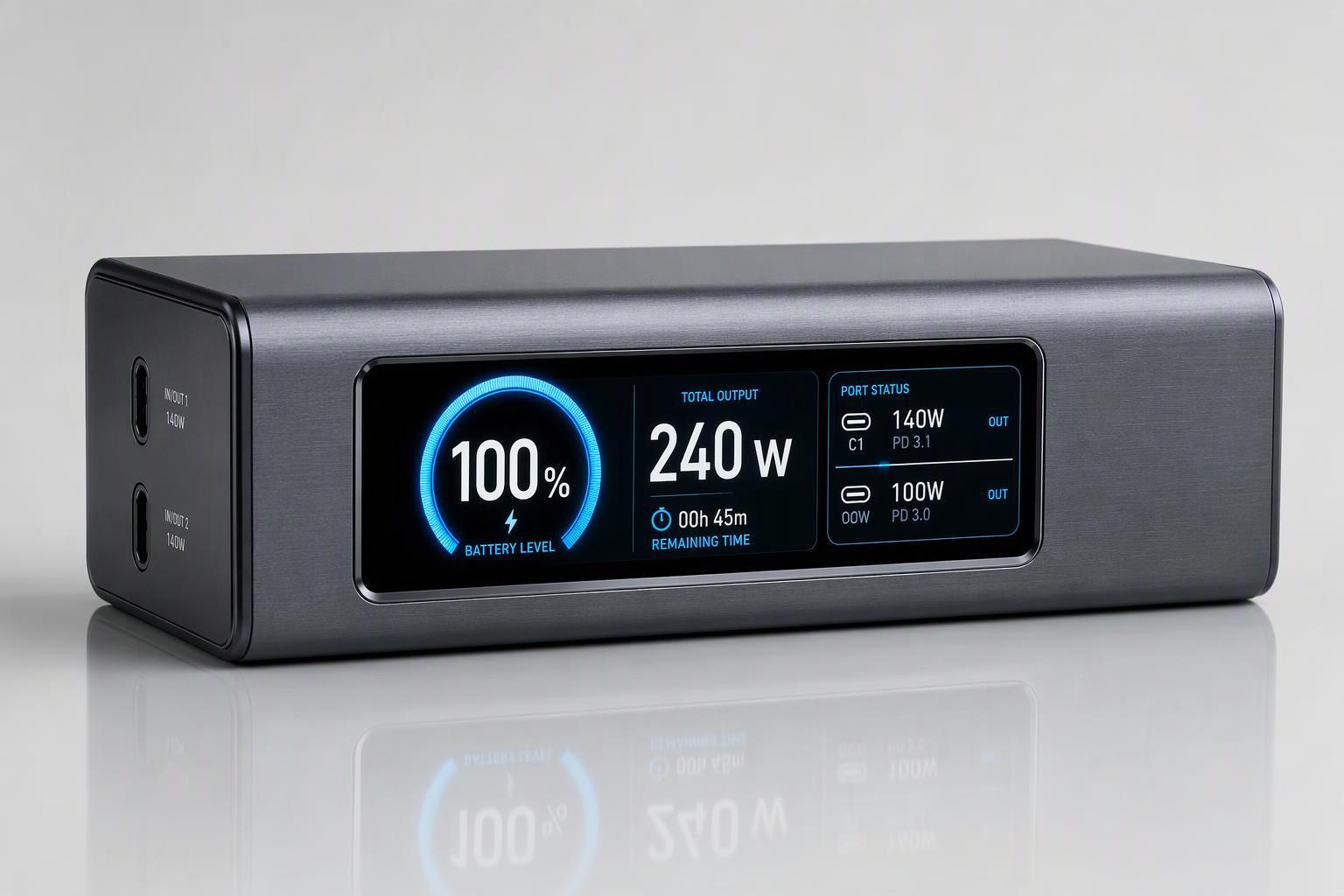
The horizontal form factor is the commercial detail, not a cosmetic one. A horizontal unit with a readable dual screen works as a desktop-side power station rather than a pocket accessory, which puts it in the laptop-adjacent channel at a premium price point. Dual-path charging matters for the same buyer: it lets a laptop and a phone draw power at the same time instead of forcing a queue.
Two caveats before you list it. First, 240 W is a PD 3.1 capability, so the device you charge has to support the higher 28 V, 36 V or 48 V tier to see that rate; a phone will still charge, just far below the ceiling. Second, a 240 W unit is larger and heavier than the pocket SKUs, so set the shopper’s expectation on size, and check the Wh rating against the 100 Wh airline threshold before you market it for travel.
If the 240 W tier is more headroom than your shelf needs, the same PODIX family ships a middle step: the PODIX PC50 145W TFT power bank packs 20,000 mAh (72 Wh) into a 619 g body with a triple C + A + C port layout. Its two Type-C ports each handle up to 100 W out and 65 W in, and smart allocation splits that into a 100 W + 45 W pairing, so a laptop and a phone charge side by side instead of taking turns. Protections run to PD3.0, PPS, QC3.0 and Huawei SCP/FCP, which covers more phone fast-charge standards than a plain PD-only unit.
The display is the part retail buyers will demo. The TFT panel shows remaining percentage, live wattage per port, temperature, battery health and cycle count, which turns an invisible battery into something a shopper can read at a glance. Self-recharge runs at 65 W, so a full top-up takes about two hours. At 72 Wh it sits comfortably under the 100 Wh airline threshold, which is the practical difference between this unit and the 240 W flagship: still laptop-capable, still carry-on legal. If you want the 145W TFT display power bank as a trial-order SKU, request it alongside the PR70 sample and compare how each one moves in your channel.
Retractable Cable Series (10,000–20,000 mAh, 22.5 W to 45 W). Best for travel retail and EDC displays, where a tidy cable is the selling point.
Flight legality is a separate question from capacity, and it drives returns when a listing gets it wrong. The FAA sets 100 Wh per battery as the passenger limit, allows 101–160 Wh only with air-carrier approval and a two-spare cap, and forbids anything above 160 Wh (FAA PackSafe). Power banks must travel as carry-on, never checked. Airlines may set stricter limits regardless of Wh capacity, and ICAO’s March 2026 power-bank addendum, as relayed by IATA, caps passengers at two power banks and forbids in-flight recharging (IATA). The 100–160 Wh approval band is time-limited and carrier-dependent, which makes SKUs above 100 Wh commercially awkward for air travel.
Category | Capacity band | Best channel | Key protocol | Flight status |
|---|---|---|---|---|
Magnetic Wireless | 5,000–20,000 mAh | Phone shops, carrier stores | Qi2 15 W / Qi2 25W | Carry-on only |
Standard Fast Charging | 5,000–20,000 mAh | Marketplaces, promotions | PD, QC, PPS | Carry-on only |
Mini Dual-Cable | 10,000 mAh | Impulse counter | PD, QC | Carry-on only |
High-Power Display | 20,000–25,000 mAh | Laptop retail, B2B | PD 3.1 up to 240 W | Carry-on only |
Retractable Cable | 10,000–20,000 mAh | Travel retail, EDC | PD, QC | Carry-on only |
Pro Tip: Match the category to the shelf, not to the spec sheet. A 25,000 mAh high-power unit on an impulse counter turns slowly; a 10,000 mAh dual-cable unit in a carrier bundle turns fast.
Key Technical & Design Features That End-Users Demand
Buyers should be able to verify every feature claim on a received unit, not just on a spec sheet. That is the test we apply to our own range, and it is the test to apply to any supplier.
Protocol support stated exactly. PPS requests voltage in 20 mV steps, so a phone that depends on PPS for peak speed will charge more slowly on a PD-only charger. USB PD Revision 3.1’s 28 V, 36 V and 48 V fixed voltages are what enable the 140 W, 180 W and 240 W tiers. Ask for the protocol list per SKU, not per series.
Housing and display. A fireproof PC/ABS housing and an LED display that shows remaining capacity are the two features end-users notice first, and both are checkable on a sample. Port count, dimensions and weight should match the catalog exactly; a 5 mm difference in thickness changes how a unit sits in a pocket.
Rated versus usable capacity. The mAh printed on the box is the cell rating, not what reaches the phone. Conversion losses mean a 10,000 mAh unit delivers less than 10,000 mAh to a device, and wireless charging adds further loss. Set buyer expectations on usable capacity, not rated capacity.
⚠️ Warning: Rated capacity is not usable capacity. Quote the delivered figure to your retail buyers, or expect returns when a customer measures the difference.
Build quality that survives handling. Drop data, insertion cycles on the ports and temperature rise under sustained load are the three checks that separate a unit that survives a retail shelf from one that comes back. Ask the supplier for the test figures behind each.
OEM & ODM Customization Options for B2B Partners
OEM ODM power bank customization is a cash-cycle decision before it is a design decision. The MOQ you accept determines how long your capital sits in inventory, so treat it as a financial variable, not a discount threshold.
What can be customized. Private-label branding, packaging, cable configuration and housing color are the usual levers. JOYROOM supports private-label programs and dropshipping for partners who need to test a channel before committing to a container.
Packaging color drift. The most common private-label complaint is not the product; it is the box. A second production run can shift the printed color slightly against the first, which looks like a counterfeit to a retail buyer. Approve a physical color standard and hold the factory to it across runs.
MOQ and lead time. MOQ is negotiated, not published, and it scales with how much of the product you change: stock units, logo and packaging, product customization, and new tooling each sit at a different volume. Ask for the MOQ at each level before you design the program, and ask for the lead time at that same level.
Logistics allocation. Incoterms 2020, the ICC’s eleven delivery rules, decide who carries cost and risk at each point. FOB, CIF, DAP and DDP allocate that risk very differently, and the choice changes your landed cost as much as the unit price does (International Chamber of Commerce). Decide who pays DOA freight before the first shipment, not after.
Confirm the term per SKU in writing, and confirm how DOA units are credited.
How to Start a Wholesale Partnership with JOYROOM
Qualify before you commit cash. The sequence below lets you evaluate the range on samples and documents, then scale only what passes.
Define the channel and the capacity band. Decide which shelf you are stocking and which category fits it, using the comparison above.
Request samples and SKU-level certification files. Ask for the certificate that names the exact model, the test summary behind it, and the protocol list per SKU.
Check sample-shipment compliance. Lithium-ion batteries shipped alone must be at a state of charge not exceeding 30% of rated capacity, and from 1 January 2026 that 30% state-of-charge limit extends to batteries packed with equipment (IATA). Confirm how samples will ship before they leave.
Build the landed-cost sheet. Unit price, freight, duty at the confirmed subheading, insurance, and DOA allocation.
Run a trial order. Test sell-through in one channel before committing to a container.
Scale the SKUs that passed. Expand the range only after the first batch clears intake and sells.
Conclusion & Call to Action (CTA)
The distributors who avoid the certificate-to-SKU trap do one thing differently: they qualify the paperwork at the same time as the product, SKU by SKU, before the first container ships. That single discipline protects the margin you calculated and the shelf space you fought for.
The next step is a quote and a sample, not a container. Request the wholesale price list and a sample of the category that fits your channel, and ask for the SKU-level certification files with it.
Get a Wholesale Price List / Request a Quote | Contact Our B2B Sales Team