


Your phone is at 12% when you walk out the door, and the pack in your bag is the only thing standing between you and a dead screen at the airport gate, on the train home, or at a campsite two hours from the nearest outlet. You already know you want a portable cell phone battery pack. What the label does not tell you is whether it will actually do the job.
That is the gap this guide closes. We are not going to define what a power bank is. We are going to turn the spec sheet into a decision, on four points that matter: real capacity, real wattage, real weight, and real safety. Every number below is one you can check yourself, either on the label or in a public record, and we point to the FAA, TSA, USB-IF, CPSC and a peer-reviewed IEEE analysis of capacity claims wherever a figure carries the argument.
Start with the number printed largest on the box, because it is the one most likely to mislead you.
1. How many times can a portable cell phone battery pack actually charge my phone?
The 20,000 mAh badge on the box tells you how much energy sits inside the cells, not how much reaches your phone. A peer-reviewed analysis of specified power bank capacity makes the arithmetic plain: watt-hours equal mAh multiplied by nominal cell voltage and divided by 1,000, so a 10,000 mAh pack rated at 3.7 V stores about 37 Wh, not 50 Wh. The USB output then loses part of that energy in conversion.
TechRadar’s measured discharge tests show how much survives. A 25,000 mAh pack rated at 90.75 Wh delivered 75.3 Wh at 10 W, 76.2 Wh at 20 W and 78.2 Wh at 100 W, or 85% to 88% of the label (TechRadar’s ZMI No. 20 review, March 2025). The same test showed efficiency climbing from 85% to 88% as output power rose, because higher output voltage trims the conversion loss. An older, smaller test thread measured many packs at 55% to 65%, so treat the low end as a real possibility on cheap units.
Key Takeaway: Read the printed Wh, divide it by your phone’s battery Wh, then take 85% of the result. A 38.5 Wh pack feeding a 15 Wh phone gives roughly two full charges, not three.
Charge counts are approximations. They move with your phone’s battery size, the cable you use and how warm the pack runs. Ignore the “charges” badge on the listing and run the sum yourself.
2. How many watts do I need, and what do PD, PPS and QC actually mean?
Wattage is a ceiling, not a promise. Our rule is simple: match the protocol your phone uses, then buy the lowest wattage that covers it.
A 45 W pack that speaks the wrong protocol can charge slower than a 20 W pack that speaks the right one, because the phone, not the charger, decides how much power it draws.
USB Power Delivery is a negotiation. The phone requests a level and the charger cannot force its maximum, which is why a USB-C PD fast charging power bank only delivers its headline figure to a device that asks for it. USB-IF’s Power Delivery specification raised the ceiling to 240 W over full-featured USB-C in Revision 3.1 (2021), up from 100 W, and the current Power Delivery specification, PD 3.2 v1.2, was published on 14 September 2026.
PPS is the mode many Android phones use to charge directly to the battery. In USB-IF’s explanation of Programmable Power Supply, the source voltage adjusts in 20 mV steps and the current limit in 50 mA steps across 3.3 V to 21.0 V, with the phone re-requesting at least every 10 seconds. That fine-grained control is what the PPS mode some providers’ Super Fast Charging uses depends on. QC is a separate legacy fast-charge scheme; if your phone charges over PD or PPS, QC on the pack adds nothing.
Multi-port packs hide a second ceiling. A pack rated 45 W on one port typically re-allocates to a shared 15 W when three devices are attached, so the headline describes one port, not the total.
Pro Tip: Check three lines before you buy. Does the listing name PD by version? Does it name PPS? Does it state per-port wattage separately from the total?
3. Can I bring a portable cell phone battery pack on a plane, and what is the Wh limit?
A portable cell phone battery pack flies in your carry-on and never in the hold. The number the gate agent reads is the watt-hour figure printed on the shell, not the mAh on the front of the box. Under the FAA’s carry-on battery rules, packs rated up to 100 Wh need no approval at all. Packs between 101 and 160 Wh are allowed only with airline approval, and you may carry a maximum of two spares. Anything above 160 Wh is forbidden. TSA’s guidance on what it allows at the checkpoint says the same thing in practice: lithium-ion packs must be in cabin baggage, and the screening officer makes the final call.
Run the arithmetic at 3.7 V and every common size sits in the green zone. A 10,000 mAh pack is about 37 Wh, a 20,000 mAh pack about 74 Wh, and a 25,000 mAh pack about 92.5 Wh. All three clear the 100 Wh line without paperwork.
Two things catch travellers out. The FAA notes that airlines may set stricter limits than the federal minimum, so the operating carrier’s policy governs your flight, not the federal ceiling. And the stakes are real: the FAA recorded 89 verified lithium battery incidents on aircraft in 2024, a record, with 38 more in the first half of 2025. Damaged or recalled packs should not board at all.
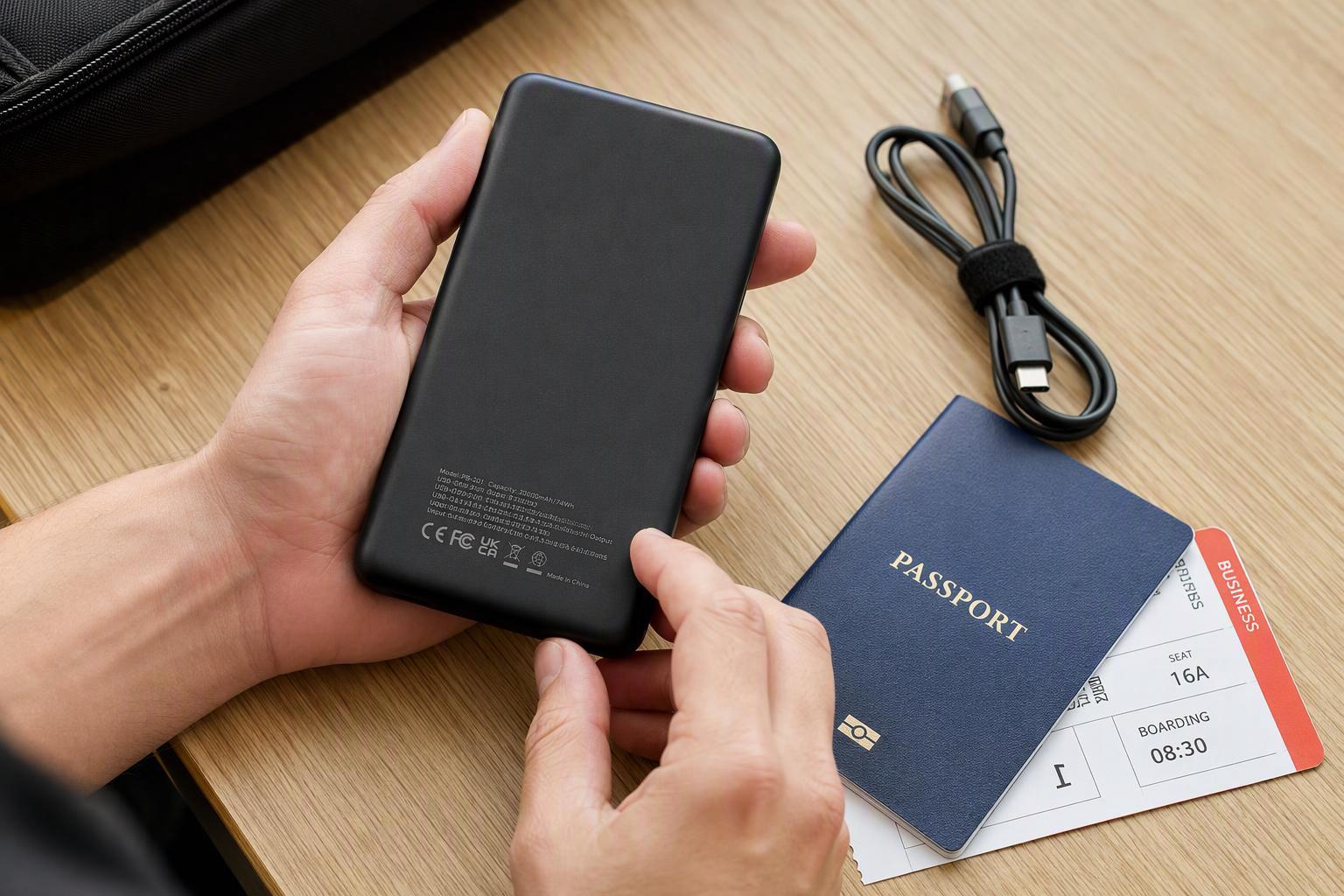
Before you pack, photograph the label. That label is what the gate agent reads.
4. How heavy is too heavy, and how do I spot an inflated capacity claim?
Weight is the fastest lie detector you have before you buy. A lithium cell of a given energy weighs what it weighs, so a listing that promises a huge capacity at an impossible weight is telling you something. Run the arithmetic before you trust the number.
Two verified points show the scale. JOYROOM’s 10,000 mAh magnetic model lists 205 g, and TechRadar measured a 25,000 mAh unit at 580 g. Those are two data points, not a benchmark range, but they bracket the class: roughly 200 g for a 10,000 mAh pack, roughly 580 g for a 25,000 mAh one. A 20,000 mAh unit that claims 150 g does not add up.
That weight decides whether the pack leaves the house. A 10,000 mAh pack disappears into a jacket pocket, which is why the daily-carry consensus in r/onebag settles on 10,000 mAh as the travel sweet spot. A 20,000 mAh pack in the 450 g class is a bag item. If you want a lightweight power bank for daily carry, the 200 g class is the one that actually travels with you.
⚠️ Warning: Check three red flags on any listing. A weight that does not match the capacity class. No Wh figure printed anywhere. A capacity claim with no cell voltage stated.
5. What safety certifications and protections should I check, and which type of pack fits my situation?
Start with the certification, not the colour. The ANSI/CAN/UL 2056 standard for power banks is the joint US/Canada safety standard for lithium-ion packs with input and output up to 20 Vdc, first published on 22 October 2024. It is voluntary: CPSC’s voluntary-standards listing for batteries shows no mandatory power-bank standard, so the mark is a floor, not a guarantee. Check that the listing traces to the exact model and factory, as UL’s own guidance on battery-safety testing sets out, because a logo on the box proves nothing on its own.
The recall record explains why we insist on that check. CPSC announced about 1,158,000 units in its 2025 Anker recall, about 210,000 in its INIU recall notice, and about 21,380 in the September 2026 NEWDERY recall. The 2026 CPSC re-announcement covered about 429,200 wireless units and followed one reported fatality.
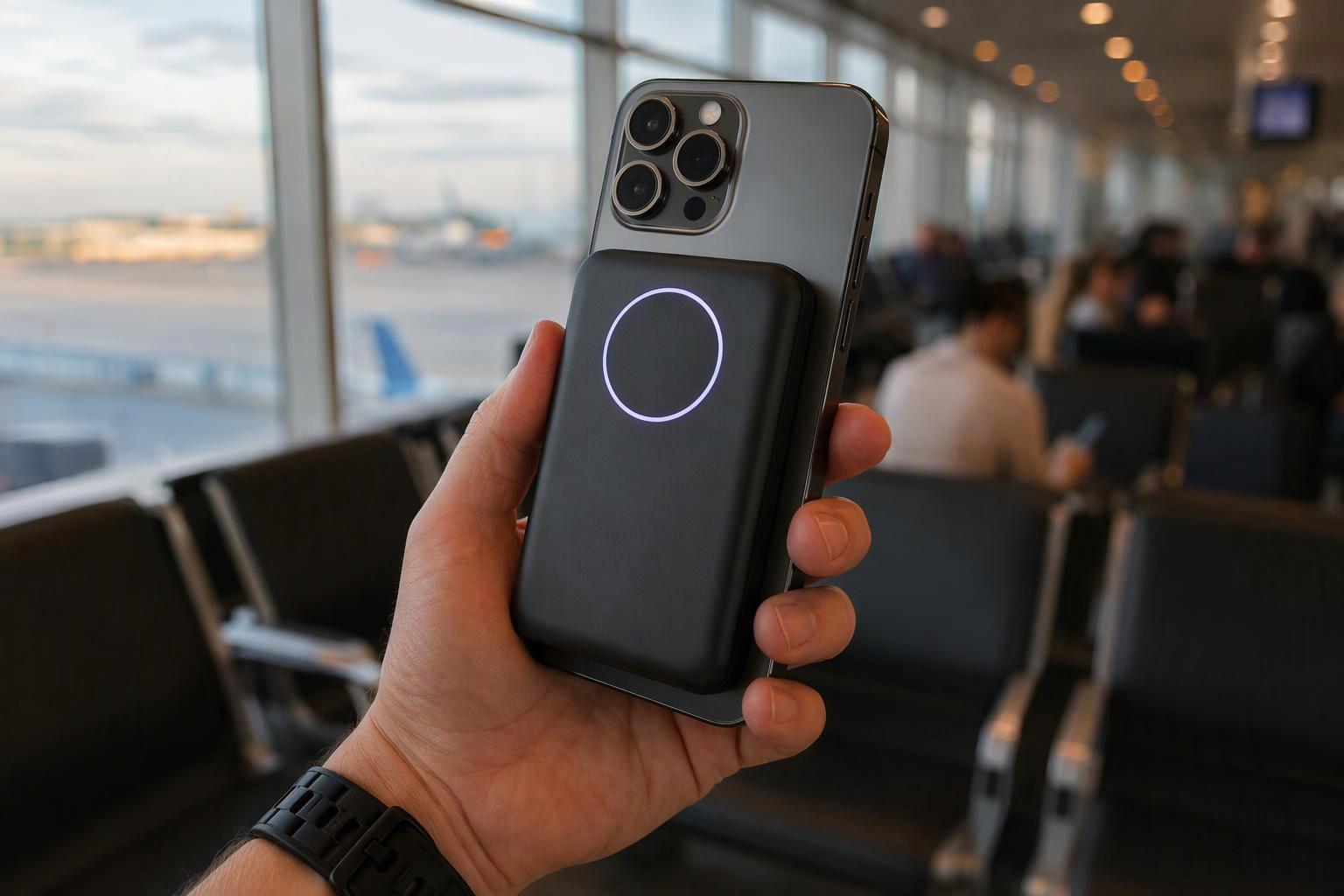
Then match the form to your day. Wired USB-C is the most efficient route; magnetic wireless adds a Qi2 alignment layer, which the Qi2 standard from the Wireless Power Consortium launched in 2023 at 15 W and raised to 25 W in July 2025.
Usage pattern | Capacity class | Port type | Weight class | What to verify |
|---|---|---|---|---|
Commute | 5,000–10,000 mAh | USB-C, magnetic optional | Under 210 g | Model-level certification; magnet strength |
Travel | 10,000 mAh | USB-C PD plus USB-A | 200–250 g | Wh printed on the shell; airline acceptance |
Outdoor | 20,000 mAh and up | Dual USB-C, built-in cable | 400 g and up | IP rating; cable strain relief |
For the best portable charger for travel, the middle row is where most readers land. JOYROOM’s Magnetic Wireless Charging Series covers it, and the JR-W020 Pro 45W Qi2.2 Magnetic Wireless Power Bank is the clearest example of the checklist in action: 10,000 mAh at 38.5 Wh, 196 g, up to 45 W over USB-C, 25 W Qi2.2-certified wireless output and an 11 N magnetic hold, with CE, RoHS and UN38.3 certification traceable to the model. The JR-PBM08 is the sibling option at 205 g with a catalog “Flight Approved” label. The Retractable Cable Series and Mini Dual-Cable Series both support 10,000 mAh without a loose cable, the High-Power Display Series can be used for laptop-class output at 20,000–25,000 mAh, and the PODIX PR70 heads the 240 W dual-built-in-cable range. Compare these against a broader guide to choosing everyday charging accessories when you are assembling pack, cable and wall charger as a set.
Frequently Asked Questions
Is a 10,000 mAh portable cell phone battery pack enough for a weekend trip?
For a phone alone, yes. A 10,000 mAh pack at 3.85 V stores 38.5 Wh, and after conversion losses you can expect roughly two full charges of a mainstream phone. Add a tablet and the same pack will not cover both for two days, so bring a 20,000 mAh unit or a second pack if a tablet is coming along.
Can a portable cell phone battery pack charge a laptop?
Only when the pack names USB-C PD at or above the wattage your laptop asks for, and only through a full-featured USB-C port that supports power delivery in both directions. A pack rated for phones at 20 W will not run a laptop that expects 45 W or 65 W, however large its capacity.
Does pass-through charging damage the pack?
Charging a device while the pack itself is charging is common and widely supported, but heat is the real variable: both conversions run at once, so the pack warms up more than in normal use. Keep it ventilated and avoid doing it in a hot car or direct sun.
Can I fly with a power bank that was recalled?
No. The FAA prohibits carrying damaged or recalled lithium batteries, and the airline’s own policy governs what boards. Check the model number against the CPSC recall list before you pack, and leave the unit at home if it appears there.
Conclusion
Read the printed watt-hours first, not the milliamp-hour headline. That number decides whether the pack boards a plane and roughly how many charges it holds. Then confirm the protocol your phone actually uses, weigh the pack against how you carry it, and trace the certification mark and recall status to the exact model number, not the family name.
The decision rule is short. If the pack lives in your bag or pocket every day, choose the 10,000 mAh class, which keeps weight and thickness down. If you travel with a laptop, step up to the 20,000 to 25,000 mAh class and check the per-port wattage before you commit, because total capacity says nothing about whether one port can run your laptop.
Our JOYROOM power bank lineup is organised along those same lines, from the magnetic wireless charging series at 10,000 mAh and 38.5 Wh to the high-power display series at 20,000 to 25,000 mAh. Compare the printed Wh, the port protocols and the weight side by side, and keep the four checks above as your shortlist filter.