




JOYROOM is a consumer electronics brand founded in Shenzhen, China, in 2009. It designs and manufactures practical digital accessories — power banks, chargers, charging cables, audio products, smartwatches, and phone holders and mounts — for everyday use. Over more than fifteen years, JOYROOM has grown from a product-focused company into an integrated operation spanning research and development, design, manufacturing, marketing, and sales, with products sold in more than 100 countries and regions.
That combination matters differently depending on who is reading. Consumers want to know whether the brand behind a charger or a pair of earbuds is one they can buy from with confidence. Importers, distributors, retailers, and procurement teams want to know whether it is one they can build a category around: whether the portfolio is broad enough to fill shelf space, whether the compliance paperwork exists, and whether supply holds up across a selling season. This article addresses both, and it separates what the company documents from what a buyer still has to confirm for their own market.
The Story Behind JOYROOM: Founded in 2009 in Shenzhen, China
Shenzhen is not incidental to the story. The city is one of the world’s densest clusters of electronics manufacturing, component supply, engineering talent, and export logistics, and a company founded there in 2009 began with structural advantages that a brand launched almost anywhere else would have had to assemble from scratch.
From a Shenzhen Startup to a Global Electronics Brand
JOYROOM’s own description of its trajectory is that of a product-focused company that became an integrated enterprise combining R&D, design, production, marketing, and sales. That progression is worth taking seriously rather than treating as boilerplate, because it describes a specific kind of company: one that controls more of its own chain than a trading operation does.
In practical terms, the early years were spent building a product business around mobile phone accessories. The portfolio then widened — from cases and protection into charging, cables, audio, wearables, and mounting — while the company added design capability, manufacturing resources, and eventually international sales channels. Each of those additions changes what the company can do. A brand that designs in-house can decide what a product should be rather than selecting from a supplier’s catalog. A brand with production resources can hold a specification across batches. A brand with its own distribution relationships can support a product after it ships.
The commercial consequence is responsiveness. Charging formats have moved quickly over the past decade — USB-C replacing micro-USB and Lightning across device categories, gallium nitride (GaN) shrinking high-wattage chargers, magnetic wireless charging standards maturing — and each shift forces accessory makers to re-engineer products and re-certify them for each market. A company that owns more of that process can move a new format from design to shelf faster, and can correct a problem without renegotiating with an outside factory.
Key Milestones in JOYROOM’s Growth
The company’s published timeline records the following, and the sequence is more informative than any single entry:
2009 — JOYROOM is established.
2010 — The JOYROOM + Swarovski “Diamond Case” is released.
2011 — Strategic partnerships with TGBUS and Tencent Games.
2013 — The company enters the domestic Chinese e-commerce market.
2014 — Resources are integrated across categories, expanding into a full product range; first participation in Tmall’s Double 11, with daily sales exceeding RMB 60 million.
2016 — First exhibition at Global Sources in Hong Kong, described by the company as its first step into international markets.
2018 — First participation in CES in the United States; Tmall Double 11 daily sales surpass RMB 15 million.
2020 — T-series true wireless earbuds exceed 1.5 million units in annual sales.
2021 — Domestic e-commerce revenue grows 60%, from RMB 500 million to RMB 800 million; cross-border e-commerce revenue increases 200%.
2023 — Official brand stores open in Guangzhou and Shenzhen; participation in the spring and autumn Global Sources exhibitions; strategic supplier signing ceremonies; cross-border e-commerce revenue doubles year over year.
2024 — Among the first companies to receive CCC certification for power banks; 160% of sales target achieved on Amazon Prime Day.
2025 — Continued CES participation; exhibitions at GITEX GLOBAL in Dubai and Global Sources in Hong Kong; 36Kr Annual Valuable Brand award; QQ Music Premium Sound Quality Partner certificate; the PODIX TRD01 desktop charging station surpasses RMB 1 million in Kickstarter funding.
2026 — The PODIX PR70 power bank surpasses RMB 1.2 million in Kickstarter funding.
The pattern reads as a staged build rather than a series of unrelated wins: domestic retail and e-commerce first, then trade exhibitions, then international distribution, then flagship product launches aimed at a global audience. The 2016 Hong Kong exhibition and the 2018 CES debut mark the point where the company began presenting itself to international buyers directly rather than only through domestic channels.
One caution on figures: JOYROOM’s published materials describe its patent portfolio in more than one way, citing different totals for utility models, design patents, and invention patents in different documents. Where this article cites a patent count, it uses the conservative “more than 300 utility and design patents” figure that appears in the company’s 2026 catalog and overview materials.
What Does JOYROOM Specialize In? Exploring Its Product Portfolio
JOYROOM’s catalog is organized into four functional families: charging essentials, smart wearables and audio, holders and mounts, and phone accessories. The logic connecting them is not category expansion for its own sake.
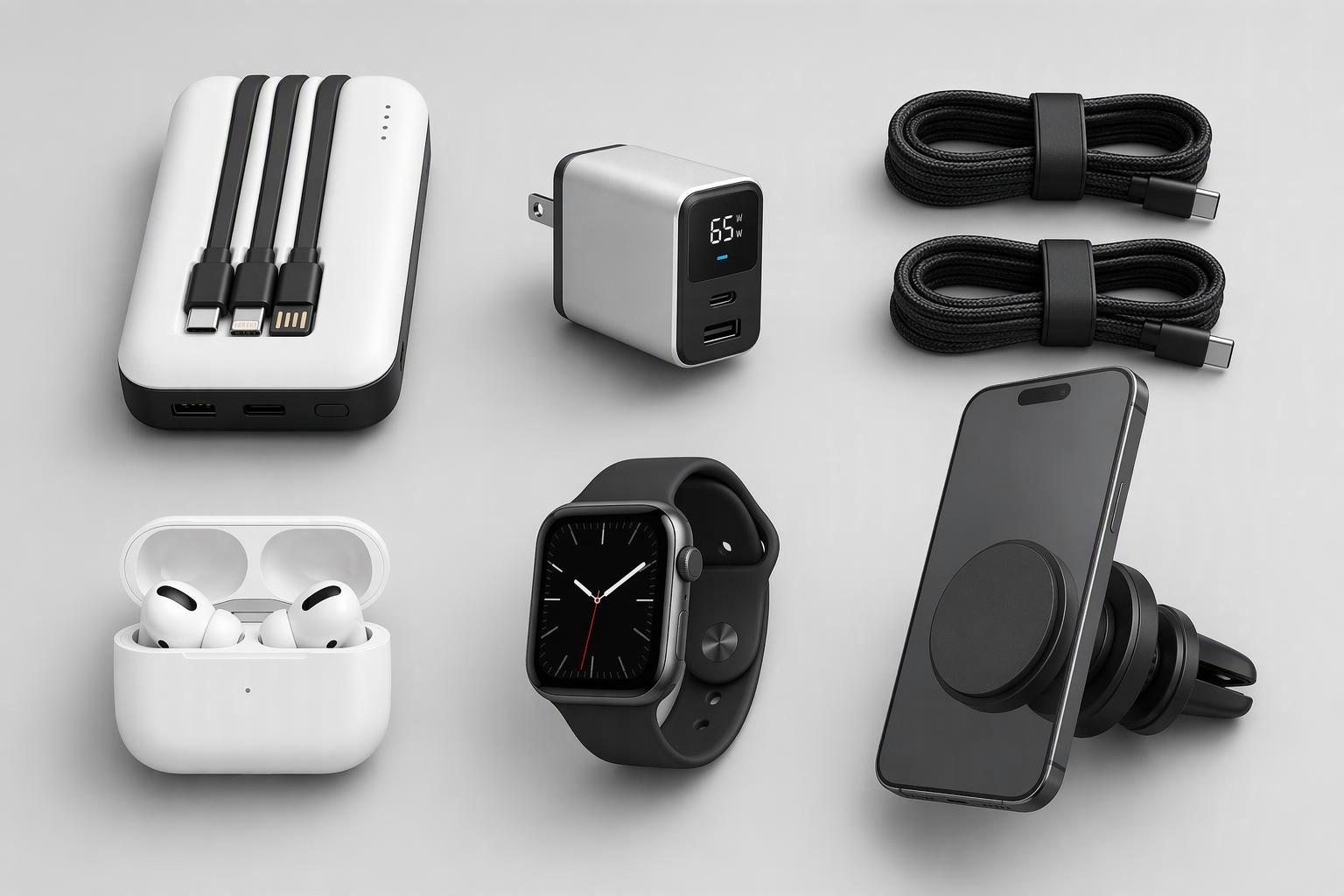
It is that the same person who carries a phone through a working day also carries the things that power it, listen through it, mount it in a car, and protect it — and a brand that supplies several of those items can be a single stop for a retailer building an assortment.
Charging Essentials: Power Banks, Chargers, and Cables
Charging is the broadest and most technically demanding part of the range. Power banks run from compact 10,000mAh units such as the JR-PC1, which has built-in Type-C and Lightning cables, up to the 25,000mAh PODIX PR70. Wall chargers span 20W single-port models to 140W multi-port GaN units, alongside desktop charging stations and a cable range that reaches from 2.4A legacy connectors to 240W USB-C.
This is the category where reliability and compatibility matter most, for reasons that are easy to state and expensive to get wrong. A charger that negotiates the wrong fast-charging protocol does not fail loudly; it simply charges slowly, and the customer blames the product. A power bank that exceeds air-transport limits becomes unusable the moment its owner tries to board a flight. Both problems are specification problems, and both are decided before the product reaches a shelf.
Two examples show how the specifications translate into use. The PODIX PR70 carries a 25,000mAh capacity rated under 100Wh — within the threshold commonly applied to lithium batteries in carry-on baggage — and JOYROOM’s materials cite a full recharge in about 1.5 to 2 hours at up to 100W input. The PODIX TRD01 desktop station accepts 100–240V AC input, so the same unit works across different mains voltages — a practical requirement for a product sold into multiple regions, and one that matters to a distributor stocking a single SKU across markets with different plug standards.
Smart Wearables and Audio Products
The audio line covers open-ear headphones, wireless earbuds including adaptive noise-canceling models such as the R3, wired earphones in 3.5mm and Type-C versions, and over-ear headphones such as the JR-JH3. The smartwatch range is organized into series — Classic, Venture, Fit-life, and Starlight — with the company’s catalog listing features such as Bluetooth calling, AMOLED displays, multi-day battery ratings, and water-resistance ratings that vary by model.
These products occupy the communication and entertainment layer of the same connected day the charging products support. A user who takes calls on earbuds and tracks workouts on a watch is also carrying two more devices that need power, which is why the categories reinforce each other commercially as well as conceptually: a retailer that already stocks JOYROOM chargers has a natural adjacent assortment in audio and wearables.
Holders, Mounts, and Mobile Accessories
The mounts range covers car phone holders, motorcycle and bike mounts, wireless car charger holders, and desktop and lifestyle stands. The accessories range adds phone cases, tempered-glass screen protectors, and stylus pens in passive, active, and multi-tip designs.
The value here is practical rather than technical: hands-free navigation in a car, a phone that survives a drop, a stylus that makes note-taking usable on a tablet. These are improvements that extend the life and usefulness of a device the customer already owns, which makes them steady sellers rather than upgrade-cycle purchases. The AR50 magnetic phone holder illustrates the company’s habit of merging functions: it integrates a 240W retractable Type-C cable into the mount, so the same accessory holds the phone and charges it.
Innovation and Design: What Makes JOYROOM Different?
The more useful question about a brand at this scale is not what it makes but how it decides what to make. Three things are visible in JOYROOM’s product record: a design approach oriented toward removing friction, a flagship line used to demonstrate engineering capability, and a patent portfolio treated as a long-term asset.
Combining Practical Technology with Modern Design
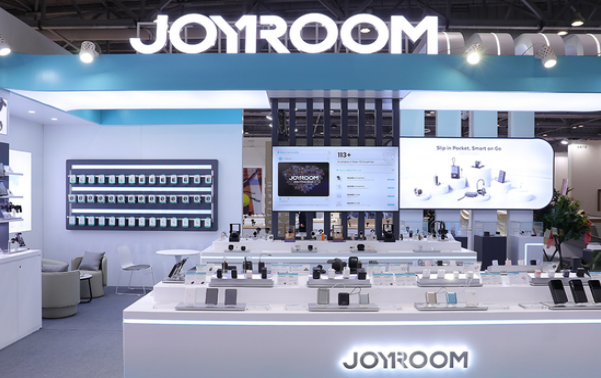
At the 2025 Global Sources Mobile Electronics Show in Hong Kong, JOYROOM presented its booth and products under the design philosophy “Minimalist Aesthetics — Less is More,” with an emphasis on clean layouts and hands-on experience rather than dense display. That positioning is consistent with choices visible across the catalog.
Retractable cables are the clearest example. The PODIX TRD01 builds two auto-retract USB-C cables into the charger body, which removes the separate cable from the desk entirely and eliminates the tangle that comes with it. Displays are another: the TRD01’s 1.54-inch LCD and the PR70’s dual TFT screens show real-time power, battery level, temperature, and per-port output, so the user can see what is happening instead of inferring it. Magnetic bases and 180° rotation on the TRD01 allow one-handed cable pulling. None of these is a breakthrough in itself; together they describe a design discipline aimed at problem removal rather than ornamentation.
Introducing the PODIX Flagship Series
PODIX is the clearest evidence of where the company’s engineering ambition sits, and it is documented in enough detail to assess on specifications rather than adjectives.
The PODIX TRD01 is a 140W 5-in-1 desktop GaN charging station. It delivers up to 140W total across five ports: one USB-C at up to 140W, two auto-retract USB-C cables at up to 100W each, and two USB-A ports at up to 30W each. It has a 1.54-inch LCD showing real-time power and animated status, a tri-magnet base, 180° rotation, and 100–240V input. The retractable cables extend to roughly 230cm and are rated for more than 10,000 pulls and bends.
The PODIX PR70 is a 240W power bank with dual TFT displays. It offers 240W total output across three USB-C ports and one USB-A port, a 25,000mAh / 90Wh capacity, and two built-in cables — a 140W retractable USB-C cable and a 100W carry-strap USB-C cable — for charging up to four devices at once. The displays track battery level, time remaining, temperature, per-port power, and battery health. It recharges in about two hours at 100W input and uses UL94 V-0 flame-retardant PC materials.
Both products were funded through Kickstarter. The company announced that the TRD01 campaign closed in October 2025 having raised over $132,000 from 1,385 backers, and that the PR70 campaign closed in August 2026 having raised over $170,000 from more than 1,300 backers. Those outcomes are evidence that a defined group of early buyers found the concepts worth paying for in advance. They are not evidence of market leadership, and they should be read as demand signals from a self-selected crowdfunding audience rather than as retail sell-through.
Product Development and Intellectual Property
JOYROOM reports a professional R&D and design team and a patent portfolio of more than 300 utility and design patents across its 2026 materials. It also reports a body of design awards, which the company describes in aggregate rather than product by product.
A patent count describes a portfolio, not a guarantee. It does not mean that any specific product on a shelf contains patented technology, and buyers should not treat it as one. What it does indicate is sustained investment in development, and that has commercial consequences that matter to a trade audience. It supports OEM and ODM work, where partners need design and engineering capacity rather than catalog selection. It gives retail partners a degree of design differentiation that a generic supplier cannot immediately copy. And it signals that the company intends to keep developing products rather than reselling others’ designs.
JOYROOM Around the World: A Growing Global Consumer Electronics Brand
International reach is easy to claim and harder to operate. For a consumer electronics brand, selling into many markets means maintaining products that satisfy different plug standards

, different certification regimes, different packaging-language rules, and different channel structures — and doing so without letting quality drift between regions.
Serving Customers in More Than 130 Countries and Regions
JOYROOM’s 2026 company materials report more than 100 million users across more than 130 countries and regions. The company’s own published figures have not been perfectly consistent over time — one About page cites 108 countries and regions, while an achievements panel cites 180+ — so where precision matters, this article uses the more conservative framing of customers in more than 100 countries and regions.
Geographic spread has a concrete product consequence. A charger sold across regions needs multiple plug variants; the PODIX TRD01, for example, is offered in UK, EU, US, CN, and JP plug types. Power banks need transport documentation that satisfies air-freight rules. Audio products with Bluetooth need radio-equipment testing for each jurisdiction. A brand operating at this scale is, in effect, maintaining a compliance and logistics operation alongside its product operation — which is the part that determines whether a product can actually be sold in a given market, not just whether it exists.
Global Distribution and Retail Partnerships
The company reports a channel network of more than 500 distributors, more than 1,000 retailers, and more than 20,000 physical shops, alongside online marketplace presence and placement in the Apple APR retail network.
Each layer of that network does a different job. Distributors handle import, warehousing, regional credit, and the logistics of getting stock to smaller accounts. Retailers handle assortment decisions and the last contact with the customer. Brand stores and premium retail placements provide presentation space where products can be seen and handled. For a brand selling through distribution rather than only direct, the health of those relationships is not a marketing detail — it is the route to market.
For B2B readers evaluating JOYROOM as a supplier, the useful questions are the ones that determine whether a partnership works over multiple seasons: whether product-level certification files and test reports can be verified rather than taken on trust; how minimum order quantities and mixed-SKU terms are structured; how reliably replenishment holds during peak periods; and what price protection exists if a channel’s pricing shifts. The company’s stated capabilities map onto several of these — compliance documentation is released to contracted partners, OEM and ODM support is offered, and market-specific certification assistance is available — but the commercial terms themselves are negotiated per partner and per market, and should be confirmed directly rather than assumed from a brand overview.
Participating in Major International Technology Exhibitions
JOYROOM exhibits at CES in the United States, Global Sources Mobile Electronics in Hong Kong, and GITEX GLOBAL in Dubai, and reports participating in four or more major global trade shows annually. The company’s first Global Sources exhibition, in 2016, is described in its own timeline as its first step into international markets; its first CES appearance followed in 2018.
For a brand at this stage, exhibitions serve three functions that are hard to replicate elsewhere. They are where new products are debuted to press and buyers at the same time. They are where buyer meetings happen in volume, which is how distribution relationships in new regions typically begin. And they are where a company benchmarks itself against competitors on the same floor. The company does not claim exhibition awards in its published materials, and none should be inferred from participation.
Is JOYROOM a Reliable Brand? Understanding Its Quality and Brand Credentials
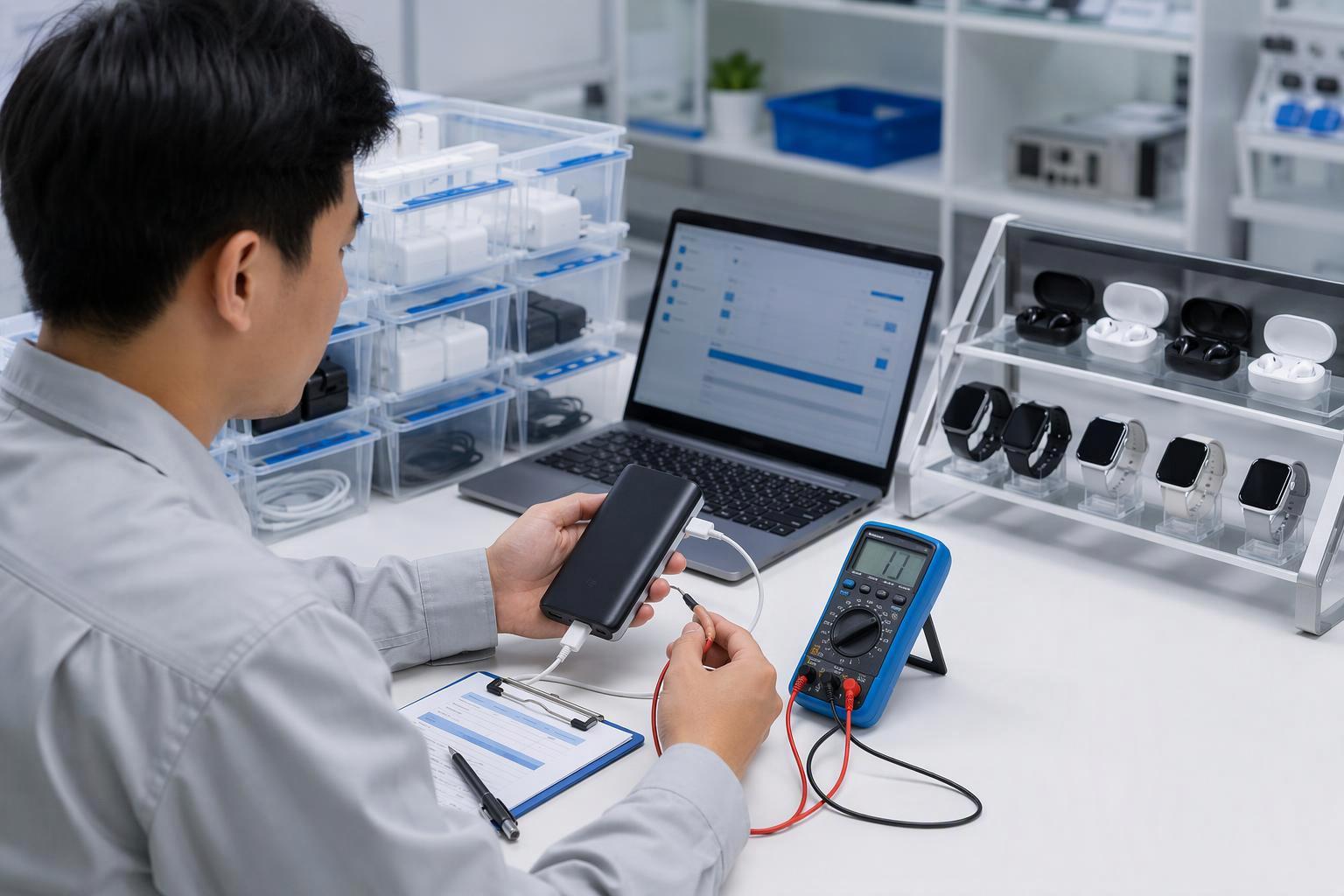
The reliability question deserves a structural answer rather than an adjective. What follows separates what JOYROOM documents about its operations from what a buyer must still verify for their own market — a distinction that matters more than any claim of quality.
Manufacturing and Supply Chain Capabilities
JOYROOM reports three modern manufacturing facilities with multiple production lines certified to ISO 9001 standards, and approximately 100,000 square meters of warehousing space supported by an integrated supply chain and logistics network.
Each element contributes something specific. In-house production supports iteration speed — a design change can be tested and put into production without renegotiating with an outside factory — and it supports batch consistency, which is the difference between a sample that performs and a shipment that performs the same way. Warehousing supports replenishment and mixed orders, which is what a distributor needs when stocking several SKUs at once rather than a single container of one product.
One qualification belongs here. ISO 9001 certification applies to the production lines the company identifies as certified; it should not be read as automatic coverage of every facility or every SKU. Buyers who need certification for a specific product line should ask for the scope of the certificate rather than the certificate’s existence.
Product Certifications and Quality Commitment
JOYROOM publishes a compliance statement describing its approach to product safety and market access. Depending on product category and destination market, its products carry or comply with CE, RoHS, FCC, UN38.3 and MSDS documentation for lithium batteries, and REACH. Additional regional marks — PSE for Japan, KC for South Korea, UKCA for the UK — are supported based on order quantities and market needs.
Three practical distinctions matter to anyone importing these products:
Certification is product- and market-specific. A CE mark on a charger does not describe the earbuds in the next carton. Buyers should match documentation to the exact model and configuration they are ordering.
Documentation is released to contracted partners. JOYROOM states that certificates of conformity, test reports, UN38.3 transport reports, MSDS files, CE-RED reports for Bluetooth audio products, and packaging compliance files are provided after order confirmation or on request through an assigned sales representative. That is a normal commercial arrangement, but it means the paperwork should be requested and reviewed before a purchase order is finalized, not after goods are in transit.
The importer of record carries local obligations. JOYROOM’s compliance statement is explicit that B2B buyers are responsible for verifying local import regulations, duties, and labeling requirements, and for ensuring local-language translation, packaging eco-labels, and importer information stickers as required by local law. No supplier’s certification transfers that responsibility.
On safety design, the company states that its chargers and power banks include multi-protection circuitry covering over-voltage, over-current, short-circuit, over-temperature, and over-charge conditions, and that housings use PC+ABS flame-retardant materials rated UL94 V-0. These are design claims about how the products are built. They are not a substitute for test reports, and buyers should treat them as complementary to documentation rather than a replacement for it.
Industry Recognition and Customer Trust
Recognition is worth presenting with its limits stated, because each form of it establishes something different.
Red Dot Product Design recognition was awarded to the JOYROOM Desk Pad, credited to Shenzhen JOYROOM Technology Co., Ltd. with in-house designers and an external design firm. The product is a heated desk pad with a dial-adjustable temperature range of 35–60°C, a digital display, and two USB charging ports, available in leather or fabric. A design award speaks to form, concept, and execution of the design brief. It does not establish durability or long-term reliability.
The 36Kr Annual Valuable Brand 2025 award is a business and brand recognition from a Chinese technology media and research organization. It reflects market presence and brand standing in that context.
Early CCC certification for power banks in 2024 is a compliance milestone: CCC is China’s compulsory safety mark for products sold in the Chinese market, and being among the first power bank companies to receive it indicates readiness for a regulatory change rather than product superiority.
Marketplace performance — the company reports strong rankings and sell-through on platforms including Amazon, Tmall, Douyin, and TikTok Shop — describes commercial traction in specific channels. It is evidence that products sell and are received well by buyers in those channels. It is not evidence of universal quality across every product and every market.
Taken together, these credentials establish that JOYROOM is a substantial, documented operation with design capability and regulatory engagement. They do not, on their own, answer whether a specific product will perform in a specific market — that is what certification files, sample evaluation, and batch consistency checks are for.
JOYROOM’s Vision: Making Everyday Digital Life Better
JOYROOM states its mission as providing high-quality resources, products, and services to customers, consumers, and partners toward an all-round win-win outcome
, and its vision as becoming a reliable global consumer electronics enterprise with strong innovation. The value proposition the company uses in its own materials is simpler: make choices simple.
Technology Designed Around Everyday Needs
That phrase is best read as a product principle rather than a slogan, because it maps onto specific decisions across the range. A travel day is the clearest test: a user needs a charger that works on foreign mains voltage — hence 100–240V input across the charger range — and a power bank that clears airline carry-on rules, which is why capacity is specified in both milliamp-hours and watt-hours, with the PR70 at 90Wh. A user taking calls on earbuds needs a connection that holds in noise. A driver navigating needs a mount that holds the phone steady and, increasingly, charges it at the same time. A user protecting a phone they intend to keep for three years needs a screen protector and case that do their job quietly.
Low-current modes, built-in cables, retractable designs, and status displays all belong to the same logic: remove a step the user would otherwise have to think about. The company’s stated direction is continuous improvement of that kind rather than claims of breakthrough technology, and the product record is consistent with that framing.
Building Long-Term Relationships with Global Partners
For a brand that sells through distribution, partners are structural rather than transactional. Distributors and retailers hold the inventory risk, carry local compliance responsibility, and determine how the brand appears on a shelf and in a market. A partnership that works over years depends on things that are less exciting than a launch: consistent quality across batches, replenishment that holds during peak season, documentation that arrives when it is needed, and commercial terms that are clear enough to plan around.
JOYROOM states that it offers OEM and ODM support, compliance documentation for contracted orders, assistance with market-specific certification under a partner’s own brand or importer name, and a product roadmap that extends across categories. Those are the capabilities a partner would evaluate. What the company does not promise — and what no brand overview can establish — is a specific margin, exclusivity arrangement, or guaranteed sell-through. Those belong to negotiation and to the partner’s own market assessment.
The reasonable conclusion for a trade reader is that JOYROOM presents the profile of a long-term supplier: an integrated operation with its own development and production resources, a documented compliance process, and a portfolio broad enough to support a category rather than a single product. Verifying that profile against your own requirements — samples, certification files, order terms, and delivery performance — is the step that turns a brand introduction into a supply decision.
Conclusion: Discover JOYROOM: A Global Consumer Electronics Brand Since 2009
JOYROOM was founded in Shenzhen in 2009 and has developed into an integrated consumer electronics brand whose portfolio spans charging essentials, audio products, smart wearables, holders and mounts, and phone accessories. Its product development is oriented toward practical innovation and everyday usability, demonstrated most clearly in the PODIX flagship series, and supported by a reported portfolio of more than 300 utility and design patents. The company reports customers in more than 100 countries and regions, a channel network of distributors, retailers, and physical shops, and a manufacturing and compliance operation built to serve international markets.
For consumers, that adds up to a brand with a documented history and a broad, coherent range. For distributors, retailers, and procurement teams, it adds up to a supplier worth evaluating on the specifics: certification files matched to the exact product and market, sample performance against production batches, replenishment reliability, and commercial terms confirmed in writing.
To explore further, readers can review the JOYROOM brand story and company background, browse the power banks, chargers, and charging cables collections, look at the audio range and car phone mounts, or examine the PODIX PR70 240W power bank and the PODIX TRD01 140W charging station in detail. Business partners can start with the JOYROOM business inquiry page.