

Introduction
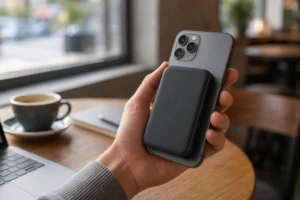
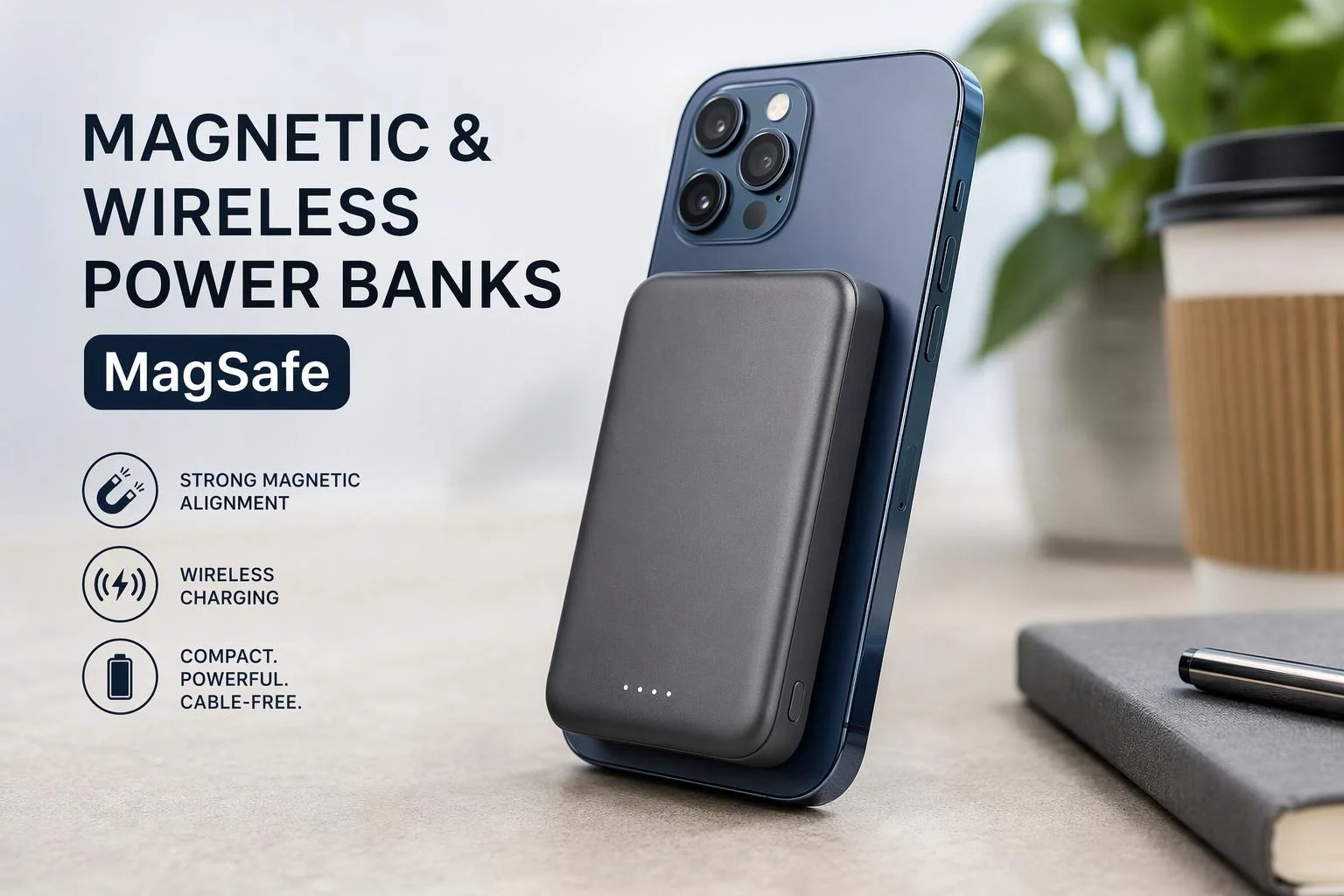
Magnetic wireless power banks are the answer to a specific, everyday problem: a phone that is running low while you are moving, with no outlet in reach and no patience for a cable. A ring of magnets holds the pack against the back of the phone, the coils line up, and charging starts without a plug. For iPhone owners this is the MagSafe-style experience, and since 2023 the same idea has been standardized across brands under Qi2.
This guide covers what magnetic wireless power banks are, how induction and magnetic alignment actually work, and where MagSafe, Qi and Qi2 differ. It then looks honestly at whether the trade-offs are worth it, what to check before buying, and how to use one without putting unnecessary stress on your battery. Detailed product picks and brand comparisons are handled in the linked supporting articles.
What Are Magnetic and Wireless Power Banks?
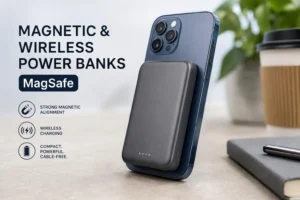
A magnetic wireless power bank combines two things: a battery and a wireless charging coil, plus a ring of magnets that holds the phone in place. Wireless charging itself uses magnetic induction — the pack’s transmitter coil creates a changing magnetic field, and the phone’s receiver coil converts it back into current. Nothing needs to plug in.
The magnets solve a separate problem. Wireless charging only runs well when the two coils sit directly on top of each other, and a phone placed loosely on a pad tends to drift. A magnetic ring snaps the phone into the same position every time.
The distinction that matters most when shopping is between MagSafe and “magnetic.” MagSafe is Apple’s own trademarked term for its magnetic charging system, listed in Apple’s trademark list with the generic term “accessories.” A third-party pack can be licensed through Apple’s MFi program and described as MagSafe, or it can simply contain magnets and charge at generic Qi speeds. Both may snap to an iPhone, but only the first has gone through Apple’s licensing program. Qi2 is a different arrangement: it is the WPC’s open standard, and Qi2 certification is a WPC test process that has nothing to do with Apple’s MFi approval. A pack can hold one, the other, or neither. Certification of either kind tells you the hardware passed defined tests; neither one promises a particular charging speed on every phone.
How Do Magnetic Wireless Power Banks Work?
The mechanics are straightforward once you separate the two jobs the hardware does.
Alignment is mechanical. The WPC explains that a magnetic charger snaps the phone’s receiver coil directly over the transmitter coil every time, and that Qi2’s Magnetic Power Profile specifies the magnet ring’s dimensions, layout and strength so certified phones and chargers fit together. The magnets do not charge anything; they remove the human error of placing the phone slightly off-center.
Energy transfer is inductive. Current in the transmitter coil generates an oscillating magnetic field; the receiver coil picks it up and the phone’s circuitry converts it to the voltage the battery needs. Any gap or misalignment between the coils wastes energy as heat instead of charge.
That is why alignment improves performance rather than merely convenience. A well-aligned pair transfers more of the pack’s output into the battery and produces less waste heat, which in turn helps the phone avoid the thermal throttling that slows charging. The magnets cannot fix poor electronics, though. Certification is the clearest signal available, but it confirms that a product passed defined safety and interoperability tests, not that it will deliver identical power or run equally cool in every situation.
MagSafe vs. Qi vs. Qi2: What’s the Difference?
These three names get used interchangeably, but they describe different things: one is Apple’s system, one is the older open standard, and one is the current standard built on magnetic alignment.
Feature | Apple MagSafe | Traditional Qi (Qi 1.x) | Qi2 with Magnetic Power Profile (MPP) | Qi2 25W (spec v2.2) |
|---|---|---|---|---|
What it is | Apple’s proprietary magnetic charging system | Original WPC inductive standard, no magnets | WPC standard that adds MPP, a magnet ring derived from MagSafe | Higher-power Qi2 profile, still built on MPP |
Magnetic alignment | Yes, Apple’s magnet array | No | Yes, standardized magnet ring dimensions, layout and strength | Yes, same MPP alignment |
Rated phone wireless power | Up to 15W on iPhone 12–15; up to 25W on newer models | Up to 7.5W on iPhone | Up to 15W | Up to 25W |
Certification body | Apple, with MFi licensing for third-party accessories | WPC | WPC | WPC |
Cross-brand use | Apple devices | Broad but slow | Certified Qi2 gear across brands | Same as Qi2, but both ends must support the higher profile to reach 25W |
The wattages in the table are what each phone is rated to accept, not what any given pack will deliver. Apple lists MagSafe and Qi2 wireless charging up to 15W on the iPhone 15, with the iPhone 12 mini and iPhone 13 mini capped at 12W, while the iPhone 16 is rated up to 25W on Qi2 25W when paired with a 30W or higher adapter. Those are Apple’s test conditions with a matching charger, and they are not a promise from a third-party pack. A power bank rated at 15W cannot push an iPhone 16 to 25W.
Traditional Qi is not obsolete — Apple notes that many Qi-certified chargers charge iPhone at rates up to 7.5W, and that chargers below 10W, such as Qi1 units, may charge more slowly than expected. Qi2 arrived in 2023 with 15W and magnetic attachment, certified by the WPC’s Qi program; Qi2 25W, branded from specification version 2.2.1, launched in July 2025 and delivers nearly 70% more power.
Are Magnetic Wireless Power Banks Worth It?
For the right user, yes — with clear limits.
The advantages are real: no cable to connect in a hurry, consistent alignment, a pack that stays attached in a pocket or bag, and one less port to wear out. Qi2’s magnetic profile also makes charging more efficient than loose placement, and the WPC notes that certified devices negotiate when to ease off and stop, so a full phone is not overcharged.
The costs are equally real. Energy is lost at each conversion — the pack turns direct current into an alternating field, and the phone turns it back — so wireless transfer delivers less usable power per charge than a cable and releases the difference as heat. Heat is the main long-term concern, because sustained warmth above room temperature is what accelerates battery ageing. Apple notes that if the battery gets too warm, software may limit charging above 80% until it cools. Magnetic packs also add bulk and weight, and a 10,000mAh unit is noticeably heavier than a slim 5,000mAh one.
Suitable users: commuters, travelers and anyone who charges in short bursts on the move, especially with a magnet-equipped iPhone from the 12 series onward. Less suitable: people who need maximum charges per gram, or who mainly charge at a desk where a cable is easier. If portability and convenience outweigh raw efficiency, a magnetic pack earns its place; if not, a wired pack of the same capacity will go further.
Best Wireless Magnetic Power Banks for iPhone
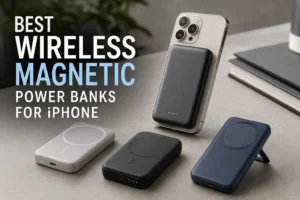
Magnetic packs for iPhone fall into three rough shapes, and the shape usually matters more than the spec sheet.
Slim packs (around 5,000mAh) are the lightest and disappear against the phone, but they typically deliver about one partial top-up. High-capacity packs (10,000mAh and up) cover a full day or a weekend trip but add weight and thickness. Multifunctional models add a fold-out stand, a ring grip, or extra ports so the pack doubles as a desk charger or a wired hub.
Key selection factors: whether the pack’s wireless output is rated at 15W (not just your phone’s rating), whether there is a USB-C wired output for faster top-ups, the pack’s weight in grams rather than its marketing photos, and whether it carries Qi2 certification rather than magnets alone. For a closer look at specific models and how they compare, see our guide to the best wireless magnetic power banks for iPhone.
MagSafe Power Banks Compared: Anker vs. Belkin and What to Look For
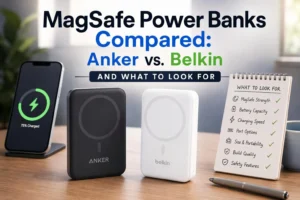
Anker and Belkin both sit at the established end of the accessory market: long product lines, broad retail support, and usually published certification and spec sheets. Smaller or newer brands more often compete on price, capacity-to-weight ratio, or extras like built-in stands and cables. Neither group is automatically better.
What to look for is less about the logo than the specifics: Qi2 or MagSafe compatibility stated explicitly, the wireless wattage the pack actually delivers (not just what the phone can accept), wired output for faster charging when you need it, and honest capacity figures. Brand positioning tells you about support and consistency; the certification and specs tell you what the product will do. Our Anker vs. Belkin MagSafe power bank comparison walks through the differences in more detail.
How to Choose the Right Magnetic Wireless Power Bank
Work through these in order, because the early ones eliminate more products than the later ones.
Compatibility first. Magnetic charging isn’t universal across iPhones. Models from the iPhone 12 series through the iPhone 15 series have a built-in magnet array and charge at up to 15W wirelessly (12W on the 12 mini and 13 mini); the iPhone 16 family and later support higher rates with matching chargers. The iPhone 16e and iPhone SE (2022) don’t have magnets, so they charge on Qi at up to 7.5W and won’t snap on without a magnetic case. Note the wattage your phone accepts — a 25W pack won’t make a 15W phone charge at 25W.
Capacity versus weight. Capacity is quoted in mAh, but watt-hours decide how much energy the pack holds and whether you can fly with it. A 5,000mAh pack is a pocket companion, 10,000mAh covers a day out, and 20,000mAh is a travel brick. Do the math before a flight: Wh is what regulators count, and the FAA limit is 100Wh in carry-on, with 101–160Wh allowed only with airline approval. A 10,000mAh pack at a nominal 3.7V works out to about 37Wh, well inside the limit.
Charging speed, advertised versus actual. Three numbers matter and they aren’t the same: the charger’s maximum output, the power bank’s rated output, and the speed your phone accepts. A USB-C wired output, often 20W or 22.5W, is usually your fastest option.
Magnetic strength. Stronger hold means less shifting and fewer interrupted charges; certification sets a baseline, but grip varies.
Safety features. A temperature-control chip and protections against over-current and over-voltage are the basics to expect.
Size and shape. Check that the pack does not block the camera and that it fits your case.
How to Use a Magnetic Wireless Power Bank Safely and Effectively
Most problems with magnetic power banks come from placement and heat, not from the hardware itself.
Attach it centered. Let the magnets pull the phone into position rather than pressing it on at an angle; a coil that is off-center wastes power as heat. Check your case. Thin cases usually work; thick, metal or battery cases can reduce performance or block the magnets, and Apple suggests removing such a case if charging is slow. Pause when it gets warm. Wireless charging produces more heat than a cable, so charge in a cooler place, keep the pack and phone out of direct sun, and don’t stack them under a pillow or blanket. If the phone gets warm, charging may slow or pause above 80% until it cools; that’s thermal management working, not a fault. Frequent high-temperature charging is what shortens long-term battery life, so a few minutes of slower charging is usually the better trade. Keep sensitive cards away. Apple warns against placing credit cards, security badges, passports or key fobs between the phone and the charger, since the field can damage magnetic strips and RFID chips. Maintain it simply. Keep the contact surfaces clean and store the pack at a moderate charge rather than fully drained.
Frequently Asked Questions About Magnetic Wireless Power Banks
Is MagSafe the same as magnetic wireless charging? No. MagSafe is Apple’s specific system; magnetic wireless charging is the broader category, which includes Qi2 and generic magnetic packs.
Do magnetic wireless power banks work with Android phones? Only a few have magnets built in. Google’s Pixel 10, Pixel 10 Pro and Pixel 10 Pro Fold charge magnetically at up to 15W, the Pixel 10 Pro XL and all four Pixel 11 models at up to 25W; the Pixel 10a is excluded. Motorola’s Edge 70 Max also has built-in magnets and supports up to 25W. Samsung’s recent Galaxy S and Z models are marketed as “Qi2 Ready” and need a magnetic case to snap on. Most other Android phones charge on Qi without the magnetic hold.
Can a magnetic power bank charge an iPhone without a MagSafe case? On a model with the magnet array, yes. A MagSafe-compatible case adds grip and thin cases work fine, but the magnets are in the phone rather than the case. Phones without magnets, such as the iPhone 16e, need a magnetic case for the pack to stay put.
Is Qi2 better than traditional Qi? For speed and alignment, generally yes: Qi2 adds standardized magnets and up to 15W (25W with Qi2 25W), versus the slower rates typical of Qi1.
Is wireless charging slower than wired? Usually. A wired USB-C connection typically delivers more power with less heat loss.
Can magnetic power banks damage phone batteries? A certified pack negotiates power and stops when the phone is full; heat, not magnetism, is the real long-term concern. Charge in a cool, ventilated spot, avoid leaving the pack and phone together on a hot dashboard or under bedding, and don’t use a thick case that traps warmth. Those habits matter more for battery health than brand choice.
How can I check MagSafe compatibility? Look for explicit MagSafe or Qi2 certification on the product, then check the model in the WPC’s certified products database. Apple’s device specs page confirms what your iPhone supports.
Final Thoughts
Magnetic wireless power banks trade a little efficiency for a lot of convenience, and for most iPhone users that is a good trade. The main benefits are effortless alignment, cable-free charging on the move, and a standardized experience thanks to Qi2. The main limitations are heat, lower effective capacity than a wired pack of the same size, and the need to check certification rather than assume it.
Buy on compatibility, wireless output, wired output and weight — not on the biggest number on the box. JOYROOM’s magnetic range includes the JR-PBM08 (5,000mAh, 19.25Wh, 205g) and the JR-PBM08 Pro (10,000mAh, 38.5Wh), both with wireless charging at up to 15W and USB-C wired output rated at 20W on the smaller model and 22.5W on the Pro. Check the individual product page for its certification and dimensions before you buy. Whichever brand you choose, match the pack’s ratings to what your phone actually accepts.