



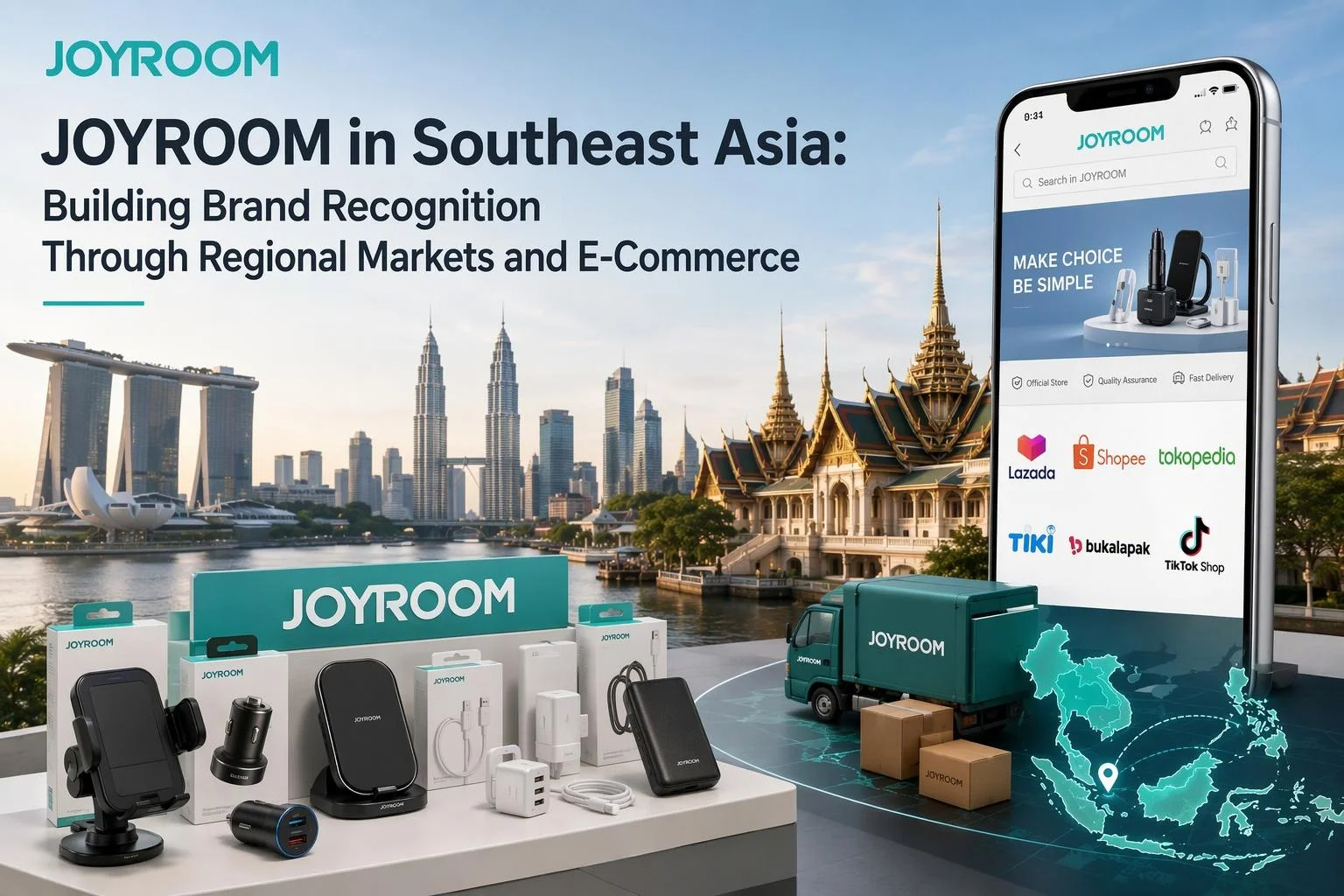
Introduction: JOYROOM’s Growing Presence in Southeast Asia
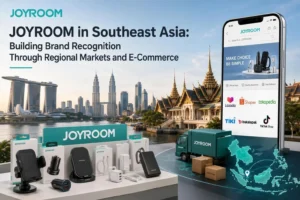
JOYROOM in Southeast Asia is part of the brand’s broader effort to build recognition in one of the world’s increasingly important consumer electronics markets. With growing e-commerce activity, mobile-first shopping habits, and rising demand for digital accessories, Southeast Asia offers opportunities for brands looking to expand their regional presence.
According to Google, Temasek, and Bain, Southeast Asia’s digital economy is projected to reach $368 billion in gross merchandise value in 2026, with e-commerce accounting for $226 billion. While these figures represent the broader digital economy and online retail market rather than the mobile accessories category alone, they highlight the region’s growing importance for consumer brands.
Social commerce is also changing how consumers discover and purchase products. TikTok reports that more than 325 million people across Southeast Asia use its platform each month, while 15 million businesses are active on the platform. For mobile accessories brands, this creates opportunities to demonstrate product features through short videos, livestreams, and creator recommendations.
JOYROOM’s company-reported performance reflects its activity in this regional e-commerce environment. The brand reports a TOP 5 position among Southeast Asia TikTok Shop Consumer Electronics & Home Appliance Brands, with travel chargers and protective accessories repeatedly ranking among its TOP 2 best-selling product categories on the platform. These are company-reported figures, not independently audited market-share results.
This article explores how JOYROOM is developing its presence across Southeast Asia, including its e-commerce performance, popular product categories, regional consumer demand, and opportunities for distributors and business partners.
Southeast Asia has become one of the most closely watched regions in consumer electronics, and not only because of its size. Google, Temasek and Bain estimate that Southeast Asia’s digital economy is projected to reach $368 billion in gross merchandise value in 2026, with e-commerce alone accounting for $226 billion. That figure describes the whole region’s online trade, not the accessories category specifically, but it explains why international brands now treat the region as a primary market rather than an export afterthought.
The channel mix matters as much as the volume. Shopping in the region increasingly begins inside a video feed rather than a search bar, and TikTok’s growing role in Southeast Asia’s digital economy is hard to ignore: the company reports that more than 325 million people across Southeast Asia open its app every month, with 15 million businesses using the platform. For a mobile accessories brand, that is a discovery environment built around demonstration: a charger that folds, a case that survives a drop, a mount that holds on a rough road.
JOYROOM’s own reporting places it inside that environment. Company materials describe the brand as a TOP 5 Southeast Asia TikTok Shop Consumer Electronics & Home Appliance Brand, with travel chargers and protective accessories repeatedly appearing among its TOP 2 best-selling products on the platform. Those are company-reported figures for a specific channel and region, not independently audited market shares, and this article treats them that way.
What follows examines how JOYROOM Southeast Asia activity has developed: the e-commerce channels behind its visibility, the product categories consumers have responded to, the demand patterns those categories reflect, and the distribution partnerships that determine whether online momentum becomes a durable regional business.
JOYROOM’s Brand Development Across Southeast Asian Markets
Brand recognition in Southeast Asia is rarely built in one place. It accumulates across marketplaces, campaigns and product categories, and it is easiest to read through the channels where consumers actually encounter a brand.
Building Brand Recognition Through Local E-Commerce Platforms
JOYROOM’s confirmed regional visibility is concentrated on TikTok Shop. The company reports a TOP 5 position among Southeast Asia TikTok Shop Consumer Electronics & Home Appliance brands, alongside a separate TOP 3 ranking for its Southeast Asia TikTok official store. These are distinct company-reported rankings covering different scopes, and neither should be read as an independently verified category leadership claim. For a trade buyer, their practical value is directional: they indicate that the brand has achieved consumer-facing scale on the platform where much regional discovery now happens. Shopee and Lazada, by contrast, are marketplaces many regional shoppers use, but JOYROOM’s company materials do not confirm official storefronts there; authorised regional partners may operate on these platforms, so any listing arrangement is best verified with the brand directly.
Establishing a Stronger Regional Market Position
Visibility and sales reinforce each other. A ranking places a product in front of new viewers; those viewers generate reviews, returns and repeat purchases; that feedback shapes the next product iteration. JOYROOM’s company materials describe this loop as part of its regional development, reporting that its best-selling travel chargers, cables and other products reach 40,000+ units in monthly sales on TikTok Shop in Southeast Asia. The figure is company-reported and covers a single platform and region, so it should be read as evidence of channel traction rather than a country-level market share. What it does show is a brand converting attention into repeatable volume, which is the precondition for a distributor conversation.
That volume doesn’t come from marketing alone. Company materials describe a product organisation holding 300+ utility and design patents in China and overseas, with launches such as a 140W 5-in-1 charging station and a 240W power bank with a dual-screen display. Whatever a partner makes of individual SKUs, the through-line matters: a brand that develops its own hardware can respond to regional requirements — plug standards, capacity tiers, case fit for models sold locally — instead of only rebadging generic stock.
How JOYROOM Performs Across Southeast Asia’s E-Commerce Channels
A brand’s e-commerce performance is best judged channel by channel, because each platform rewards different behaviour and reaches a different kind of shopper.
TikTok Shop as a Key Channel for Brand Growth
TikTok Shop combines entertainment and checkout in a single session, which shortens the distance between seeing a product and buying it. JOYROOM’s reported results on the platform include its TOP 5 brand ranking and a Double Day campaign that the company says exceeded its sales target by more than 200%. Campaign multipliers of this kind reflect promotional timing and channel readiness as much as baseline demand, so they are best read as evidence that the brand can execute a coordinated platform campaign, not as a permanent growth rate.
Turning Product Visibility into Online Sales
Short-form video, livestream selling and creator recommendations do more than advertise; they explain. A charger’s foldable plug, a case’s reinforced corners or a mount’s grip can be shown in seconds, which answers the questions a static listing leaves open. TikTok’s own regional reporting describes small businesses increasing revenue by nearly 50% through selling on the platform, a company-commissioned survey result that points to how central demonstration-led selling has become. For JOYROOM, the categories that perform best are the ones that reward that format.
Building a Multi-Channel E-Commerce Presence
TikTok Shop generates discovery, while marketplaces such as Shopee and Lazada serve shoppers who arrive with intent: comparing specifications, reading reviews, checking seller ratings. Keeping product information, pricing and warranty terms consistent wherever a JOYROOM listing appears — including on marketplace channels that authorised regional partners may operate — lets a consumer who first meets the brand in a video find the same product on the marketplace they already trust. For distributors, that consistency across channels also reduces dependence on a single platform’s algorithm or promotional calendar, which matters when planning stock across a selling season.
JOYROOM’s Best-Selling Products Reflect Local Consumer Demand
Sales rankings describe demand, but product categories explain it. The categories where JOYROOM reports its strongest platform performance map closely onto how people in the region actually use their devices.
Travel Chargers for Everyday Convenience and Mobile Lifestyles
Travel chargers are among JOYROOM’s strongest reported categories, with the company stating that best-selling travel chargers and cables reach 40,000+ units in monthly sales on TikTok Shop in Southeast Asia, and describing the brand as the fastest-growing mobile accessories seller on the platform in 2026. The appeal is practical: compact GaN designs with foldable plugs and multi-port output let one unit serve a phone, a tablet and occasionally a laptop, which suits commuters, students and frequent travellers. JOYROOM’s charger range includes multi-port models with universal 100–240V input and UK and EU plug options, a specification that matters to distributors stocking one SKU across markets with different socket standards.
Protective Accessories for Everyday Device Protection
Protective accessories address a different kind of demand: the cost of a damaged phone relative to the cost of preventing the damage. JOYROOM’s company materials report protective accessories among its TOP 2 best-selling products on TikTok Shop in the region. The category also carries commercial logic for retailers, since cases and screen protectors are model-specific, bought repeatedly and often purchased alongside a device. JOYROOM’s published specifications for its case and screen protector lines describe features such as reinforced corners, anti-yellowing materials and high-transparency tempered glass, the details shoppers compare before buying.
Meeting the Broader Demand for Digital Accessories
Beyond chargers and protection, JOYROOM’s portfolio covers charging cables, power banks, phone mounts and wireless charging products, alongside audio, smart wearables and stylus accessories. The breadth is a development capability as much as a catalogue: the same team designs charging electronics, mechanical accessories such as holders and mounts, and protective products, which means a partner can source a coordinated range rather than assemble one from unrelated suppliers. Commercially, a retailer that already stocks JOYROOM chargers has a natural adjacent assortment in cables and power banks, while a distributor can build a category rather than place a single-SKU order. Company materials describe power bank options from compact 10,000mAh units to a 25,000mAh model rated under 100Wh for carry-on travel, which illustrates how the range is tiered by use case rather than by price alone.
Understanding Southeast Asian Consumer Demand for Digital Accessories
Product performance on a platform is a symptom; consumer behaviour is the cause. Understanding why these categories sell helps partners judge whether demand is likely to persist.
Mobile-First Lifestyles Drive Demand for Charging Solutions
According to GSMA Intelligence’s Mobile Economy Asia Pacific 2026 report, mobile connectivity across Asia Pacific is now larger than ever: nearly 1.8 billion unique mobile internet users, representing more than 60% of the region’s population. These are Asia Pacific figures, a geography broader than Southeast Asia alone, so read them as the backdrop against which regional Southeast Asian demand sits rather than as a Southeast Asia-only measure. More connected people, spending more of the day on a phone, translate into more charging cycles and more reasons to carry backup power. The same logic drives demand for compact chargers, cables and power banks that fit into a bag or a pocket rather than staying on a desk.
Practicality, Affordability, and Product Design Influence Buying Decisions
Buying behaviour varies across the region’s markets, income levels and retail formats, so no single description fits every shopper. What recurs in accessory purchasing is a set of practical checks: does it charge my device at the speed it supports, does it fit my plug standard, will it survive daily handling, and is the price reasonable for how long it should last. Product design answers those questions visibly. A digital display showing remaining battery, a foldable plug or a reinforced case edge communicates value before a shopper reads a specification sheet, which is why design and durability claims carry commercial weight in this category.
Social Commerce Is Changing How Consumers Discover Products
Video commerce has moved from novelty to a substantial share of regional online trade. Temasek’s summary of the e-Conomy SEA 2025 report notes that video commerce in Southeast Asia accounted for approximately 25% of total e-commerce GMV in 2025, driven by trusted local creators and short video that connects directly to checkout. TikTok’s regional reporting similarly describes creators building income through livestreams and brand partnerships. For JOYROOM, this is why channel strategy and content strategy are the same decision: the brand’s reported rankings depend on creators and livestreams presenting products in a format regional shoppers already use to decide.
How JOYROOM Expands Its Market Presence Through Regional Channels and Partnerships
E-commerce performance creates visibility; distribution determines whether that visibility converts into sustained sell-through. JOYROOM’s regional approach therefore pairs marketplace activity with local channel partners who hold stock, serve retail accounts and handle the last mile to the consumer.
Strengthening Online Distribution Across Local Markets
Local e-commerce operations go beyond listing a product. Product titles, plug-type variants, warranty information and after-sales responses need to match the market they serve, because a buyer comparing a UK-pin charger with an EU-pin listing is making a compatibility decision, not just a price decision. JOYROOM provides product-specific compliance documentation and test reports, with details available to contracted partners on request. Because requirements differ by SKU and by target market, buyers should confirm the certification files that apply to the exact models they intend to import before placing an order.
Working with Local Distributors and Business Partners
Wholesalers, importers, distributors and retailers each solve a different problem. Distributors carry import, warehousing and regional credit; retailers decide assortment and face the customer. JOYROOM reports products sold in 130+ countries and a network of more than 500 distributors, 1,000 retailers and 20,000 physical shops worldwide, alongside OEM and ODM support and market-specific certification assistance under a partner’s own brand or importer name. Behind that sits the part buyers usually ask about second: three ISO 9001-certified manufacturing facilities and around 100,000 m² of warehousing, which is what makes replenishment during a selling season a planning question rather than a hope. Commercial terms such as MOQs, mixed-SKU orders, price protection and replenishment during peak season are negotiated per partner and market, so they should be confirmed directly rather than assumed from a brand overview.
Combining Online Visibility with Long-Term Regional Development
Campaign spikes are easy to measure and easy to over-read. A brand that ranks well during a Double Day promotion has demonstrated that its content and pricing can convert attention; it has not demonstrated that stock will be available in month six, that a defective batch will be replaced quickly, or that channel pricing will hold. Those outcomes depend on distribution depth, product availability and the trust a partner builds with its own accounts. For a distributor evaluating JOYROOM, the useful question is whether the e-commerce record is backed by supply reliability and documentation that survive an annual purchasing cycle.
Conclusion: Building a Recognizable Digital Accessories Brand in Southeast Asia
JOYROOM’s Southeast Asian story is one of a brand building recognition through the channels where regional consumers actually discover products. Company-reported results place JOYROOM among the TOP 5 Southeast Asia TikTok Shop Consumer Electronics & Home Appliance Brands, with travel chargers, protective accessories and other products repeatedly ranking among TOP 2 Best-Selling Products, best-selling travel chargers and cables reaching 40,000+ units in monthly sales on TikTok Shop in Southeast Asia, and the TikTok Double Day campaign exceeding its sales target by 200%+. These are company-reported figures for specific platforms and campaigns, not independently verified market-share data, and they should be read as evidence of channel momentum rather than proof of category leadership.
What those results indicate for a trade buyer is narrower and more practical: there is demonstrated consumer demand in the region for the categories JOYROOM builds, and a working playbook for presenting them on video-led marketplaces. That demand is the raw material a distributor or retailer can convert into sell-through, provided the supply side holds up.
That is where regional partnerships matter. E-commerce generates the first sale; distributors, importers and retailers generate the repeatable one. Partners bring import capability, warehousing, credit, retail relationships and local market knowledge that no brand can replicate from a distance, and they carry the compliance and labeling responsibilities that sit with the importer of record in each market.
For a distributor sizing up the opportunity, the case rests on four things that can be checked rather than taken on faith. First, category coverage: charging, power banks, cables, mounts and protective accessories let one supplier fill several shelves, with ports and plug variants tailored per market. Second, proven demand and visibility: reported TikTok Shop rankings and monthly volumes show consumers in the region are already buying these categories. Third, an established partnership model: 130+ countries of distribution experience, OEM/ODM support and certification assistance mean the brand has supported importers before. Fourth, documented compliance: product-specific compliance documentation and test reports available to contracted partners, confirmable SKU by SKU against the requirements of each target market.
For wholesalers and distributors assessing JOYROOM as a supplier, the productive next step is a concrete evaluation rather than a general impression: request samples across the charging, power bank, cable and protective categories; ask for product-level certification files and test reports for the SKUs you intend to import; confirm MOQ, mixed-SKU terms, lead times and warranty handling for your market; and compare how the assortment performs against your existing range. Contact JOYROOM’s business team to start that conversation with your category requirements and target markets in hand.
FAQs
Is JOYROOM available in Southeast Asian markets? JOYROOM sells through e-commerce platforms including TikTok Shop in the region, and the company reports a TOP 5 position among Southeast Asia TikTok Shop Consumer Electronics & Home Appliance Brands. Availability of specific SKUs varies by market and channel, so buyers should confirm assortment with the local seller or JOYROOM directly.
What are JOYROOM’s best-selling product categories in Southeast Asia? Company materials report travel chargers and protective accessories repeatedly ranking among TOP 2 Best-Selling Products, with best-selling travel chargers, cables and other products reaching 40,000+ units in monthly sales on TikTok Shop in Southeast Asia. Charging cables, power banks, phone mounts and wireless charging products round out the portfolio.
Can wholesalers and distributors source JOYROOM products in bulk? Yes. JOYROOM works with distributors, importers, retailers and OEM/ODM clients, and offers product-specific compliance documentation for contracted orders. MOQs, pricing, lead times and regional certification support are agreed per partner and per market.
What certifications do JOYROOM products carry? Certification and test documentation varies by product model and target market, so there is no single list that applies across the portfolio. Registered partners can request the compliance documents and test reports that apply to specific SKUs, and should confirm them against their own market’s import requirements before ordering.
Which e-commerce platforms does JOYROOM use in Southeast Asia? JOYROOM’s confirmed regional presence centers on TikTok Shop, where the company reports its Southeast Asia rankings. Shopee and Lazada are widely used by regional shoppers, but official JOYROOM storefronts there are not confirmed in company materials, and authorised regional partners may operate on those marketplaces; buyers should verify channel status directly with the brand or its local partners.