

Introduction
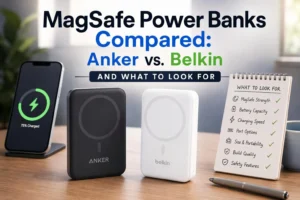
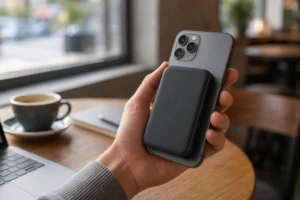
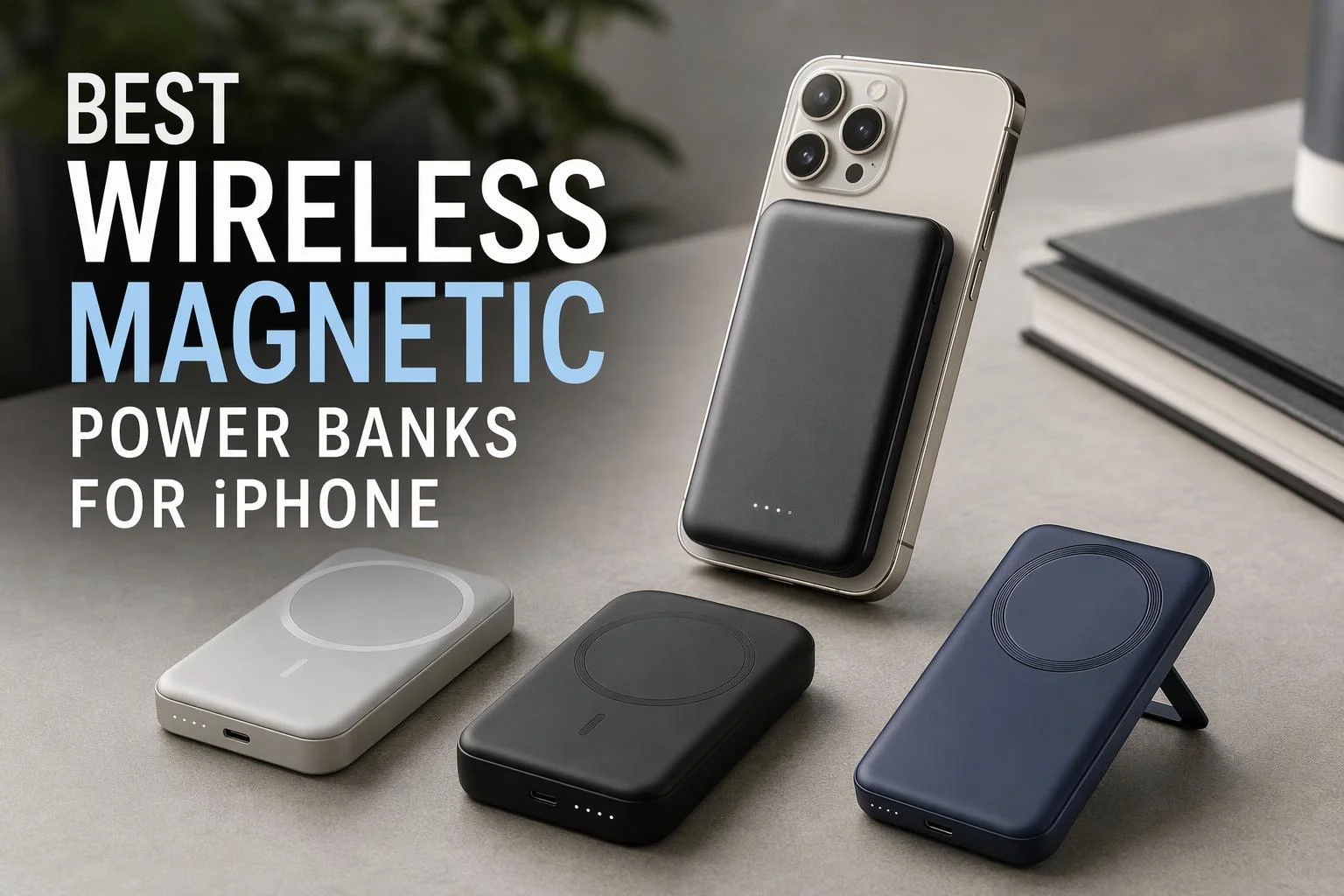
The best wireless magnetic power banks for iPhone combine convenient cable-free charging with a slim, portable design. A MagSafe battery pack snaps onto the back of a compatible iPhone, using magnetic alignment to keep the charging coils in position while you walk, text, or navigate. There’s nothing to plug in, and nothing to unplug before you answer a call.
The appeal is mostly about friction. A conventional power bank lives in a bag until you remember it, then asks for a cable you may not have. A magnetic pack stays attached to the phone, so the charge you carry is the charge you actually use. Apple describes the experience plainly: on supported models, MagSafe chargers and battery packs snap to the back of the iPhone or its MagSafe case, the magnets ensure proper alignment for fast wireless charging, and you can hold and use the phone while it charges (Apple iPhone User Guide).
That convenience comes with trade-offs worth understanding before you buy. Capacity decides how many top-ups you get, but the number printed on the box is a cell rating rather than the energy that reaches your phone. Wireless charging speed depends on the iPhone model, the power source and the standard involved, not just the pack. Magnet strength and case compatibility decide whether the pack stays put in a pocket or slides off in a bag. Thickness and weight decide whether you tolerate carrying it every day. Price separates a basic 5,000mAh unit from a 10,000mAh model with a stand and a second output port.
This guide works through those factors in order: how magnetic charging actually works, which iPhone models support it, which type of portable wireless charger for iPhone users is right, how to compare specifications honestly, and how Apple’s own battery accessories compare with third-party options. Business buyers sourcing for retail or distribution will also find a section on what to check before placing a bulk order.
What Is a Magnetic Power Bank and How Does It Work?
A magnetic power bank combines a lithium battery, a wireless charging coil and a ring of magnets in one housing. The magnets position the coil directly over the iPhone’s receiving coil; the battery pushes current through the coil, and the phone converts the magnetic field back into electricity. Because the two coils sit in a fixed position rather than being nudged around by hand, alignment stays consistent — the point Apple makes when it says MagSafe provides optimal magnetic alignment for faster, more efficient charging (Apple Support).
That is the difference from a traditional portable charger. A standard power bank delivers energy through a cable, so the phone and the battery can sit anywhere. A magnetic pack is designed to travel attached to the phone, which is why its capacity, thickness and magnet array matter as much as its wattage.
MagSafe vs. Qi2: What’s the Difference?
Four wireless standards matter here, and they arrived in this order.
Original Qi is the baseline. It delivers power by induction without a magnet ring, so you line the phone up on the pad by eye, and alignment shifts as soon as the phone moves. Qi’s basic power profile is modest, and early Qi chargers were slow in practice, but the standard has been revised repeatedly: supported wattage varies by Qi version, and each phone and charger negotiates its own level. That’s why “Qi” on a box tells you little about real speed compared with Qi2, and why two Qi chargers can behave very differently on the same phone.
MagSafe is Apple’s own magnetic system, introduced with the iPhone 12. A ring of magnets locks an accessory into place, and Apple-certified chargers go through Apple’s own approval process. On power, Apple’s own MagSafe Charger reaches up to 25W of peak wireless delivery on models that support it, which today means iPhone 17 Pro Max and the iPhone 18 Pro models, and only when paired with a 30W-or-higher adapter (Apple Support). That figure belongs to the wall charger, not to a battery pack.
Qi2, launched by the Wireless Power Consortium in 2023, standardized the same idea for every brand. Its Magnetic Power Profile gives cross-brand accessories magnetic alignment at up to 15W, and certified products pass interoperability and safety testing (WPC). Qi2 25W, based on Qi specification v2.2.1 and announced in July 2025, raised the certified ceiling to 25W — nearly 70% more power than the original Qi2.
Keep the sources of those numbers apart. Apple’s MagSafe Charger can hit 25W because it is a mains-powered device built to Apple’s specification. A Qi2 25W certification describes what the standard allows. A third-party magnetic power bank is a battery, and most are marketed at 15W wireless output, sometimes lower. And the iPhone only accepts what its own hardware permits: iPhone Air peaks at 20W on a MagSafe Charger, a figure tied to that specific accessory and adapter combination, not to any magnetic pack you attach. A 25W phone paired with a 15W pack charges at 15W or less.
Certification and performance are different things, too. A Qi2 logo means the product passed testing; it doesn’t promise that every iPhone will pull the rated wattage. Three numbers get confused in product listings, and they should stay separate:
What it describes | Example | What it means in practice |
|---|---|---|
Maximum the iPhone accepts | 25W on iPhone 17 Pro Max or iPhone 18 Pro with a compatible MagSafe Charger; 15W on iPhone 17e | The phone’s own ceiling, and only under the conditions Apple specifies |
Maximum the power bank outputs | A third-party pack rated at 15W wireless | The best case, measured at the coil |
Power actually delivered | Usually below both figures | Drops with heat, case thickness, phone load and battery level |
So a 15W pack and a 25W phone don’t add up to a 25W charge; the lower limit wins, and real-world delivery sits under that.
Which iPhone Models Support Magnetic Wireless Charging?
Don’t assume a whole generation qualifies. Apple’s MagSafe support starts with the iPhone 12 family, but the cheaper “e” models don’t all follow the same rule. The iPhone 16e charges on a Qi pad and accepts power from a MagSafe charger, yet it has no magnet array of its own (Apple Support). The iPhone 17e is the exception that proves the point: Apple lists MagSafe and Qi2 wireless charging up to 15W for it, along with a built-in magnet array (Apple 17e Tech Specs). One letter separates two very different products.
iPhone models | Qi wireless charging | Built-in MagSafe magnets |
|---|---|---|
iPhone 12, 13, 14 and 15 families (all models) | Yes | Yes |
iPhone 16, 16 Plus, 16 Pro, 16 Pro Max | Yes | Yes |
iPhone 16e | Yes | No |
iPhone 17, 17 Pro, 17 Pro Max | Yes | Yes |
iPhone 17e | Yes | Yes |
iPhone Air | Yes | Yes |
iPhone 18 Pro, 18 Pro Max | Yes | Yes |
iPhone 8 through iPhone 11, iPhone SE (2nd and 3rd gen) | Yes | No |
Keep two capabilities separate. Wireless charging support means the phone can receive power through induction. Magnetic attachment means the phone holds the accessory in place. A phone can have the first without the second, and that gap is the most common source of disappointed buyers. If your iPhone has no magnets, a magnetic case or an adapter ring restores the grip.
Best Wireless Magnetic Power Banks for iPhone: Which Type Should You Choose?
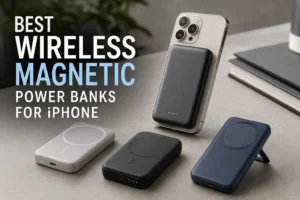
Magnetic power bank models divide into four practical categories. The right one depends on whether you prioritize pocketability, total energy, charging speed or hands-free use.
Slim 5000mAh Magnetic Power Banks for Everyday Use
A 5,000mAh pack answers the usual problem — you left the power bank at home — because it never leaves the phone. This is the slim power bank 5000mah iphone buyers reach for on a commute, a gym session or a night out, where the goal is reaching an outlet rather than running a second full day. Expect somewhere between half a charge and a full charge once conversion losses are counted, so treat it as a safety net, not a tank.
Two details separate a good slim battery pack for iphone from a disappointing one. First, thickness: a body around 9–10mm still slips into a jeans pocket attached to the phone. Second, magnet count and hold, because a thin shell with weak magnets is fine on a desk and useless in a bag. Treat capacity as an estimate rather than a promise, since the top-up you actually get varies with the iPhone model, its battery age, screen brightness and how hard the phone is working.
High-Capacity Magnetic Power Banks for Travel
Travel packs move to 10,000mAh and beyond, trading thickness and weight for multiple charges across a long day of maps, camera and messaging. Size and weight vary considerably between models at this capacity — a slim 10,000mAh design and a 3-in-1 unit with a stand and watch charger are very different objects in the hand — so compare the published figures for the specific product rather than relying on a capacity-based rule of thumb. If you’d rather not carry it against the phone all day, leave it in the bag and snap the phone on during a coffee stop.
Two checks before you fly. Convert capacity to watt-hours — a 10,000mAh cell at 3.7V is 37Wh, comfortably under the 100Wh carry-on limits most airlines and aviation regulators apply — and keep the pack in your cabin bag rather than checked luggage, since that’s where spare lithium batteries must travel.
Reconsider the size if you only need one top-up. A 10,000mAh pack that stays in the hotel room is worse than a 5,000mAh one that comes with you, and the wireless power bank for iphone that gets used beats the bigger one that gets forgotten.
Fast Wireless Charging Power Banks for iPhone
Speed-focused packs pair a higher wireless output with Qi2 certification where available, and add a USB-C port so you can fall back to wired charging when time is short. The wired port usually delivers more power than the wireless coil, which makes it the better choice for a quick top-up before a meeting.
Magnetic Power Banks with Built-in Stands and Multi-Device Charging
A folding kickstand or ring stand turns the pack into a viewing stand for video calls, navigation or streaming while charging. Multi-output models add a second port for earbuds or a companion phone, which suits travellers carrying more than one device and desk users who want one accessory to do two jobs.
How to Choose the Best MagSafe Power Bank for iPhone
Five specifications decide most of the buying decision. Compare them in this order and the shortlist narrows quickly.
Battery Capacity: Is 5000mAh or 10000mAh Better?
Neither is better in the abstract. Rated capacity is a cell figure, and conversion losses mean the phone receives less than the number on the box — wireless charging adds further loss. Choose 5,000mAh for daily pocketability and 10,000mAh when you need more than one charge between outlets.
Magnetic Strength and Attachment Stability
Magnet strength decides whether the pack stays aligned in a pocket, a bag or a car mount. Weak hold means the coils drift apart, and drift costs you power twice: less energy crosses the gap, and the resistance that builds up turns into heat.
Think about how the pair will be carried rather than how it feels on a desk. A pack that stays square when you lift the phone is a better sign than a spec sheet claim, and the heaviest phones put the most load on a magnet ring. Car vents are the harshest case, since vibration plus a heavy phone can exceed what the magnets alone will hold.
The case is the most common culprit. Thick, non-magnetic, or otherwise MagSafe-incompatible cases can weaken the magnetic hold and stop the two coils lining up properly, which costs you both grip and charging speed. If a pack that seemed secure at the counter slips once it’s on your phone, test it without the case first. For everyday use, a case explicitly labelled MagSafe-compatible is the simplest fix, because it carries its own magnet array in the right position.
Wireless Charging Speed and Qi2 Compatibility
Peak wireless power is a system figure, not a product promise. Apple notes that actual power delivered varies by iPhone model, adapter wattage and conditions, and that the 25W peak appears only on supported models with a compatible MagSafe Charger and a 30W-or-higher adapter — while iPhone Air reaches 20W peak under the same kind of setup (Apple Support). A magnetic pack rated at 15W runs at its own limit, and a pack rated above your phone’s ceiling simply runs at the lower of the two.
Slim Design, Weight, and Portability
Thickness and weight determine whether the pack lives on your phone or in a drawer, and slimmer bodies are simply easier to hold one-handed. Housing design does affect how a pack handles heat — manufacturers choose materials and internal spacing for that reason — but no single material guarantees cooler running, and the wireless coil’s efficiency and power management matter at least as much. Read the model’s own documentation rather than assuming that a metal or flame-retardant shell settles the question.
Battery Safety and Thermal Protection
Look for explicit protection against overcharge, overvoltage, overcurrent, short circuit and overheating, ideally listed in the manual rather than implied by a marketing badge. Apple notes that an iPhone can get warmer during wireless charging and that software may pause charging above 80% when the battery runs hot (Apple Support). That behaviour protects the phone, but it also tells you the pack is generating more heat than the system likes.
Practical habits help more than any single spec. Charge on a hard surface rather than under a pillow, take the pack off before gaming, and don’t stack the phone on a wireless pad while using a magnetic pack. Heat is cumulative, so a hot phone plus a hot pack on a summer dashboard is the combination worth avoiding.
Verify a few things before purchase: an NTC temperature sensor, a recognised cell supplier, a watt-hour figure stated clearly, and transport documentation such as UN38.3 if you’re buying in volume. Flame-retardant housings are common but not universal, so confirm rather than assume.
MagSafe Battery Pack vs. Traditional Wireless Power Bank: Which Is Better?
The comparison is less about which technology wins and more about which one you will actually use. Magnetic packs win on convenience; traditional pads and wired banks win on efficiency and cost per charge.
Magnetic Attachment vs. Cable-Free Wireless Charging
A magnetic pack and a flat wireless charging pad are both cable-free at the phone, but they behave differently. The pad stays on a desk and charges whatever you set on it; the magnetic pack travels with the phone and holds its own alignment. For a bag or a pocket, only the magnetic form factor survives the trip.
Wireless Charging vs. USB-C Wired Charging
Wireless charging is the more convenient option: you set the phone down and it starts charging, with no cable to plug in. Wired USB-C charging is generally faster and loses less energy as heat, because power travels through a direct connection rather than an induction coil. Many magnetic power banks offer both, so you can snap the phone on for a hands-free top-up and switch to a cable when you need speed.
Apple MagSafe Battery Pack Review: Is Apple’s Original Solution Worth Considering?
Apple’s original MagSafe Battery Pack was built for iPhone 12 through iPhone 14 models, added up to 60% charge on standard models, and used a Lightning port. Apple discontinued it in 2023, so it is no longer sold new.
The newer iPhone Air MagSafe Battery is a different product in every sense: it fits only iPhone Air, adds up to 65% charge, and delivers up to 12W wirelessly when used on its own. Attach it to a 20W or higher USB-C adapter at the same time and it passes through up to 20W. Those numbers describe a battery pack, not a wall charger — Apple’s MagSafe Charger is a separate accessory that reaches up to 25W on compatible iPhone models with a 30W-or-higher adapter. Comparing a battery pack’s 12W to a wall charger’s 25W mixes two different jobs.
Third-party magnetic power banks often beat both on capacity and price, and many add a USB-C port for wired fallback. Just confirm the model’s wireless coil actually works with your iPhone, and remember that Apple’s own battery is the only first-party option for the Air.
Are Magnetic Power Banks Compatible with iPhone Air and iPhone 17 Pro Max?
Both phones support magnetic wireless charging, but they differ in ways that affect which pack suits them. The iPhone Air is Apple’s thin model and tops out around 20W with a MagSafe Charger; the iPhone 17 Pro Max is larger and heavier, accepts up to 25W, and puts more strain on a magnetic attachment. Match capacity, charging speed and grip to the phone you actually carry.
Choosing a MagSafe Battery Pack for iPhone Air
The iPhone Air has its own magnet array, so third-party magnetic power banks work — you’re not limited to Apple’s accessory. What you should watch is proportion. The Air’s appeal is its slimness, and a thick 10,000mAh brick cancels that advantage the moment it snaps on.
A 5,000mAh unit around 9–10mm thick keeps the pair close to a normal phone in hand, and that capacity covers a typical evening out. Apple’s own iPhone Air MagSafe Battery fits only the Air (and vice versa), so it isn’t a shared household accessory. If one pack has to serve several phones at home, buy third-party.
Finding an iPhone 17 Pro Max MagSafe Battery Pack
An iPhone 17 Pro Max magsafe battery pack needs more grip than the Air does. The Pro Max is a heavy phone, and a weak magnet array lets it swing on the coil when you lift it one-handed — the exact motion that breaks alignment and drops charging to a trickle.
Capacity is worth the bulk here: 10,000mAh makes sense for a phone that runs a large, bright display, maps and the camera all day. Look for a wireless coil rated at 15W, plus a USB-C wired output of 20W for the ten minutes before you leave. Then check the fit in a pocket with the pack attached — that’s the number marketing sheets never print.
Why Choose JOYROOM Magnetic Power Banks for Your Business?
For importers, distributors and retailers, the magnetic category moves quickly, and it rewards a supplier who can match specifications to the exact SKU and back them with documentation. JOYROOM’s power bank range is built around that requirement: magnetic designs that fit a defined shelf position, plus the files buyers ask for before an order.
Magnetic Power Banks Designed for Everyday Portability
JOYROOM’s magnetic range covers three distinct shelf positions rather than three versions of the same product.
The JR-PBM08 is the slim entry point: 5,000mAh, up to 15W wireless output and up to 20W USB-C wired output, in a body of 102 × 67 × 9mm. It weighs 115g bare, or 165g in its finished packaging. The aluminum alloy shell and card-like profile suit buyers who want a pack that disappears against the phone — this is the slim iphone battery pack shopper who won’t accept bulk. JOYROOM lists USB-C and Lightning inputs, so either cable works.
For both models, quote the outputs exactly as published: 15W wireless and 20W USB-C. Neither is advertised by JOYROOM as Qi2-certified, so don’t let a retail listing imply otherwise. Apple’s MagSafe support for magnetic attachment is a separate question from any certification badge, and the product page is the only safe source for either claim.
The JR-W050 moves to 10,000mAh with a rated capacity of 6,000mAh at 5V, 15W maximum magnetic wireless output and 20W maximum USB-C PD wired output, in a body of 105 × 60.5 × 23.5mm that weighs 213g. Its built-in ring holder doubles as a kickstand, and the housing is PC+ABS fireproof material. That combination fits video-first customers who prop the phone up while it charges.
The JR-PBM02 is the 3-in-1 option: 10,000mAh, up to 15W magnetic wireless output and up to 22.5W wired output, plus a built-in watch charging function and a 360° flip-and-go stand that folds flat or props the phone up. It weighs 213g. Use it when a customer carries a phone and a smartwatch and wants one accessory for both, and confirm watch compatibility for the specific device on the product documentation.
Product Quality and Innovation
JOYROOM has manufactured mobile accessories since 2009, and the company publishes a patent portfolio that includes more than 300 utility model patents alongside its design patents. Its own company materials also describe three production facilities whose production lines are certified to ISO 9001 — the baseline most distributors ask about first. Treat those as the manufacturer’s published figures and ask for the current certificates covering the line that will build your order, which is a normal part of supplier qualification rather than a sign of doubt.
On safety, don’t assume uniformity. Charging protection varies by model, so ask for the specification sheet of the exact SKU rather than accepting a range-wide description. The JR-W050, for example, is documented with a smart chip covering over-charge, over-discharge, over-voltage and over-temperature protection, plus a PC+ABS fireproof housing; comparable protection on other models should be confirmed against their own manuals. That’s a reasonable request to make of any supplier, and a good test of how well they know their catalogue.
Wholesale and OEM/ODM Opportunities for Magnetic Power Banks
JOYROOM supplies wholesalers, importers, distributors and retailers, and works with partners on OEM/ODM projects covering logo, packaging and product customization where a program supports it.
Sourcing conversations usually start with four questions: capacity and output mix for your market, the form factor your shelf already supports, which customization items you need, and which documents your customs or retail compliance team requires. Timing and volume thresholds are quoted per project, since they depend on how far the customization goes. Documentation such as CE, RoHS, FCC, UN38.3, MSDS and REACH is issued against the specific model ordered, so request it by SKU number rather than by product category.
Frequently Asked Questions About Magnetic Power Banks for iPhone
What is the best magnetic power bank for iPhone? The best magsafe power bank for iphone is the one that matches your model’s ceiling and the length of your day. If the phone lives in a trouser pocket, prioritize a 5,000mAh unit around 9mm thick with strong magnets. If you travel or shoot video, a 10,000mAh pack with a USB-C port and a stand earns its extra weight. Start every shortlist with three specs: wireless output, magnet hold, and usable rather than rated capacity.
Do all iPhones support MagSafe battery packs? No, and the exceptions sit inside recent generations rather than only at the old end. The iPhone 16e supports Qi charging but has no magnet array, so a pack won’t attach without a magnetic case or ring. The iPhone 17e does have magnets, with MagSafe and Qi2 listed up to 15W. Older Qi-only models include the iPhone 8 through 11 families and the iPhone SE (2nd and 3rd gen). Check your exact model name, not just the generation, and remember that a magnetic pack’s peak output is its own figure, not the 25W an Apple MagSafe Charger can reach on the newest Pro models.
Is a MagSafe battery pack better than a regular wireless power bank? It depends on whether the phone moves. A magnetic pack holds its own alignment and travels well, which makes it the better fit for commuting and for anyone who charges while using the phone. A flat wireless pad wins where the phone sits still all day, or where several people share one charger on a desk. Plenty of homes keep both.
Can I use a magnetic power bank with an iPhone Air? Yes. The iPhone Air keeps a full magnet array and accepts up to around 20W from a MagSafe Charger, so a third-party magnetic pack rated at 15W will work at its own limit. What you can’t do is borrow Apple’s iPhone Air MagSafe Battery for another iPhone — it’s built exclusively for the Air, and earlier Apple battery packs don’t fit the Air either. Choose a slim pack to preserve the phone’s light feel.
Is a 5000mAh magnetic power bank enough for an iPhone? Often, yes — for a partial top-up. Rated capacity is a cell figure, not a promise about what reaches your phone. Wireless transfer loses energy to heat and coil gaps, so a 5,000mAh pack usually delivers somewhere between half and one full charge depending on your model, screen brightness and whether the phone is working hard while it charges. For two phone-free days, move up to 10,000mAh.
Does a magnetic power bank affect iPhone battery health? Heat matters more than the act of charging. Lithium batteries age faster when they sit at high temperatures, and a pack pressed against the phone’s back is a warm place by design. Choose a pack that manages heat deliberately, remove it during gaming or sunlit navigation, and let the phone cool before charging again. iOS may also pause charging above 80% when the battery runs hot, which is protection rather than a fault.
Can I use my iPhone while charging with a magnetic power bank? Yes. Apple says you can hold and use supported iPhones while they charge on a MagSafe charger or battery pack, which is the point of the form factor. Expect the net charge rate to fall during demanding tasks, because the phone is drawing power while the pack delivers it, and both generate heat. Messaging, calls and maps are fine; a long gaming session mostly warms your hands.
Conclusion: Finding the Best Wireless Magnetic Power Bank for iPhone
Choosing the best magnetic power bank for iphone comes down to four decisions: capacity that matches your day, a wireless output your phone can actually use, magnets strong enough to hold your specific model, and heat management you trust. Check whether your iPhone carries magnets at all — the iPhone 16e doesn’t, while the iPhone 17e does — then match the pack: a slim 5,000mAh unit preserves the iPhone Air’s proportions, while a 10,000mAh pack with a stand and USB-C port suits an iPhone 17 Pro Max.
For business buyers, the same logic applies at portfolio level. JOYROOM’s magnetic range covers a slim 5,000mAh option, a 10,000mAh model with a ring holder and stand, and a 10,000mAh 3-in-1 unit with watch charging — each documented on its own spec sheet and available for OEM/ODM programs. Request the spec sheet and compliance files for the exact SKU before you commit to a range, and stock capacity and form factor variants rather than duplicates.